
Hyundai secures government contract for fuel cell vehicles
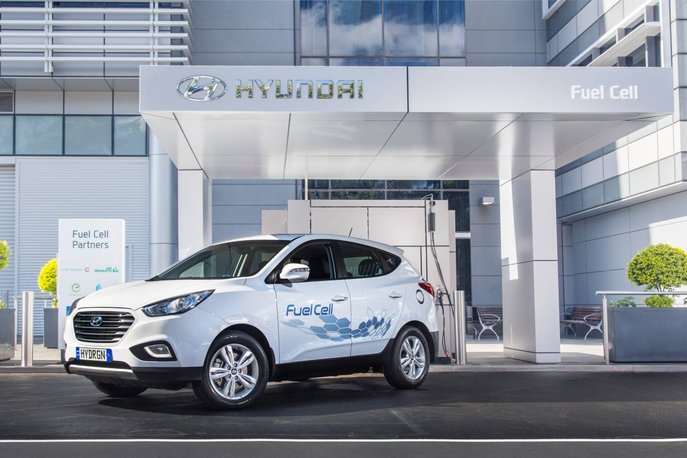
The Australian Capital Territory Government has ordered a fleet of 20 hydrogen-powered fuel cell cars for the first time as part of a $23 million renewable energy project in Canberra.
Servicing and maintenance is included in this project by Neoen, Megawatt Capital and Siemens, and made possible through the Hornsdale Windfarm Stage 3 contract with the ACT Government.
The cars supplied by Hyundai will be next-generation zero-emissions fuel cell electric vehicles due for launch in 2018. They will replace the current ix35 Fuel Cell, the world’s first mass-produced hydrogen-powered vehicle.
In most aspects of its performance – including acceleration, range, safety and practicality – the ix35 fuel cell is much like any other family SUV. However, it runs on hydrogen and emits nothing but water from its exhaust pipe.
Hornsdale Windfarm Stage 3 will provide renewably-sourced electricity to the Renewable Transport Fuels Test Berth, which features a Siemens Silyzer system hydrogen refueller. At full capacity, this refueller will be capable of providing fuel-grade hydrogen gas for over 1000 zero-emissions fuel cell electric vehicles travelling an average of 14,000km a year.
Hyundai Motor Company Australia was the first car company in Australia to fully import a hydrogen-powered vehicle into the country – an ix35 Fuel Cell in 2015 – and first to install a hydrogen refueller for light vehicles in Australia. This remains the only operational hydrogen refueler in the country, located at HMCA’s headquarters in Macquarie Park, Sydney.
“Hyundai’s leadership in hydrogen has been rewarded with a contract to supply 20 of our next-generation hydrogen fuel cell vehicles to the ACT Government,” said Hyundai Motor Company Australia chief executive Charlie Kim.
“We commend the vision and ambition of everyone responsible for the Renewable Transport Fuels Test Birth and Hornsdale Wind Farm Stage 3. We hope this brilliant project inspires others to see the potential of hydrogen as a future fuel for our cars. This first small step toward a zero-emissions transport solution for Australia is very significant and we are proud to be involved.”


Join the conversation