
Review: Ioniq impresses with simplicity
This story first appeared in the May issue of EVTalk – CLICK HERE to download the magazine FREE
 While the initial impetus for the roll-out of electric vehicles in New Zealand has come from passionate members of the private sector, the government’s ambitious targets for EV ownership are based on the commercial fleet market.
Why? Because businesses buy more new cars than the public does, they can spend more, and the bigger corporates have a far greater interest in cents per mile than anyone else.
They also like to look good. A hint of green can go a long way in marketing.
 Until now they have had few choices in the market. The Renault Zoe and BMW i3 are small, and in the case of the i3 a little too premium, were their only real new choices for a pure electric. They could go used and buy a Nissan Leaf, but without the support structure a new-car distributor requires, many are reluctant to go down that track.
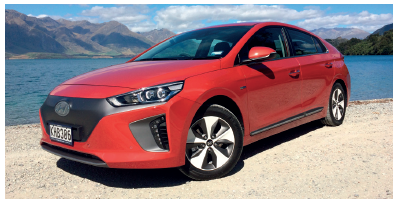
Last month Hyundai, which has a strong record in fleet sales, delivered the first of its offering, the Ioniq. While private buyers will love this car, it is the vehicle Kiwi fleets have been waiting for.
Firstly, it is not out of the range of what companies spend on cars. If you are putting your staff in the average mid-size sedan, prices range from $45,000 to $60,000. The Ioniq opens at $59,900, with a higher-specification Elite priced at a reasonable $64,990.
The ‘entry’ model is well specified, with cloth seats, leather steering wheel, electric lumbar support, keyless entry and start, alloy wheels, and an eight-inch touchscreen featuring Apple CarPlay and Android Auto. The Elite adds full leather, heated front and rear seats, a heated steering wheel and electric control for the driver seat.
Both are loaded with safety and driver assist features, including adaptive cruise control, autonomous emergency braking, lane keep assist and lane departure warning. The Elite also gets rear cross traffic alert.
 The company offers a 10-year unlimited-kilometre warranty on the Ioniq battery, which it says “removes all excuses”. Support is also high, more than three-quarters of its 23-strong New Zealand dealer network will retail the new Ioniq Electric.
The pure-electric version of the Ioniq — a hybrid and plug-in hybrid will follow — is powered by an 88kW/295Nm motor, equipped with a 28kWh battery capacity. Hyundai claims a ‘real-world’ range of 200km, and our short time with the car leads us to believe that figure is accurate.
In fact, to back up the point, a Hyundai team member split off for a day during the recent Leading the Charge road trip to drive direct from Tauranga to Auckland’s Sky Tower for a range test. He made it easily, with 16km to spare.
That is an important measure, as it means with fast charging staff can quickly hop between most major business centres.
A 7.4kW wall charger will replenish the Ioniq Electric’s battery from near empty in four to five hours, or it can be fast-charged to 80% in 30 minutes by a 50kW DC rapid charger. Plugs are type 2 and CCS2. We found the Ioniq did not slow down as much as others we have tried when approaching close to full, handy if you have a big drive ahead.
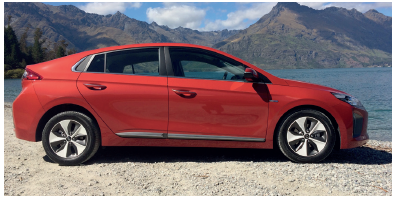
Jumping into the Ioniq for the first time – our review car was an Elite – I was impressed at how simple, and as close to a normal small-to-medium Hyundai the car is. The only obvious difference between this and the petrol-powered Elantra was the replacement of the transmission shifter with a panel of buttons on the centre console for park, drive and so forth. Many will delight in the button shift, but I was not so sure, preferring a shifter, even a unique one like the BMW i3 or Nissan Leaf, over buttons. You at times need to look down to ensure you are pushing the correct one.
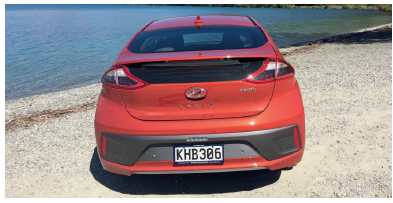
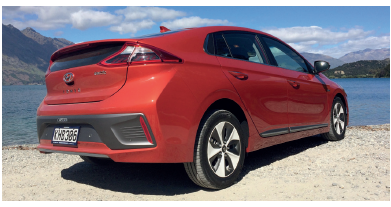 Visibility out is surprisingly good, even to the rear where the Ioniq features a split window in the liftback. Seat comfort is excellent, and the car feels spacious. The back seat has plenty of space for two adults — three would be a squeeze — while the boot is huge.
The Ioniq is, as expected, almost silent to drive. It does not feel as zippy as a Leaf — they have basically the same power, but the Ioniq is larger with more range — but it makes quick work of most city duties. The steering is very light, appreciated for getting in and out of tight spots in the city.
Like the Mitsubishi Outlander, the Ioniq features paddles on the back of the steering wheel, allowing you to increase or decrease engine braking depending on conditions. You can also set the car in a range of drive modes that will automatically vary the regeneration load. The paddles are an excellent touch, and likely very useful on open-road trips. Around town, we preferred letting the Ioniq do its own thing.
We were very impressed with the Ioniq — as much by the pricing and packaging as the car itself. There is little doubt the Hyundai will quickly become the top-selling new electric vehicle in New Zealand.
Join the conversation