
Ford’s autonomous cop patent
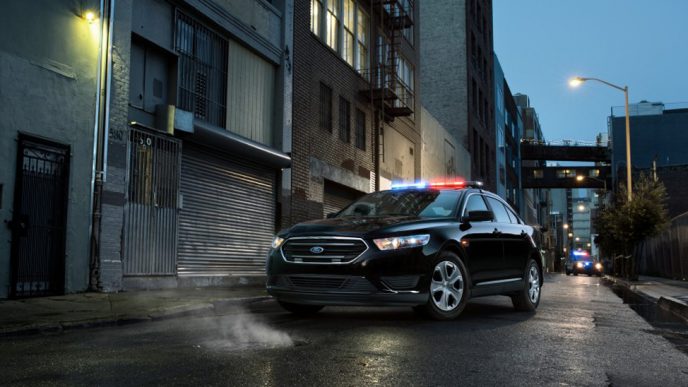
Ford has secured an autonomous police car patent, reminiscent of sci-fi action blockbuster Judge Dredd or even Robocop, dispensing swift, machine-like justice.
Ford Global Technologies in Dearborn, Michigan, has patented the idea of an autonomous police car that catches offending motorists and autonomously issue penalties for traffic violations.
The patent titled “Autonomous Police Vehicle” includes the police car being able to hide behind buildings and trees to protection or stealth surveillance purposes, communicate wirelessly to other vehicles and a command centre and apprehend and book offending motorists – essentially developing an artificial intelligence that allows it to perform basic police work.
While initially the idea could replace human patrol officers, the patent does elaborate about operating “in lieu of or in addition to human police officers.”
“A method may involve a processor associated with an autonomous vehicle obtaining an indication of violation of one or more traffic laws by a [offending] first vehicle,” it states. “The method may also involve the processor maneuvering the autonomous vehicle to pursue the first vehicle. The method may further involve the processor remotely executing one or more actions with respect to the first vehicle.”
The autonomous police car would operate as an automated detection and apprehension device, and a dispenser of penalties that can learn from offender behaviour, similar to the operating procedures in 1980s sci-fi action movies Judge Dredd and Robocop.
The autonomous police car patent would allow it to be capable of “Executing a machine learning tool to learn about one or more locations at which the violation of the one or more traffic laws by one or more vehicles is visible; and maneuvering the autonomous vehicle to park at one of the one or more locations.”
The robocop car “may be trained or otherwise programmed using machine learning tools (e.g., deep neural networks) to find good hiding spots to catch violators of traffic laws such as, for example, speeders, red light violators and stop sign violators,” the patent describes.
It would be able to automatically detect license plates – if they continue to exist in an infrastructure-to-vehicle communications future – and activate other autonomous or manned police units to respond, as well as detecting whether the offending vehicle was being driven by a human or operating in ‘autonomous mode’.
“While autonomous vehicles can and will be programmed to obey traffic laws, a human driver can override that programming to control and operate the vehicle at any time,” the patent explains.
“When a vehicle is under the control of a human driver there is a possibility of violation of traffic laws. Thus, there will still be a need to police traffic.”


Join the conversation