
Kia Niro predicted to become best-selling electrified SUV
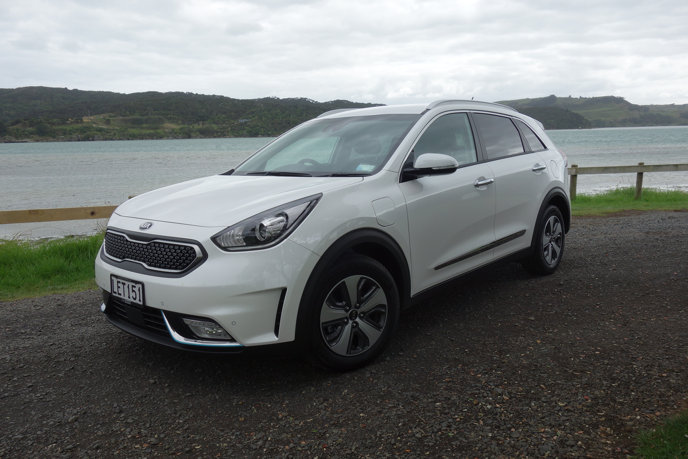
The relationship between Kia, Korea’s oldest automotive brand, and the Hyundai Motor Company that absorbed it two decades ago is best typified by the twin-towered corporate HQ of HMC in Seoul. The smaller tower is occupied by Kia, while the higher one is dedicated to Hyundai. Consider it in-the-concrete proof that where Hyundai goes, Kia always follows.
That includes entering the electric vehicle arena, something that Kia NZ has just done for the first time with the launch of the new Niro compact SUV range. Hyundai Automotive New Zealand introduced a comprehensive range of similar electrically-enhanced Ioniq vehicles last year, giving buyers the choice of three new alternative powertrain technologies.
There was a parallel hybrid using a 77kW petrol four primarily for its motivation, a plug-in hybrid that could provide more than 60km of whispering travel between connections to the grid before igniting its accompanying combustion engine, and a fully-electric Ioniq that could roam for 200+km between recharges. It’s a highly-promising line of environmentally-responsible cars that hasn’t really lived up to its sales potential in this country, despite good reviews.
HANZ sold just five of the most-affordable Ioniq model ($46,990) with the parallel-hybrid powertrain in 2017. Will the same Kiwi market indifference affect the mechanically-similar Niros?
Kia New Zealand’s managing director, Todd MacDonald, says the SUV-like design of the Niro will make all the difference. Although the Niro has no off-roading abilities and is driven by the front wheels only, MacDonald says it has a “shape” that is currently in vogue.
“All of New Zealand is taking to the small SUV, which makes the success of the Niro a surety.
“By the end of the year it’ll be New Zealand’s best-selling hybrid SUV.”
To do that, the Niro range needs to beat both the best-selling plug-in hybrid SUV (Mitsubishi Outlander PHEV) and the best selling parallel-hybrid-powered range (Lexus 300/400). Fortunately, affordability will be on the side of the incoming Niro models. The base parallel-hybrid model, the Niro HEV EX, is expected to list for $39,990 later this year. It launches with a $5000 incentive at $34,990, and included are a three-year free servicing plan, five years of roadside assistance, and a seven-year warranty for the 1.6kWh battery.
That’s a launch price position that places the Niro HEV EX right in the sweet spot of the compact SUV segment, the mid-thirties, where most brands are opening their sales negotiations with customers. It’s a segment dominated by a gang of five – the Mitsubishi ASX, Nissan Qasqhai, Mazda CX-3, Suzuki Vitara, and Honda HR-V. Yet the Niro EX has several trump cards to play when comparing it to these. The equipment levels are relatively high with cellphone projection to the central touchscreen (Apple CarPlay and Android Auto), autonomous emergency braking, rear view camera, and smart camera-enhanced cruise control included; plus some of the most voluminous passenger and luggage space in the segment.
Although 125mm shorter overall than Kia’s mid-sized Sportage, the Niro has a wheelbase stretched 30mm further apart, blessing the interior with a roominess not usually associated with small SUVs. With the smallest battery in the model range, the EX can have a lower luggage bay floor, allowing 401 litres of stuff to be stashed behind the rear seat, or 1399 litres of luggage room with the second-row seating folded away. Thanks to NZ-specific changes to larger-diameter rear disc brakes and larger radiator cooling fans, braked-trailer towing capacity is also competitive at 1300kg.
The request of the Kiwi distributor to the factory for more tow shows just how keen Kia NZ is to present the Niro to the buying public as an SUV rather than as an electrified hybrid vehicle, and this also reflects in the driving experience of the EX.
As the lightest vehicle in the range, the EX comes closest of any new Niro to driving just like its controlled-explosion competitors. Parking and crawling along can be done just using the 33kW/170Nm electric motor alone, and when getting off the line the accessible torque of the electric motor snuggled between a 1.6litre direct-injection petrol four and a six-speed twin-clutch gearbox gives the Niro an extra nudge forward denied to its combustion-only rivals.
At open road speeds, the electric motor and the attendant 64-cell, 33kg battery located under the luggage bay floor mostly become ballast, but at least in the battery’s case it is ballast well located. For the Niro EX has better chassis balance than most front-drive cars thanks to the more even distribution of powertrain components.
It would only be a better drive if the eco-tyres were substituted for those with increased grip, and if the steering wheel could transmit messages from the road/tyre interface with increased clarity. Most though, will feel right at home, enjoying hushed wind noise levels, ride quality that lasts over a wide range of speeds, and most of all – extremely-satisfying fuel economy.
Used round town where the hybrid powertrain has most advantage, the EX will return fuel use figures close to the advertised 3.8litres/100km. Expect extensive open road use to add a litre to that figure every 100km or so.
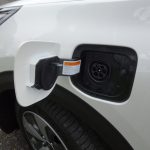
Meanwhile, the plug-in hybrid version of the Niro is evidently capable of achieving 1.3litres/100km fuel economy thanks to its larger 96-cell, 117kg, 8.8kWh battery. It also gains the increased equipment levels of the upmarket version of the Niro HEV Limited parallel hybrid ($43,990), with leather upholstery and the addition of extra crash-savers like blind-spot monitors, lane keeping assistance, rear cross traffic alert, and front parking sensors. Open the alloy tailgate of the $55,990 Niro PHEV Limited, and you’ll find two charging cables. One is for 8-amp domestic house plugs and it can recharge the battery in four hours; the other is for three-phase charging stations and can reduce the time taken to full power storage to 2.5 hours.
By the time I got to drive a Niro PHEV on the launch, the previous pilot had drained all the power from the battery. This highlighted that cheaper HEVs have the advantage in open road use because their combustion engines are constantly recharging the battery, whereas Kia/Hyundai PHEVs need to be plugged in to restore their batteries.
If serious about driving electrically, perhaps it’s better to wait for Kia’s fully-electric version of the Niro. When it comes, this won’t be using the 28kWh battery of the current Hyundai Ioniq Electric, but a larger, more efficient energy storage unit that will be capable of doubling the range to 400km. Cant wait.




Join the conversation