
Jucy idea for campervan fleet
This story first appeared in the May issue of EVtalk – CLICK HERE to download the magazine FREE

Dan Alpe
Jucy could introduce five to 10 more electric campervans this summer following the success of a trial tour of New Zealand in one by two French students.
Longer range Nissan e-NV200 40kWh vans may be added to Jucy’s campervan fleet, possibly for this coming summer, Jucy chief operating officer Dan Alpe says.
He says most campervan customers do around 150km to 170km daily, so the40kWh vans would be more suitable with a range of about 200km on a single charge.
The students, Heloise de Bokay and Solene Trinquet, are due for a debrief with Jucy designers and other staff in June.
Alpe says Jucy has received constant feedback from the pair during their seven-month tour in a converted prototype e-NV200 campervan for which Jucy donated the use.
Coincidentally, Alpe caught up with the students in Queenstown recently when they stayed at a Jucy Snooze hotel.
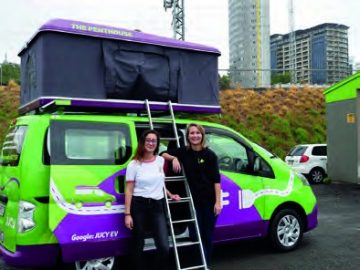
He says the colder weather has shortened the campervan’s range from around 100km to about 90km, and the students were also taking some detours to see the views.
Their itineraries will be very useful for Jucy too, possibly able to be used by other tourists.
Charging experiences will also be discussed. The pair had once instance where they had to door knock and use a householder’s power to charge up during the Kaikoura leg of their South Island trip.
Alpe says Jucy is investigating the installation of chargers in camping grounds, especially in areas where charger access is limited.
The students have been using a pop-up rooftop tent on their campervan for sleeping, rather than the van’s interior bed, something Jucy’s designers are expected to discuss.
“They only used the interior bed when there was a storm one night,” Alpe says.
He says a rooftop bed creates more weight and drag.
The French tour has been good for promoting EVs in general and Jucy in particular.
Trinquet and de Bokay have attended many events, such as the Leading the Charge EV tour Nelson stopover and EV City’s opening in Christchurch.
These and other occasions have featured on social media, through EVtalk and other avenues.
“It’s been great to get that amount of feedback,” Alpe says.
The students have been adopted by New Zealand’s EV community, which has provided advice and help when needed.
Green Cabs allowed them to charge their campervan for free in Queenstown, for instance. They also have a partnership with ChargeNet while here.
Alpe says Jucy is committed to providing a clean, green, environmentally friendly travelling experience for visitors to New Zealand. “Ultimately, our goal is to offer a product which will also play a part in environmental tourism.”
He says after reading about the French students’ plans in EVtalk he reached out to them and has found the whole experience worthwhile.
“It’s been valuable because they will have been here so long, rather than just a month, which gives us a lot more data to work with. They’ve been great ambassadors for us.”
Alpe says the Jucy electric campervan has been based at the Trenz 2018 travel and trade show in Dunedin from May 7-10, the show attracting more than 1500 delegates from around the world.
It highlights New Zealand’s $35 billion tourism industry.
During the show, the French pair travelled to Milford Sound, boarding one of Jucy’s boats.
After completing their South Island journey, Trinquet and de Bokay will return to the North Island to complete some parts they’ve missed.
They plan to return to France around July or August.

Join the conversation