
Aerodynamic Audi has virtual exterior mirrors
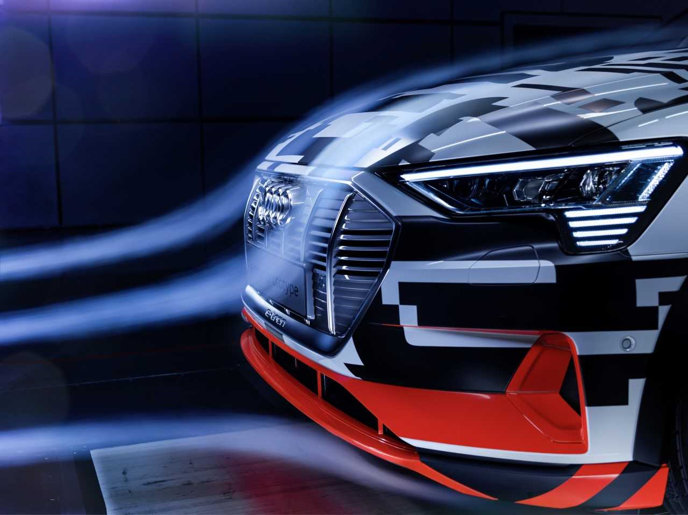
The better an electric car’s aerodynamics, the further it travels.
That’s the reason behind the Audi e-tron SUV prototype recording more than 1000 hours in wind testing.
Audi engineers have been harnessing the nearly 300km/h wind speed capability of the Audi Wind Tunnel Centre to perfect the car’s efficiency and comfort in readiness for the series production model.
 That’s expected to be revealed on August 30 in Brussels, Belgium, at the second annual Audi Summit.
A key includes optional virtual exterior mirrors – much narrower than standard mirrors and including a small camera which displays images inside – a series production car first. Three views are available – for motorway driving, turning and parking.
The result of testing is an impressive drag coefficient of 0.28 – a top achievement in the SUV segment and a decisive factor in the everyday range of about 400km in the Worldwide harmonised Light vehicles Test Procedure (WLTP) cycle. A hundredth of the drag coefficient figure represents a range of around 4.8km under everyday conditions.
On a long journey, drag constitutes the key driving resistance.
That is why good aerodynamics are so important, Audi says.
In urban traffic, however, other factors come into play. Here an electric car can recover a large part of the used energy when braking, thereby reducing the importance of its mass.
Audi engineers developed a wide range of aerodynamic measures in all body areas.
As a result, the drag coefficient for the Audi e-tron prototype is almost 0.07 less than for a comparable, conventionally powered vehicle. With a typical usage profile this set-up increases the range by around 33.7km per battery charge in the WLTP cycle.
Adaptive air suspension is standard, aerodynamically optimised wheels, an enclosed underbody and a controllable air inlet all contributing to the low drag figure.
Pneumatic suspension with adjustable damping at speeds above 119km/h lowers the body by up to 26mm below the normal position, reducing drag.
The 255/55 size tyres have ultralow rolling resistance.
The Audi e-tron will be powered by a dual-motor powertrain using a 95kWh lithium ion battery and capable of 150kW DC fast charging, while 11kW AC chargers recover energy on the move – with 22kW chargers as an option.
Audi says the e-tron can be fully charged in 8.5 hours from a 400V three-phase outlet.
Visit e-tron.audi
for more information.

Join the conversation