
Charging ahead BMW i3s

This story first appeared in the June issue of EVtalk – CLICK HERE to download the magazine FREE
The BMW i3 burst on to the market back in 2013. It was and still is, a five-door hatchback that boasts emission-free driving and futuristic good looks. The Mega City Vehicle is both practical and ultimately very driveable – so what’s with the extra S in the new i3s?
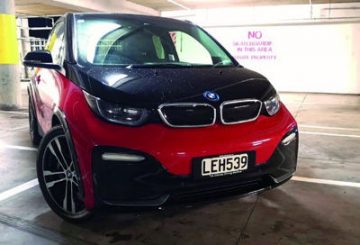
Adding an S to a vehicle nameplate invariably means “Sport” and with the i3s, this is as true as it’s ever been. Aside from the clever cosmetic tweaking that includes re-crafting the gloss black panelling, flaring the arches to cover the 20” alloys (F 175/55, R 195/50) and repositioning of the vehicle rear badging, BMW has widened the i3s’s rear track by +40mm and the sports suspension has lowered it by +10mm too.
The i3s retains the same 94Ah/33.2 kWh battery packs (27.2 kWh usable), and the eDrive technology, but BMW have upped the power to 135kW and torque to 270Nm, resulting in a reported 0-100kph time of 6.9s and an overall power to weight ratio 9.4kg/kW – which, by the way, is a smidgen better than the BMW i8.
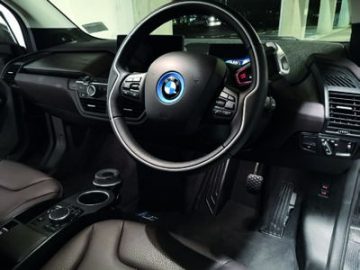
The cabin is racier too, still ultra modern and still full of natural materials, but now with aqua blue seatbelts and i3s badging. It comes loaded with both driving and sportscar-ilk aids, such as cruise and parking assists, new ASC with much quicker slip control, Dynamic Traction Control and a new Sport mode that has the i3s reacting quicker to driver inputs such as acceleration and steering.
As luck would have it, I had a variety of things going on during my time with the Melbourne Red i3s, errands and events that would have me testing the $85,900 BEV’s range and “liveability”.
Picking up the fully charged vehicle from Mt Wellington quickly had me immersed in reasonably flowing traffic that slowly nibbled at the bars of the easy to understand range meter displayed at the foot of the instrument cluster screen. By the time I had returned home after work at 6pm in Albany, I was two bars down. The next day promised plenty of kms, so I trickle charged back up to full which, according to the screen, would be completed by 11pm.
The following day’s event (the launch of the new BMW M5) was held at Hampton Downs Motorsport Park and according to Google, meant a 1hr 7m/96.4km trek in a vehicle that when charged, forecasted 196km – yes the i3s would apparently do it on one charge, but dicey to say the least.
The ride to the Motorsport Park was great. The i3s handles as advertised, it’s quick, and the extra power comes into its own during overtaking manoeuvres (apparently it takes 4.3s to go from 80-120kph), quiet, comfortable, and very informative, especially the range forecast that you can’t help but be fixated on as you go. I arrived at the racetrack with around 100km used so immediately hooked up to a power socket to trickle charge back up.
 Following a morning of fossil fuel frivolity, plus 4+ hours of charge, I headed back off to the office (and then home) with enough juice to be carefree, which was in the region of 50km extra.
Checking the BMW i interactive map on the i3s’s 10.25” infotainment screen, there was a Chargenet option in Pukekohe, so without the racetrack power, I could have detoured there, grabbed a coffee or two and been sorted – as it only takes 39 minutes to get to 80% charge from empty.
Not so bizarrely, my commute the next day was a polar opposite event. In the very heavy traffic, the i3s barely touched the range monitor and I arrived back home without the need to plug in, something I repeated the rest of the week – all the commutes being a joyful experience, tunes on loud, heated seats, AC full, I used it all.
This was one of those times where I managed to get a “real world” use out of the review and it gave me a better understanding of where we’re at when it comes to EVs. Summing it all up. Around town and its surrounding areas, the i3s is most excellent. Plenty of power underfoot, sports styling, easy to manoeuvre and offers plenty of fun off the line, overtaking and in the twisties. However, longer runs still require forethought and planning, ample of time, or an additional $7500 for a range extender.
Join the conversation