
Tourism Holdings to have electric motorhomes available this summer

This story first appeared in the June issue of EVtalk – CLICK HERE to download the magazine FREE
Kiwi firm Tourism Holdings Limited (THL), operator of the Britz, Maui and Kea motorhome brands, is planning on renting electric motorhomes to customers in New Zealand this coming summer season.
The company has trialled multiple vehicles, with its latest concept – the expected base for the vehicles to be made available to the public – based on the LDV EV80 cab chassis, similar to the van reviewed in EVtalk last month.
The vehicle is a two-berth unit, with an expected range of around 140km.
The vehicle, and the routes it will be recommended the vehicle take, were developed with the assistance of the Energy Efficiency and Conservation Authority’s low emission vehicles contestable fund.
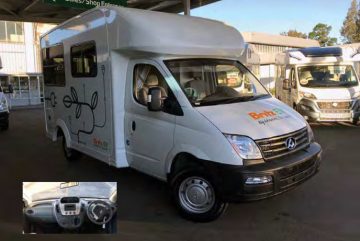
Giving EVtalk a tour of the vehicle, THL’s Ed Burak, who has run the development programme for the EV, explained first and foremost the vehicle needs to be a functioning motorhome like any other.
“It’s important that it’s a motorhome first, and the fact that it’s an EV is somewhat secondary in terms of how it functions,” Burak says.
“We’ve looked at things such as the length and we’ve reduced it so that it’s easy to store, you have advantages of travelling on the ferry, and parking.
Attention has been paid to the interior and house systems.
“We’ve gone a little bit more contemporary – it’s almost sort of like out of apartment living in terms of the finishes, and there’s lack of handles,” Burak says.
“I guess in terms of some of the things which are different because of this EV approach is that we’ve eliminated all fossil fuels.
So there’s no LPG gas for cooking, for example – we’ve replaced that with a induction cooktop, which is nice and smooth – it looks beautiful.
And it simplifies the whole vehicle.
“Of course, lighting is all LED lighting throughout the whole vehicle.
And outside of that, we’re starting to experiment with different materials to just try and improve the fit and finish and the presentation, and reduce weight as well.
”
Alongside the development of the vehicle has been the process working out where they will travel – the comparatively short range of the vehicle and need to charge requires a different approach.
“We also are fundamentally an experience company,” Burak says.
“Whereas perhaps 10 years ago we considered ourselves a campervan company.
And so what that means is that we’re interested in the overall experience and what the expectations of our customers are.
“We’ve developed itineraries which we believe slow the customer down a little bit and get them to enjoy each destination far better.
We’re also offering up things such as great food and wine experiences that they perhaps wouldn’t be aware of if a classic tourist.
”
Routes will take into account charging – both existing charging infrastructure and THL provided charging points at camping facilities – developed as part of a partnership with Holiday Parks of New Zealand.
Charging points at this stage will be at up to 22kW AC.
When vehicles are parked up for the night, they can be plugged into site facilities at two points – one for the vehicle and one for the house supply.
The LDV is DC charge capable, though most charging is expected to be overnight.
“They’re going to have EV specific sites where they can plug in for the house at the back, to charge the microwave and their phones and bits and pieces, and plug in the vehicle in the front to recharge your vehicle battery.
”
Burak says the EECA funding has been valuable to the project.
“The availability of that funding is fantastic and incredibly useful.
What it does is make things happen faster.
”
The plan is to have vehicles available for rent this summer season, though the initial fleet will be small.
“It is quite a control set, so about 10 vehicles,” Burak explains.
“Putting five in the North Island and five in the South Island, going up to perhaps 20 as we continue to roll out.
”
Burak suggests users may not need to pay any more for the vehicle than a diesel-fuelled vehicle, and costs will likely be overall less.
“I don’t expect that we should be charging the customers extra to be using one of these vehicles.
In fact, the overall cost of renting and operating should be significantly cheaper.
”
Read our full review of the all-electric LDV EV80 in the last EVtalk, which can be found online at EVtalk.
co.
nz.
You can see a full interview with Ed Burak and a tour of the motorhome at the Auto Media Group Youtube channel.
Join the conversation