
Primed for the best of both worlds
This story first appeared in the August issue of EVtalk – CLICK HERE to download the magazine FREE
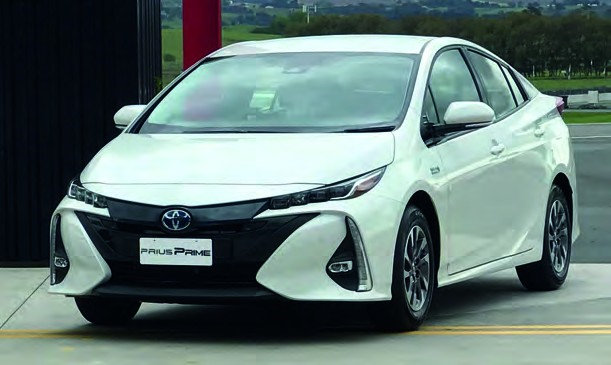
The Toyota Prius Prime plug-in hybrid enjoys the best of two worlds – electric and petrol.
It works well as a hybrid (associate transport minister Julie Anne Genter has the use of one), rather than just in electric or petrol mode.
The Prius Prime is the first PHEV sold new here by Toyota New Zealand, coming with the claim it’s a $150-a-year car in terms of running costs, and our cheapest new plug-in at $48,490 drive-away.
 So how does it drive?
The car feels heavy but stable and drives well.
Steering is good, if a little heavy too.
The ride is comfortable, the Prius absorbing road bumps in its stride.
The long dash’s many lit up icons and information can be a little confusing at first, usually until the driver finds the information they need to watch.
A HUD windscreen display shows your speed and the speed limit of the road you’re driving on.
This is a repeat of what’s on the dash but again can be confusing when you come to different speed zones.
For instance, on the Northwestern motorway between Waterview and Western Springs the speed limit was 80km/h (by now it should be back to 100km/h), but the HUD says it’s 120km/h.
We experienced the same issue in other areas.
It is not perfect, but it is promising.
Visibility is good front and back – the rear window is split by a spoiler but the bend in the middle of it still allows good viewing.
Not so good is that passers-by can see what’s in your boot, which is roomy enough to fit my bicycle without removing its wheels.
The Prius Prime has a range of drive modes.
The Eco mode switches between electric and petrol depending how you drive and whether power is urgently needed.
Petrol and electric use in this mode is good if your driving is even.
Steady driving over a 67km run to Mission Bay and back in Eco mode (zero charge in many cases) saw fuel consumption (95 octane plus) around 1.
4-1.5 litres per 100km.
A 3% charge registered at Parnell after the downhill run through Grafton Gully, but that charge evaporated after a few kilometres.
A rising or falling bar under a green car symbol (which goes black when EV power is off) indicates how you are faring in electric mode.
And a report comes up on screen after each drive to rate your driving behaviour out of 100, with comments added.
Mine after one trip was around 85% with the remark: “Excellent steady driving.
Keep your current driving style”.
Another time it suggested more even acceleration.
It feels weird having a car comment on your driving.
But, hey, that might be good for many Kiwi drivers.
Pure electric range is reported to be about 63km, although real-world travelling puts it a lot less than that.
It’s more like 40km to 50km depending on terrain and driving style.
On a fairly flat run from Swanson in West Auckland to downtown Auckland City, a distance of around 21.
7km, the charge dropped from 90% to 31% using EV City mode (electric only) in heavy traffic.
A 31km run over hilly rural roads with plenty of flat stretches in-between saw the charge drop from 73% to zero, petrol power kicking in automatically once the EV battery power was gone.
The Prius Prime does regain a little charge through regenerative braking, especially on downhill runs.
While electric mode is quiet (you can just hear the tyres), the petrol engine (95 octane minimum) doesn’t make that much more noise, although you will notice it kick in.
The car has a footbrake and the gear shifter is dash mounted and easy to operate, just a touch needed to select between drive, reverse and neutral.
Driver assistance features include blind spot assist and lane assist.
Both external rear view mirrors provide lit up warning icons when cars are close by, and sensors indicate when you are close to objects.
A beeping from the lane assist can indicate when you stray over a road line – it doesn’t operate under 50km/h and can be switched off if it becomes annoying.
There are plenty of pockets for storage and the glovebox is reasonably roomy (much of it was taken up with the car’s thick hand-book).
The Prius comes with a wall plug charger (EVSE) which should fully charge it from zero in about four hours.
Check to see if there’s a charging cable available suitable for faster charging.
Another mode allows self-charging on the move, although it won’t top up past 80% full.
All-in-all, a great vehicle for getting around inexpensively – it will be interesting to see if a few taxi drivers can be lured from their traditions drives into something with a plug!
Join the conversation