
Waiheke wants to be world’s first EV residential island
This story first appeared in the December issue of EVtalk – CLICK HERE to download the magazine FREE
Auckland’s Waiheke Island has embarked on a plan to become the world’s first electric vehicle-only residential island by 2030.
It already has about 86 EVs among a permanent population of about 9000, summer visitor numbers pushing that to 45,000.
Around 7000 conventional cars, buses and trucks on the island would need to be replaced, advocacy group Electric Island Waiheke says.
Visitors probably won’t be allowed to bring their internal combustion engine (ICE) vehicles over on the car ferry either after 2030 – especially with passenger and vehicle ferries likely to be electric and possibly hydrogen powered by then.
They would have to leave their ICE vehicles at home – though in 11 years there will be far more electrics around – and perhaps rent an island EV or e-bike, or use an electric shuttle or taxi service.
Leading Auckland ferry provider Fullers Group is considering introducing electric ferries by 2025 and also aims to have electric shuttle buses serving the island’s ferry terminal.
About 30 buses will be operating, many through Auckland Transport which is already trialling two electric buses in the city.
Increased power supply from Auckland to Waiheke will be needed to help provide adequate charging infrastructure, particularly to recharge the 30 buses overnight, Fullers Group chief executive officer Mike Horne says.
He says providing such infrastructure is expensive, so help will be needed with funding.
Horne says millions of dollars will be spent on Auckland ferry terminals during the next 20 years, so appropriate technology has to be included.
Boat builders McMullen & Wing chief executive officer Michael Eaglen says the company is leading a collaboration of New Zealand firms developing electric ferries for Auckland.
He says the vision is for a zero-emission commuter fleet by 2025.

“As one of our biggest customers, Fullers has been very encouraging and helpful – as are the Auckland Council, Auckland Transport, ATEED, NZTE and others.”
Eaglen says they’re concentrating on commuter ferries for the inner and upper Waitemata Harbour and that a small fleet of electric ferries should be in service by 2021.
“Battery electric is our first choice because it is simple and cost-effective,” he says.
“However, this is easier on shorter runs than longer ones.”
Waiheke ferry runs are a longer distance with a large passenger load and higher speeds, while limited charging power is available on the island, Eaglen says.
So it’s uncertain whether electric or hydrogen is the best answer for the Waiheke ferry, he adds.
“The hope of having both electric charging stations and hydrogen filling available at the dock enables us to look at both options without being held back by supply constraint.”
Waiheke is ideal for EVs, says Electric Island committee chairman Max Parkin, who agrees “another powerline” is needed to the island to meet future demands.
Most would be charged at home – the island not yet having a public fast-charging station.
Parkin says EVs on the island would run out of road before running out of range, supporting the suggestion that island people should have access to cheap EVs perhaps no longer suitable for mainland use.
That’s partly because the average annual income on the island is $25,000 lower than the rest of Auckland, an Electric Breakfast to launch the electric island plan heard.
Parkin says the island and the committee has to prepare for associated challenges, including ferries no longer bringing fuel to the island for residents’ use.
“We just have to try to sort it out,” he says.
Parkin suggests the Waiheke Local Board could help push to get a bulk power deal for the island.
Retiree Jim Reid says he put solar power in his Waiheke home five years ago and this year bought a Nissan e-NV200 electric van which he drove from Dunedin.
He says after three months his power bill is now less than it was for the same time last year.
“Solar power has got to be a key part of the electric island deal,” he says, suggesting electric buses could also use solar power.
Waiheke Island-based Energy Alternatives energy solutions manager Dana Darwin says the company is already working on ways of contributing to the “electric pathway” so homes can not only charge up EVs but the EVs themselves provide back-up power for home use when needed.
He says recycled EV batteries can be used for home energy storage.
“We have a real opportunity on the island,” says Darwin, adding the electric island could be a shining example to the rest of New Zealand.
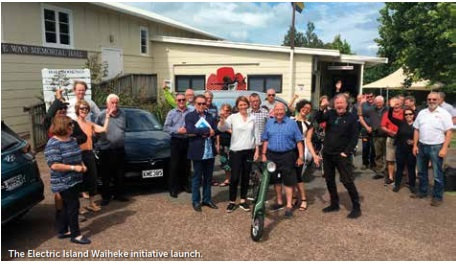
Darleen Tana Hoff-Nielsen, who compered the Electric Breakfast at the Waiheke RSA on November 30, already runs an electric bike, e-scooter and e-moped business on the island with husband Christian.
Its communities like Waiheke which are driving the EV change, Norwegian Electric Vehicle Association secretary general Christina Bu told about 45 people at the launch.
She later suggested a sister island link with the Hvaler (Whale) Islands in the south of Norway which have a “Smart Energy Hvaler” project running that presents similar challenges to that faced at Waiheke.
Electric Island Waiheke spokesman Vern Whitehead says the island has some of the most expensive petrol in New Zealand, so ditching fossil fuel vehicles will have economic and environmental benefits.
“Electric Island – bring it on!” Waiheke Local Board chairwoman Cath Handley says, adding it is part of a raft of measures to make the island more sustainable.
Waiheke may have to get a wriggle on with its Electric Island ambitions, as South Korea’s Jeju Island with a 625,000 population also aims to have all-electric vehicles and be carbon free by 2030.
It got 20 electric BYD buses this year and recently passed 10,000 EVs.
Join the conversation