
The street that talks

This story first appeared in the December issue of EVtalk – CLICK HERE to download the magazine FREE
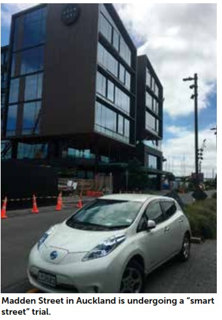
Auckland has a smart street.
Not a smarty pants street or the winner of any clean, most beautiful street award – more a street with “smarts” as in high-tech.
Madden Street on the Viaduct Harbour waterfront is “smart” in that it can have a two-way communication with you, your connected (and in future autonomous) vehicle, and other appropriate agencies and infrastructure.
The smart street trial is based around a 5G innovation showroom already operating in the Wynyard Quarter, allowing Spark and others to demonstrate how 5G tech will enable robots, connected cars and even smart farming.
“The reality is that we are still some way from 5G being available at a commercial level,” Spark digital services lead Michael Stribling says.
He says Spark is, for instance, working with nearby Emirates Team New Zealand around what needs to be in place for the America’s Cup defence in 2021.
Spark is also working with Auckland Transport and Auckland urban regeneration agency Panuku Developments at Madden Street around smart street tech that can eventually be deployed throughout a smart city.
The showcase is available to Spark’s business customer by appointment to show how it all works.
“We’re encouraging New Zealanders to think about what a smart city might look like with the tech available,” Stribling says.
Spark is working alongside NB (Nordic Built) SmartCities which provides much of the infrastructure, including smart LED IoT enabled street lights which are pre-integrated with smart city technologies to monitor and record the environment around them.
These can then facilitate, CCTV cameras, air quality sensors and more.
Electrotechnology company McKay, which has about 380 staff across New Zealand, is also involved in the Madden Street project, particularly around the street lighting and associated connective devices.
So how does it all work?
The four smart street lights in Madden Street can integrate many of the sensors like CCTV cameras and air quality monitors, and in the future could dim down the lights when no-one is around and then brightening when people or vehicles move through.
The smart technology is used to monitor the light output and the surrounding environment, translating this into real-time data that is accessible via a smartphone app.
Air quality sensors can let people know about the levels of carbon dioxide and other pollutants as well as humidity temperature and noise – information useful for those with respiratory issues.
CCTV encourages public safety, and there are smart waste sensors in rubbish bins which can let the appropriate agencies know when they need emptying – improving time efficiency and streamlining bin collection services.

“These help make the processes more efficient for the local council,” Stribling says.
“It creates a more pleasant environment with no overflowing bins.”
Parking sensors could in future also indicate to a connected vehicle and its driver where a parking space is vacant.
The system can also be used to forewarn the driver on their mobile device when their parking time is up, avoiding any parking infringements.
It also means no longer having to rush back to the vehicle to move it or put money in the parking meter.
Stribling says it saves people driving around and around trying to find a vacant park.
EV charging stations may eventually be incorporated less obtrusively into the street scape, perhaps into the lamp posts themselves or as inductive charging in the road itself.
And there’s less likelihood of the road being constantly dug up to deal with underground services.
Ultimately, the smart city infrastructure provides measurable environmental data, demonstrating just what can be achieved in the future of urban technology.
With a host of environmental, social and economic challenges facing New Zealand’s big cities, NB SmartCities NZ Ltd and McKay have worked alongside Spark to highlight the opportunity for councils to access real time data to measure and reduce the impact of inner-city pollutants while streamlining city services.
Visit NBSmartCities for more information.


Join the conversation