
EVs key to Fuji Xerox New Zealand’s sustainable plan
This story first appeared in the December issue of EVtalk – CLICK HERE to download the magazine FREE
 Electric vehicles play a major role in Fuji Xerox New Zealand’s drive towards a sustainable future.
A global brand, Fuji Xerox provides digital printing technologies and document services and solutions, and the New Zealand operation formed in 1964 has 16 branches throughout the country employing about 500 staff.
The New Zealand business has undergone major restructuring and transformation during the past few years and has just released its first sustainability report which shows its vehicle fleet is the largest source of its emissions.
Of about 160 vehicles leased through leading international mobility solutions provider SG Fleet, 17 are electric and four are hybrids.
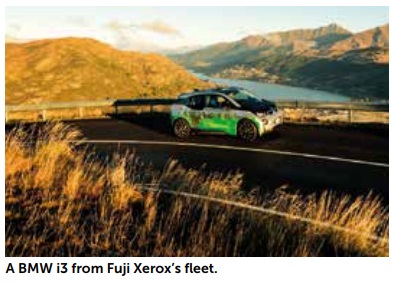
These are mainly Hyundai Ioniqs and Konas, with BMW i3s included.
Fuji Xerox NZ’s managing director since October 2017, Peter Thomas is determined to see more pure electric vehicles in the company’s fleet as soon as possible.
But some challenges have to be overcome.
Among them are finding an appropriate EV suitable for the purposes required, particularly for service staff.
“We’re using station wagons and small SUV types like the RAV4 as they have to carry parts and other products under lock and cover,” Thomas explains.
He says they currently use petrol Holden Cruze station wagons and Mazda CX-5s for that purpose.
“Toyota is releasing a RAV4 hybrid next year, but we’re looking at 100% electrics rather than hybrids.”
Electrics with a long range are also needed in some areas, like parts of the South Island where staff negotiate isolated gravel roads a long way from charging stations.
The company certainly doesn’t have to worry about buy-in from workers.
 “Staff love them,” Thomas says of the current crop of EVs. He says when the company signed up for its 30% commitment, staff were “chomping at the bit to get EVs, with many staff putting up their hands to be in the new vehicles”.
Some have even bought their own EVs, although staff using company lease vehicles can take them home for reasonable private use as well.
“That’s good for us and for staff,” Thomas says. Those who usually take a leased petrol vehicle home have to pay a $20 a fortnight charge to cover costs, but that’s waived for those using a company EV privately. EV charging can be done at home, at a public charging station (often free), or at stations provided on company premises.
At the moment that’s limited to four chargers at the company’s Auckland head office, two at its Auckland warehouse and one in Palmerston North.
Thomas says once the company has the right EVs for the tasks required it will work with local community and councils to put in charging infrastructure, mainly Type 2 chargers.
As one of the Climate Change Coalition signatories, Fuji Xerox says it’s proud to stand alongside some of New Zealand’s most successful and inspirational organisations in declaring a commitment to being part of a low-carbon economy.
It aims to be net zero carbon by 2030.
The company’s sustainability report on carbon covers its internal operations, with footprint data for import, export and freight operations expected to be published in its 2020 report.
It has already seen an 8% reduction in emissions, mainly through changing from diesel to petrol vehicles with a further decrease expected during the next two years in the switch to electric.
The inaugural sustainability report says that while it’s challenging finding EVs to meet service staff needs, the company has focused on transitioning sales and support teams, with 3.5% of its fleet switched by the end of the 2017 financial year.
The company intends to reduce its operations energy consumption by 3% by the end of the 2019 financial year.
It’s also sharing the message by getting staff out and about in EVs.
The Fuji Xerox New Zealand sustainability team did a 5700km road trip over four weeks driving a BMW i3 from Whangarei to Bluff to highlight the company’s sustainability strategy and gather qualitative data for their 2018 Sustainability Report.
They offered staff at each branch a test drive along the way.
The EVs would have to handle more than 40,000km annually while carrying engineers’ heavy kits, so road testing for endurance and national charging infrastructure was crucial, the sustainability plan report says.
The EV did run out of charge making a large detour to avoid Kaikoura road closures following its devastating November 2016 earthquake, but the two drivers say the trip confirmed many benefits of having EVs in the company fleet.
One of Fuji Xerox New Zealand’s EV champions Jeremy Matthews represented the company at a Palmerston North Leading the Charge event in March 2018.
Visitors could test drive his Hyundai Ioniq and other EVs there.
The company customer training analyst covers an area of more than 43,500 square kilometres and reckons if he can make it from Palmerston North to Gisborne in a 200km range Ioniq then anyone can.
Matthews works mainly in metro areas so rarely needs to charge the EV during work hours, but on longer journeys where health and safety dictates a break every two hours, he says it’s a good chance to charge up and meet other EV drivers at the stations.
All that’s music to Peter Thomas’ ears, who has found further encouragement for his EV message during a business event at which Norwegian Electric Vehicle Association secretary general Christina Bu was speaking.
“I found it inspirational what has been achieved there and the impact on climate change and other targets,” Thomas says.

Join the conversation