
Mercury steps up on EVs
This story first appeared in the March issue of Evtalk – CLICK HERE to download the magazine FREE
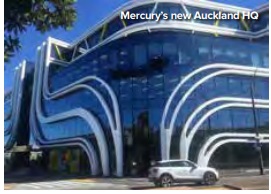
Mercury’s new Auckland offices illustrate its renewable energy outlook and drive for electric vehicles.
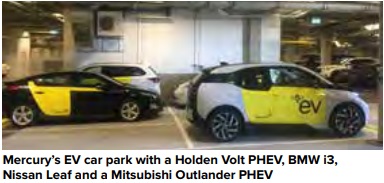
The basement carpark on the five level Broadway building in Newmarket has about 12 EV chargers for a growing fleet of EVs.
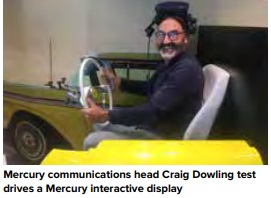
Interactive displays in the ground floor reception include a mock-up of Mercury’s famous electric 1957 Ford Fairlane “Evie” in which you can take a “drive” with a virtual reality headset.
There’s even a build-your-own hydro dam activity using sand and special lights.
Mercury also leases levels three to five, consolidating its Auckland offices to now house around 550 people in the one building.
 The energy generator and retailer had been in the new headquarters just weeks when a briefing was held there on February 26 covering the company’s good second half performance for 2018.
What was especially notable during the briefing was Mercury chief executive Fraser Whineray’s update covering a wide range of topics.
including New Zealand’s ability to supply EVs with renewable electricity in the future, and his take on climate change and hydrogen as a fuel source.
Whineray scotched any suggestions the drive for EVs in New Zealand could impact on electricity generation.
“In terms of future growth, New Zealand has enough commercially feasible renewable electricity generation for every car, truck, ferry, train, domestic plane, bike and scooter to be electric.And then some,” he says.
Both he, chair Joan Withers (in her last year in this position) and chief financial officer William Meek walk the talk on EVs.
Whineray has driven a Mitsubishi Outlander PHEV for five years – racking up 70,000km, along with a 2011 Nissan Leaf which has done 45,000km.
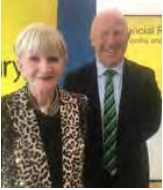
Withers claims a record with 83,000km on her Mitsubishi Outlander PHEV over four years.
She noticed a 75% drop in her fuel bill after switching from a Porsche Cayenne.
Meek gets around on a variety of electric transport, including an e-scooter, a YikeBike and a 2011 Nissan Leaf.
Whineray has some strong views around the energy sector.
Discussing climate change and pointing out that another policy report is due this year from the Interim Climate Change Committee, he says the ICCC recognises renewable electricity in New Zealand is no longer the issue.
“Electricity is the solution to displace liquid and solid fossil fuels.”
Electricity can reduce costs to the economy and consumers, increase how much energy we make and reduce carbon emissions, he says.
“All political parties should abandon renewable electricity targets in New Zealand and instead focus on New Zealand’s low-carbon energy policy if they are genuinely interested in achieving those outcomes.”
Talk on climate change and emission reduction policies is reaching unprecedented levels globally, driving governments, businesses and others to be seen to be doing something, Whineray says.
“This leads to activities which sound logical but could well be irrelevant at best and, in many instances, likely drive a perverse outcome.
This is greenwashing.And it is the fastest way to a hot planet.”
Leadership should be about helping people understand what will make a real difference, Whineray says.
“An example is the attention currently being given to hydrogen as a fuel source.
We think hydrogen could be a great export but will have only limited and highly niche applications domestically.
“Mercury could selfishly say it would love a domestic hydrogen economy, because it takes a lot of electricity to produce hydrogen in a fuel-ready form (more than three times as much as using electricity directly).
But why would you direct New Zealand’s electricity, which is already generated from predominantly renewable sources, into a less efficient fuel source?”
Whineray says hydrogen cannot beat building new wind or geothermal renewable generation on pricing.
He says the electricity grid network is already in place, unlike much of the infrastructure for making, storing and transporting hydrogen.
Covering the Government’s Electricity Price Review (EPR) – which has a final report due later this financial year – Whineray warns the Government to tread carefully on electricity matters to “avoid the tremendous unintended consequences now plaguing Australia, the United Kingdom and Germany”.
Long-standing ring-fencing arrangements for network companies need updating to cover new technologies, Whineray says.
“As a real example, it is indefensible that many network companies think all consumers in their monopoly area should pay for public electric car chargers as part of a regulated asset base.
We support proposals in the EPR options paper to give greater powers to the EA (Electricity Authority) to regulate in this area if required.”
Join the conversation