
New EV campervans available
Customised electric campervans are being prepared by Jucy for international tourists and are expected on New Zealand roads from July.
Five Nissan e-NV200 40kWh vans are being adapted at Jucy’s Helensville workshop in Auckland with five more to come later, able to be booked this month.
The new campervans are the first of a much larger and longer range new EV fleet to be developed after a successful nationwide trial involving two French eco-tourists, Jucy chief executive officer Tim Alpe says.
Students Heloise de Bokay and Solene Trinquet’s plans to travel New Zealand in an EV were picked up by Jucy after featuring in EVtalk.
The pair drove a prototype 24kWh Jucy electric campervan more than 13,000km to 45 destinations over five months last year, recording data and charging infrastructure as well as attitudes towards EVs.
While the trial found it was feasible for tourists to traverse the country it identified some gaps in the fast-charging network in parts of the South Island.
Alpe says these have since been addressed with new longer-range batteries and redesigned interiors.
“We have since been able to analyse the data from their experience and incorporate it into the new vehicles, which have lighter weight interiors and can travel significantly longer on a single charge.
“This allows tourists to travel up to 180-200km – around twice as long as the prototype – with each charge,” he says.
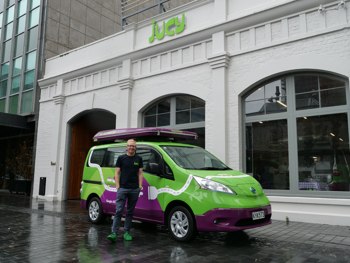
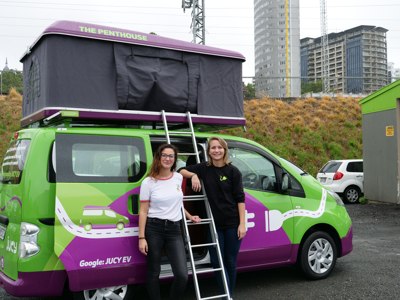 The self-contained vehicles have a roof-top solar panel which charges a secondary or domestic battery while driving, a router for wireless internet, device charging ports, an electric blanket for the sleeping area, and induction cooking. A mobile app will advise campervan users when battery levels are low and plot a course to the nearest fast-charging facility.
A pop-up roof-top tent provides accommodation.
Alpe says production of the first EV campervans was made possible in part by funding from the Energy Efficiency and Conservation Authority (EECA) low emission vehicles contestable fund.
The new EV campers will be rented at about the same daily cost as new internal combustion engine (ICE) models but at the equivalent of about 30 cents per litre and will have a fraction of the running costs; savings which will make it less expensive for tourists to travel, Alpe says.
“Ultimately if we can switch as many tourists from an expensive imported commodity such as petrol or diesel to a low cost, renewable energy source, that allows them to inject that additional disposable income from their travel budget into other parts of the New Zealand economy.
 “Since our trial last year, a number of tourism operators and regional towns have seen the potential opportunity around EV travellers and invested in new charging infrastructure in the hope of attracting more visitors using this mode of transport.
“Each battery charge would take around 40-60 minutes at a rapid charge station – which is additional time tourists will spend in many of our provincial town centres or attractions,” Alpe says.
“If we aggregate that additional time and spend over thousands of visitors annually, it is a significant win for our regions, our environment and the country’s brand image.”
Jucy’s announcement coincided with TRENZ, the country’s largest tourism conference, in Rotorua from May 13-16.
Join the conversation