
Connected AVs improve traffic flow – study
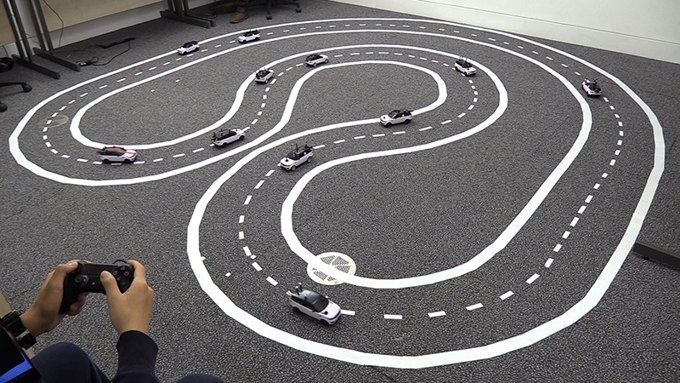
A driverless vehicle fleet working together to keep traffic moving smoothly can improve overall traffic flow by at least 35%, researchers say.
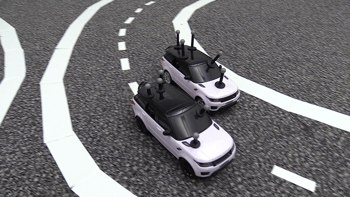
University of Cambridge researchers programmed a small fleet of miniature robotic cars to drive on a multi-lane track and observed how the traffic flow changed when one of the cars stopped.
When the cars were not driving cooperatively, any cars behind the stopped car had to stop or slow down and wait for a gap in the traffic, as would typically happen on a real road. A queue quickly formed behind the stopped car and overall traffic flow was slowed, they say.
However, when the cars were communicating with each other and driving cooperatively, as soon as one car stopped in the inner lane, it sent a signal to all the other cars.
Cars in the outer lane in immediate proximity of the stopped car slowed down slightly so that cars in the inner lane were able to quickly pass the stopped car without having to stop or slow down significantly.
Additionally, when a human-controlled driver was put on the ‘road’ with the autonomous cars and moved around the track in an aggressive manner, the other cars were able to give way to avoid the aggressive driver, improving safety.
 The results, presented at the International Conference on Robotics and Automation (ICRA) in Montréal (May 20-24), will be useful for studying how autonomous vehicles (AVs) can communicate with each other, and with cars controlled by human drivers, on real roads in the future.
Co-author and St John’s student Michael He designed the algorithms
for the experiment. “Autonomous cars could fix a lot of different problems associated with driving in cities, but there needs to be a way for them to work together,” he says.
Co-author Nicholas Hyldmar says that if different automotive manufacturers are all developing their own autonomous cars with their own software, those cars all need to communicate with each other effectively.
The research study team says its design allows for a wide range of practical, low-cost experiments on AVs.
The researchers plan to use the fleet to test multi-car systems in more complex scenarios including roads with more lanes, intersections and a wider range of vehicle types.
Join the conversation