
Tranzit grows its EV Bus charging network
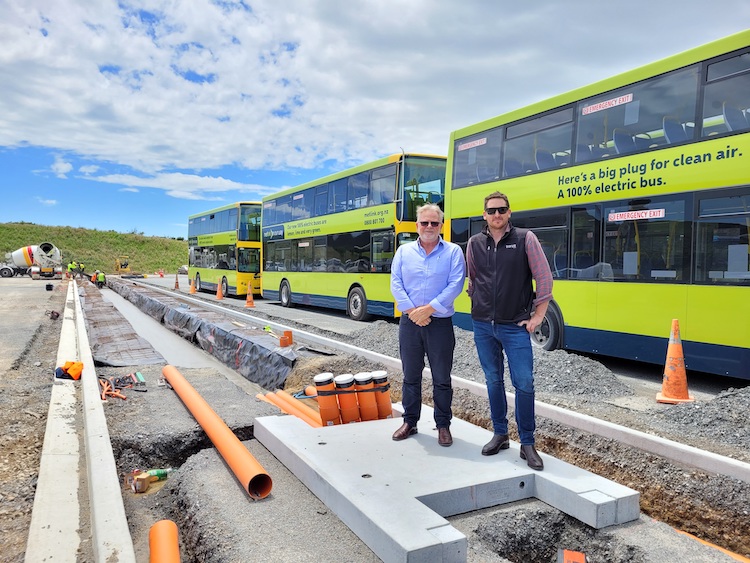
The New Zealand family-owned Tranzit Group believes it the first privately held company in country to own the largest charging network to power its electric bus fleet.
Tranzit’s transport and operations director Keven Snelgrove says this week’s installation of a 1080kW new charger at its Grenada Depot brings the company’s total charging network to 2820kW.
“Since we began exploring electric bus technology in 2014 and then made a commitment to electrifying public transport to provide a really smooth and quiet ride for our passengers, we’ve worked to ensure we have the infrastructure to charge our growing fleet of electric buses,” Selgrove says.
“From January 2022, we will have capacity up to 2820kW which means we can charge the 20 electric buses we currently have running in Auckland, Palmerston North and Wellington, as well as future proof our business for the next tranche of double deck electric buses we are incrementally adding into Wellington to run as part of the Metlink network,” he says.
To enable electrification in Wellington, Tranzit has built a network of chargers around the wider region. This includes the country’s two fastest chargers – a 450kW charger located in Reef Street in Island Bay and the soon-to-be completed 450kW charger at the Wellington Interchange in Thorndon. Here, Tranzit’s electric double deck buses can be charged from 20% to 100% in 12 minutes.
In addition, a total of 1080kW is currently being installed at Tranzit’s Grenada Depot. Tranzit also has a 1MW substation installed at its Rongotai depot, with a 300kW upgrade planned for early 2022. Also, there is a 120kW charger operational at its Palmerston North depot and a portable 25kW charger at its new Taupo depot.
In Auckland, Tranzit uses a unique charger.
“In Auckland we can charge our single deck electric bus, which was the first one we introduced into New Zealand thanks to EECA’s Low Emission Vehicles Contestable Fund and our partnership with AUT, on a special charger. This can charge buses with two different plug types removing the need for two chargers as most chargers can only accommodate one plug type,” Snelgrove says.
In order for Tranzit to accommodate its growing fleet of electric buses, it has worked closely with Regional Councils and regional electricity providers to secure power for its charging network. At the same time, the company has invested in upskilling many of its workshop team who have gone from working on diesel buses to electric buses.
To date, four of Tranzit’s diesel mechanics have completed their MITO New Zealand Certificate in Electric Vehicle Automotive Engineering (Level 5) and there are plans to upskill more of the team in 2022.
Tranzit utilises charging infrastructure by Heliox in the Netherlands which offers a slow or fast charger. Slow chargers take between 3-4 hours to charge a double deck electric bus to capacity. These can be done overnight with the advantage being it uses a cheaper night cost and lower impact to the power network.
Tranzit’s fast chargers take between 8 to 12 minutes to charge a double deck electric bus to capacity. Once charged, Tranzit’s double deck electric buses can run between 4 -6 hours or clock up to 130kms – per charge, costing as little as $35 per charge (excluding charger cost).


Join the conversation