
Li-ion battery alternatives key for storage – IDTechEx

Developments to alternative, next-generation, non-lithium battery chemistries, including redox flow, metal-air, or sodium-ion batteries, are now a regular occurrence.
In spite of interest in these alternatives, lithium (li-ion) batteries remain the dominant choice for EVs, consumer devices, and stationary storage.
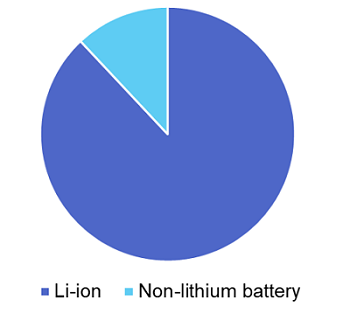
However, the importance of non-lithium battery chemistries is expected to grow considerably during the next 10 years, especially in the stationary energy storage sector. By 2025, IDTechEx forecasts that more than 10% of the stationary market will be accounted for by non-lithium chemistries, up from about 5% in 2021.
Stationary energy storage is expected to become a larger part of the battery market. Though EVs are the largest market for battery technology and will remain so, the importance of the stationary market will grow and once energy density can be de-prioritised as it can be for stationary storage systems, the choice of battery chemistries and systems becomes less restrictive, says IDTechEx.
In particular, more long-duration storage is expected to be needed to enable higher penetration levels of variable renewable power sources. Here, lower cost and longer-lasting technologies are needed. Li-ion batteries will likely struggle to profitably exploit electricity price variations over storage periods of six to eight hours, let alone the days or weeks’ worth of storage that may eventually be needed, it adds.
Improvements to alternative battery technologies will help to make them more attractive, IDTechEx explains.
“A number of companies are working on a variety of chemistries, demonstrating prototypes and rolling out battery systems for early customers. In the stationary sector, redox flow batteries based on vanadium have been relatively well commercialised but new finance schemes that lease the electrolyte, or new electrolyte chemistries altogether, can help ease the capital cost burden.
“To this end, various battery chemistries based on zinc, iron, and other low-cost materials are also being developed and commercialised. Interest in these alternatives can be highlighted by some of the funding raised in 2021 from companies developing these long-duration technologies, including the US$200 million for Form Energy’s iron-air, US$144m for Ambri Inc’s high-temperature battery, and US$100m for Enervenue’s nickel-hydrogen hybrid battery.
“Companies developing non-electrochemical storage technologies such as Highview Power and Energy Vault have also raised considerable funding in 2021.”
The second half of the 2020s could feasibly bring supply disruption and bottlenecks to the li-ion industry. Lithium, cobalt, and nickel could all be in short supply and while alternatives to nickel and cobalt exist, lithium is fundamental to li-ion batteries, which will continue to be needed for the vast majority of EVs.
The safety of li-ion batteries and environmental credentials of materials throughout the li-ion supply chain are also being questioned. This opens up an opportunity for battery chemistries and energy storage technologies that utilise lower cost, more widely available materials and that can also offer additional safety and environmental benefits, says IDTechEx.
Li-ion will continue to dominate the energy storage space in the short term. For battery electric vehicles (BEVs) this will continue to be the case even in the long-term as there are few realistic alternatives beyond related chemistries based on silicon and lithium-metal anodes or solid-electrolytes, IDTechEx adds.
“But for stationary storage, alternatives to li-ion are set to play an increasingly important role due to their potential for improving cost and safety, easing material supply burdens, and the often less demanding requirements on energy density in the stationary sector.”
See the IDTechEx report Advanced Li-ion and Beyond Lithium Batteries 2022-2032: Technologies, Players, Trends, Markets or visit IDTechEx’s website for more information on its battery and energy storage research coverage.

Join the conversation