
Power prices up
Electricity prices are on the rise, due to New Zealand’s dry conditions and regulation changes.
Consumer NZ predicts at least 40% of Kiwi households are likely to see a jump in their power bills from April as the industry does away with low use plans during the next five years, especially hitting those whose power use is very low.
“As part of the phasing out, power companies have permission to double the daily fixed rate for low users from 30c a day to 60c a day, which works out to an increase of around $110 over the next year,” it explains
“For those consumers currently on low fixed charge rates, prices will continue to rise each year for the next four years. A consumer currently paying 30c a day ($110 a year) for lines charges can expect to be paying $1.80 a day (around $660 a year) in 2026.”
The Ministry of Business, Innovation and Employment estimates 60% of households will be better off and 40% will have higher bills. It says those worse off are likely to be those who use less than 6500kWh annually (average household consumption is 7233kWh annually).
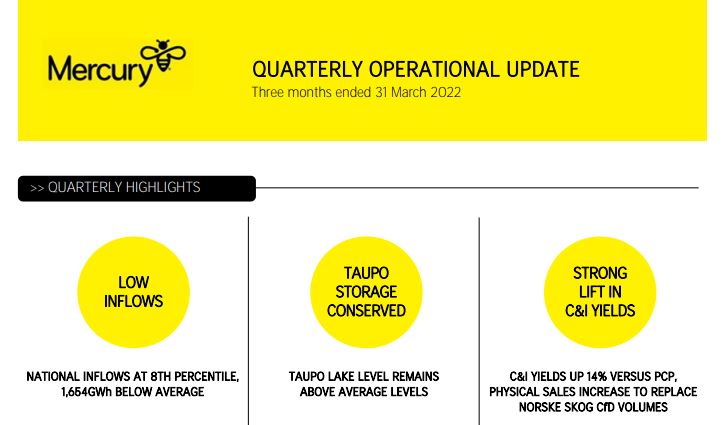
Meanwhile, Mercury’s newly released quarterly operational update for the three months ended March 31, 2022, points to dry conditions exacerbating power problems.
It mainly blames low inflows at hydro stations, with national inflows 1654GWh below average, although Lake Taupo levels are above average (closing at 58% full, 66GWh above average) with storage helped by Cyclone Dovi bringing rain in mid-February expected to help as power demand increases leading into winter.
Mercury’s hydro generation decreased by 57GWh versus the prior comparable period as inflows into Lake Taupo trended below average at the 19th percentile, 175GWh below average, it says. However, record low inflows in January were offset by Cyclone Dovi.
“Geothermal generation remained steady at 653GWh in FY2022-Q3 (versus 658GWh in FY2021-Q3) and spot price linked wind generation, from Mercury’s Turitea North wind farm, was 99GWh. Generation from PPA-linked (Power Purchase Agreements) wind farms was 226GWh.”
Mercury says declining national hydro storage has lifted spot prices.
“Conditions were dry across both the North and South Islands as 8th percentile inflows saw national hydro storage end the quarter 309GWh below average.
“South Island inflows were particularly affected with record low inflows in both the January and March months.
“This was reflected in elevated spot prices in FY2022-Q3 of $176/MWh at Otahuhu and $149/MWh at Benmore, down from $206/MWh and $203/MWh respectively in the prior comparable period but still above historical averages.”
Mercury points out that futures prices responded strongly to dry hydrological conditions with the FY2022 price increasing at Otahuhu and Benmore from $125/MWh and $103/MWh respectively to $167/MWh and $143/MWh across the quarter.
“Longer-dated futures also increased with the Otahuhu FY2023 and FY2024 futures lifting by $47/MWh and $34/MWh respectively to $191/MWh and $163/MWh, reflecting increased expectations of thermal costs with carbon prices remaining at historically high levels of ~$75/NZU.”
The Commercial & Industrial (CI) segment average yield (including both physical and financial sales) increased by 14% from $94/MWh in FY2021-Q3 to $107/MWh in FY2022-Q3 due to re-contracting and the early termination of a Contract for Differences (CfD) with Norske Skog Tasman. CfD sales volumes decreased by 127GWh, from 381GWh in FY2021-Q3 to 254GWh in the current quarter but were offset by an increase in physical sales of 118GWh, from 477GWh to 595GWh.
Mercury continues to look to maintain market share, however mass-market customer numbers declined in the quarter from 327,000 to 324,000, reflected in mass-market sales volumes decreasing from 544GWh to 528GWh. Mass-market yield increased by 2%, from $141/MWh in FY2021-Q3 to $144/MWh in the most recent quarter.


Join the conversation