
Nearly 36m EVs sold last year
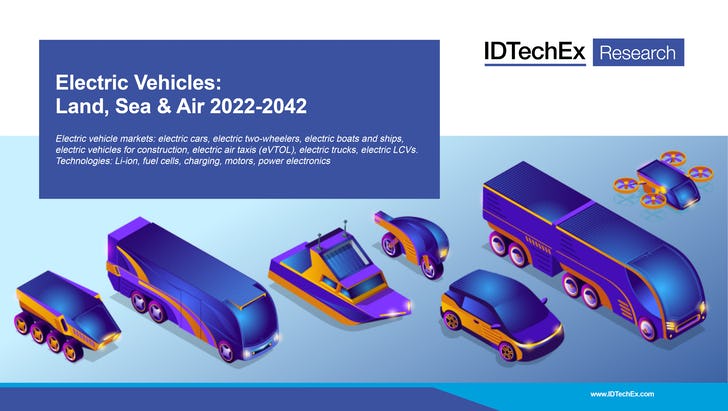
A new IDTechEx report Electric Vehicles: Land, Sea & Air 2022-2042 says 35.7 million EVs were sold in 2021 demanding 307GWh of lithium-ion batteries, with the first quarter of this year continuing the record growth.
The report on electric cars, electric two-wheelers, electric boats and ships, electric vehicles for construction, electric air taxis (eVTOL), electric trucks, electric LCVs, technologies, batteries, fuel cells, charging, motors, and power electronics will be covered in a May 19 webinar.
IDTechEx’s comprehensive EV master report covering eight EV markets including more than 90 forecast lines covers all vehicle volume and platform breakdowns, including battery-electric, fuel cell and hybrid vehicle unit sales, battery demand (GWh) and market revenue generation.
it suggests EV markets across land, sea and air will generate US$2.6 trillion by 2042.
The report further details emerging technology trends underpinning the transition, from silicon-anode batteries to axial-flux motors and DC fast-charging.
Electric car markets are the largest EV markets for the next 20 years in terms of battery demand and market revenue generation.
Unit sales surged in 2021 to more 6.4 million, in spite of a lingering chip shortage and price rises in key raw materials.
The report provides a long-term market forecast on battery-electric, plug-in hybrid, hybrid and fuel cell car markets for the next 20 years.
Growth has been consistent across all major auto markets. While China remains the largest EV market, Europe has been catching up, driven by strong emissions policy as 2021 was the first full year of the new 95g CO2 per km target.
In the US, the market continues to be underpinned by Tesla, particularly with the success of the Model Y. The situation is evolving rapidly as president Joe Biden as well as traditional automakers have re-energised their electrification targets.
Automotive manufacturers have also announced plans to release and ramp up production of new electric pickup trucks, the most popular passenger car type, in a bid for EV leadership during the next few years. Key examples are Ford’s electric F-150 and General Motors’ Silverado.
The report details the rise of 800V platforms, silicon carbide (SiC) inverters, more efficient motor systems and DC fast charging capability.
Electric buses are also covered in the report, finding that future growth in the near term is driven by Europe, while businesses are recognising that electrifying their light commercial vehicle (LCV) fleets – especially vans – is not only a successful mechanism by which they can demonstrate their green credentials to their customers, but is also a good economic decision.
“The next few years will see companies conducting large pilot projects to establish that eLCVs meet their operational range, load capacity, payload and reliability requirements,” the report says.
“Electrification is also driven by increasing demand for freight delivery as the retail industry grows its online sales platforms, and consumers gradually abandon private car ownership for mobility as a service (MaaS) platforms.”
Electric trucks are coming in droves too.
Tesla, Daimler, VW and Volvo are all investing heavily in battery electric trucks while the likes of Toyota, Hyundai, and Nikola, have chosen to focus their efforts on fuel cell trucks – especially for long haul trucking applications.
As cities and nations phase out diesel and petrol fuelled vehicles by 2030 the electrification of truck fleets is likely to happen rapidly, says IDTechEx. The report contains 18 forecast lines for trucks through 2042, for battery electric, plug-in hybrid and fuel cell trucks across medium-duty and heavy-duty variants.
Sales of electric two-wheelers are also strong, and electric and hybrid marine applications are growing too, with the report providing forecasts for electric leisure boats, short sea commercial vessels and deep-sea commercial vessels.
A strong market also exists for EVs in construction, electric air taxis and other electric vertical take-off and landing (eVTOL) formats.
The report also concludes EV charging demand – especially on the grid – will rise, although expert assessments vary.
The US Department of Energy, for instance, predicts a 38% increase in electricity consumption by 2050, mostly due to a high EV penetration. “At IDTechEx, we believe the electric vehicle industry will not be derailed and will continue with its staggering momentum.”


Join the conversation