
Kia announces pricing for hybrid and electric Niro line-up

Kia New Zealand has confirmed a 10-model Niro line-up for the local market, including pricing.
The line-up is split into three powertrain options; hybrid, plug-in hybrid, and EV, and four trim levels. Every model is eligible for some form of Clean Car Discount rebate.
The hybrid and plug-in hybrid will both be sold with four potential trim level options; Light, Earth, Water, and GT-Line. EV variants, meanwhile, will only be offered in either Light or Water form.
The hybrid line-up’s Light, Earth, Water, and GT-Line variants are priced at $39,990, $44,990, $53,990, and $57,990 respectively. Each model is eligible for a $3418 Clean Car rebate.
The plug-in hybrid line-up, meanwhile, across its Light, Earth, Water, and GT-Line variants is priced at $49,990, $55,990, $63,990, and $67,990 respectively. Each model is eligible for a $5750 rebate.
Finally, the two-model EV line-up consisting of the Light and Water grades, is priced at $67,990 and $73,990 respectively. Both model earn the maximum $8625 rebate, making this one of the few electrified model line-ups where all models are rebate eligible.
Three models in the line-up, the Light hybrid, Earth hybrid, and Light plug-in hybrid, have introductory “limited-time offer” prices attached. This means consumers may have to get in quick to be able to purchase these models at this price before they’re potentially raised at a later date.
Hybrid and PHEV models both utilise a 1.6-litre petrol four-cylinder engine paired to an electric motor. HEV models get a 1.32kWh battery, while PHEVs get a larger 11.1kWh unit. Outright power is rated at 104kW/265Nm in the HEV and 134kW/265Nm in the PHEV.
The PHEV is capable of up to 65km of pure electric range in Light and Earth models and 59km in flagship models, according to Kia. The HEV’s economy is rated at 4.4L/100km. Each petrol-assisted model gets a 6-speed dual-clutch transmission.
The Niro EV, meanwhile, features a single 150kW/255Nm electric motor paired to a 64.8kWh battery. Kia claims a range of 460km per charge, with battery efficiency of 16.2kWh/100km.
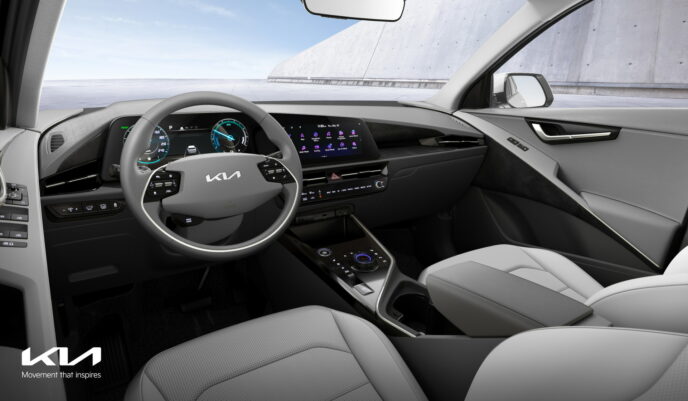
As standard, the Light gets a comprehensive active and passive suite of safety tech (including rear parking sensors, safe exist assist warning, lane keep assist, AEB with pedestrian and cyclist detection, radar cruise, and more), roof rails, cloth interior trim, and an 8.0-inch touchscreen.
The Light EV adds in the 10.25-inch digital cluster that other Light variants miss out on.
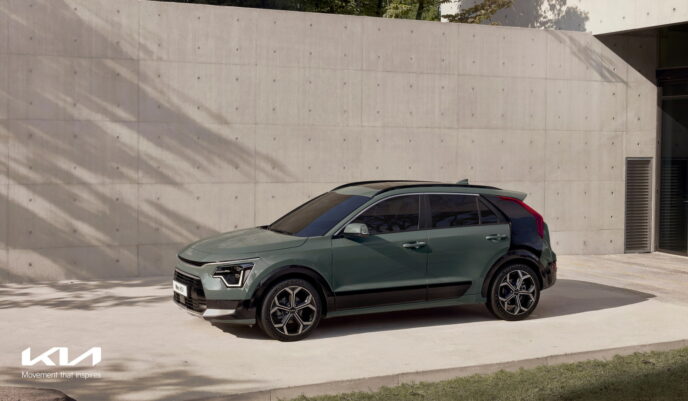
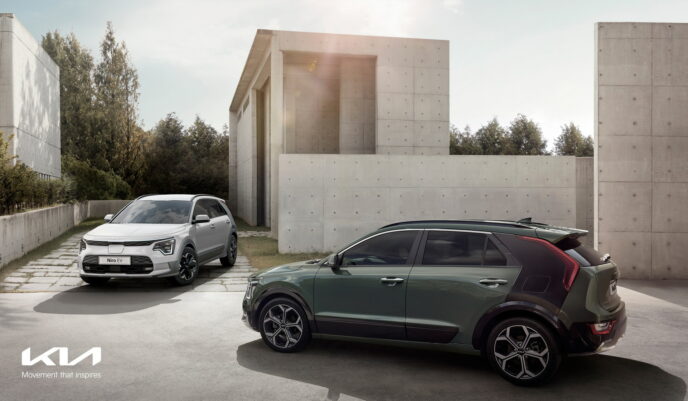
Earth models add fog lamps, gloss black highlights on the wing mirrors and grille, faux leather appointments inside, air vents for rear passengers, rain-sensing wipers, and more.
Water models add a larger 10.25-inch touchscreen paired to a 10.25-inch digital cluster, satnav, head-up display, power tailgate, a power driver’s seat, Harman Kardon audio, heated front seats, wireless phone charging, 18-inch wheels, and push-button start on HEV and PHEV variants.
Finally, GT-Line models add a dial gear selector in HEV and PHEV models, a power sunroof, vegan leather, ventilated and heated front seats, heated steering wheels, sports pedals, electronically adjustable front seats on both sides, and more.
Water and GT-Line models are also the only models where buyers can add a striking contrast colour to the C-pillar, as seen in the variants used in most of the Niro’s promotional imagery.
Full specification information is available on the Kia New Zealand website.
Join the conversation (2)
This sentence: “The 11kW on-board charger helps the Niro charge from 10% to 80% capacity in just over 40 minutes when plugged into a DC fast charger.” reveals that you don’t understand what you’re writing about.
The on-board charger is not used for DC fast charging, because it’s an AC charger. Charging from 10 to 80% of a 64.8kWh battery is 45kWh, and doing it in 40 minutes means a power of 68kW (on average), which is significantly great than 11kW.
This makes no sense “The 11kW on-board charger helps the Niro charge from 10% to 80% capacity in just over 40 minutes when plugged into a DC fast charger.”
The optional 11kW onboard charger is for AC charging and has nothing to do with the DC charging rate.