
Canterbury students aim for world EV land speed record
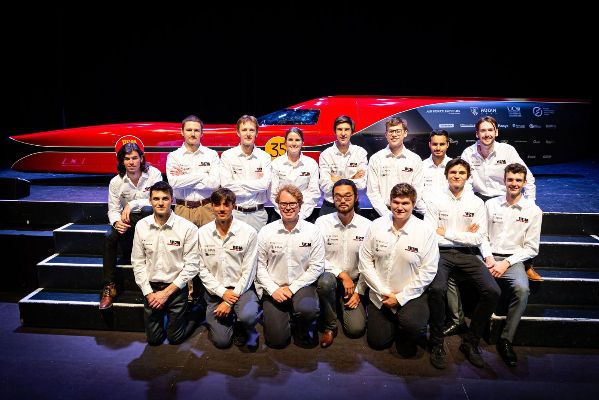
University of Canterbury students inspired by late legendary Kiwi racer Burt Munro are aiming for a world land-speed record in a rocket-shaped electric car they’ve designed and built.
The 16 University of Canterbury Motorsport (UCM) club members, most in their final year of engineering degrees, have this year been building a 7.5-metre EV they hope will break a record of 329km/h held by an American university.
They plan to compete in the Dry Lakes Racers Australia (DLRA) Speed Week 2023 at Lake Gairdner in South Australia in March where Auckland mechanical engineer Eva Hakansson will also be competing in her electric streamliner Green Envy.
Hakansson provided some feedback on the students’ EV design.
The EV called UCM35, launched at the University of Canterbury Students’ Association Ngaio Marsh Theatre in late November, features red, black and gold livery and the number 35.
These were Invercargill racer Burt Munro’s colours and number when aged 68 he set a new official land speed record (184mph/296km/h) racing his heavily modified Indian Scout Streamliner at Utah’s Bonneville Salt Flats in 1967.
His story is in the 2005 Roger Donaldson film The World’s Fastest Indian starring Anthony Hopkins.
Burt Munro died in 1978, but son John and other members of the Munro family which has given support to the UCM’s record bid were among guests at the launch.
UCM team principal Kaenan Ferguson says it will be the first time a New Zealand university team has attempted a land speed record at the South Australian event, and only the second time a university team from anywhere in the world has entered the electric competition class.
“This is a chance to do something that nobody in the world has ever done before and we’ll never get the chance to do again, so it’s pretty exciting,” says Ferguson.
“Brigham Young University in the United States is the only other university to ever compete in the Electric Land Speed category and they spent 10 years working on their car.
“We’ve had 12 months and we think we can break the E1 class record (electric car under 500kg) as well as competing for the DLRA E2 (electric car 500 to 1000kg) record by adding a bit of weight to the car for E2. The current E1 land speed record is 329km/h.”
Ferguson says the team wanted the car’s livery to honour Burt Munro.
“So we contacted the family to see if they were OK with that, and they really liked what we were doing and have been very supportive.
“I’ve always idolised Burt Munro and his story and we wanted to build on that legacy. He was incredibly creative and was really up against it. For us, trying to build a car in 12 months was never a smart or easy decision but now it’s all coming together, and I feel really confident in the car.”
The University of Canterbury has provided sponsorship, supervision, facilities and workshop staff for the project, while the team has been using Wigram Airforce Museum’s runway for testing.
Other major sponsors include Rodin Cars and Aruhiko Power Engineering Excellence Trust (PEET).
“The project celebrates a connection to New Zealand engineering heritage through the Burt Munro story but is also very forward looking with use of technology for performance, efficiency, and safety,” says UC design engineer Bruce Robertson who mentors the UCM team.
The car has a carbon-fibre monocoque, fully electric powertrain system, front-wheel drive, a parachute deployment system, and on-board telemetry.
The 16 team members plan to travel to the DLRA Speed Week event and have yet to decide will will drive the EV in the record attempt.
Ferguson says the team is also keen to take on Bonneville Speed Week.
“We’d like to follow in Burt Munro’s trail and head to Bonneville in the United States next August, but we’ll make those decisions after the DLRA competition.”
Ferguson, who finished his Mechatronic Engineering BE (Honours) degree this year, has a job as a project manager for infrastructure consultancy and advisory firm Tactical Group in Auckland starting next year.
He adds he’s learned much from the EV project.
Join the conversation