
‘Hyundai Motor Way’ for accelerated electrification and future mobility
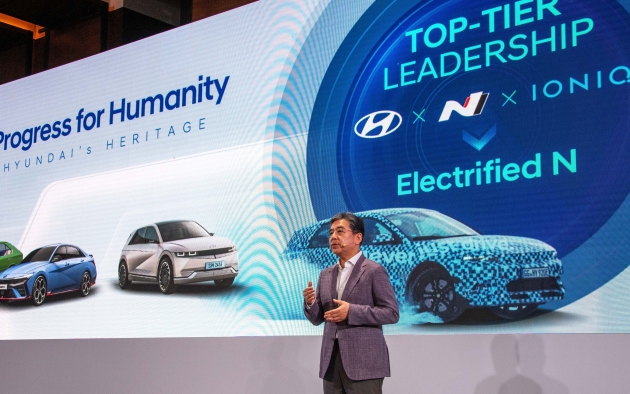
Hyundai Motor shared its mid- to long-term business and financial plans based on its ‘Hyundai Motor Way’ strategy at the June 21 ‘2023 CEO Investor Day’ in Seoul.
The company plans to boost its annual EV sales goal to two million units by 2030 and accelerate its transition toward becoming a smart mobility solution provider by investing about NZ$137.6 billion (KRW 109.4 trillion) during the next 10 years.
About NZ$45 billion (KRW35.8 trillion) will go towards electrification, including NZ$11.9 billion (KRW9.5 trillion) for battery development and the remainder funding development of a next-generation modular architecture for EVs and increased EV production capacity.
Hyundai Motor’s blueprint includes developing Integrated Modular Architecture (IMA) for its next-generation EV-dedicated platform, which will replace the E-GMP EV platform.
It will expand EV production and optimise capacity, not only building new EV factories but also utilise existing internal combustion engine (ICE) plants to reduce costs and time.
The brand aims to strengthen the overall battery value chain, including stable procurement of battery materials, design capability, and next-generation batteries (including NCM and LFP batteries).
Future businesses will continue working with strategic partners to advance plans for autonomous driving, software, robotics, advanced air mobility and hydrogen.
The company announced it will achieve a successful transition to electrification by efficiently and effectively leveraging its long experience in vehicle production and sales.
“As it originated from Pony, the Ioniq 5 N – a high-performance EV scheduled for unveiling in July – will embrace and carry forward the enduring heritage of Hyundai Motor Company,” says president and chief executive Jaehoon Chang.
He explained the ‘Hyundai Motor Way’ roadmap for success in the electrification era, emphasising the company’s advantages as a legacy automaker and its proactive pursuit of EV leadership.
The next-generation platform (IMA) will be used on 13 new EV models from Hyundai Motor Group’s automotive brands Hyundai, Kia and Genesis through 2030.
With IMA, the company expects to standardise modules and parts between the models to further expand economies of scale and significantly reduce EV development complexity and costs, allowing more than 80 common modules which can be utilised across different segments (including small and large SUVs to pickup trucks and Genesis flagship models), irrespective of vehicle type, allowing for versatile combinations.
To further extend the driving range, Hyundai Motor intends to implement cutting-edge technology enabling battery charging and discharging while driving, utilising an independent power bank.
Integration of an AI-based battery management system will ensure real-time monitoring and diagnosis of battery conditions, providing enhanced safety by preventing thermal runaway.
In addition to these hardware improvements, the modular architectures and next-generation platform will enable software architecture compatibility in support of Hyundai Motor’s software-defined vehicle (SDV) strategy.
The company aims to build an app ecosystem through the application of an open operating system and controller integration, including Level 3 and higher autonomous driving capabilities, high-performance semiconductors, and over-the-air (OTA) update advancements.
Hyundai says the proportion of global EV production is set to increase from 8% this year to 34% in 2030.
Since the demand for ICE vehicles remains high, Hyundai is producing EVs on mixed production lines as it is more cost efficient than building more EV-dedicated factories and can be ramped up quickly to meet EV demand.
The company is building dedicated EV factories in regions that are expected to grow significantly in the future and require localisation, equipped with new ‘smart factory’ technologies.
Hyundai’s first dedicated EV factory, the Hyundai Motor Group Metaplant America (HMGMA) in Georgia, is under construction with a targeted start-up date in the second half of 2024, with an annual production capacity of 300,000 vehicles to meet the demand for EVs in North America.
Meanwhile, an EV-dedicated factory in Korea aims to start mass production in 2025, aiming not just for the domestic supply but the rapidly growing global market too.
Hyundai Motor Group’s Innovation centre in Singapore (HMGICS), scheduled to be operational this year, will be equipped with ‘smart factory’ technology.
With global EV demand growing faster than market forecasts, Hyundai Motor is raising its 2030 sales target from 1.87 million units to two million units and aims for more than 10% profitability for EVs in 2030.
Click here for more information.


Join the conversation