
Electrification outside automotive a trillion-dollar market – IDTechEx

The automotive sector is rapidly electrifying, with electric car sales totalling more than 5.8 million units in the first half of 2023 across China, Europe, and the US.
While automotive electrification is at the forefront of the public eye, other vehicle sectors also present huge opportunities, with IDTechEx predicting the EV global market for land, sea, and air to be worth more than US$1 trillion in 2044 (excluding automotive).
IDTechEx’s report Electric Vehicles: Land, Sea, and Air 2024-2044 provides historic performance and granular forecasts of unit sales, battery demand, and market value for EV markets, including cars, buses, vans, trucks, two-wheelers, three-wheelers, microcars, boats and ships, construction, trains, and air taxis (eVTOL).
Commercial vehicles (vans, trucks, buses) are deployed in smaller volumes than automotive but are also heavily electrifying and an important stage in global emission reduction, says IDTechEx principal technology analyst Dr James Edmondson.
These markets are at an earlier stage of electrification but are making significant progress, he explains.
IDTechEx predicts that due to the saturation of China’s electric bus market, global sales will not surpass their 2016 peak until 2040, with future growth fuelled by replacements in China and greater adoption in Europe.
Electrification of light commercial vehicle (LCV) fleets is proving to be an effective way to demonstrate green credentials to customers, but also a strong total cost of ownership (TCO) reduction for fleet operators, says Edmondson.
“Significant adoption has been seen from operators like Amazon and UPS. In Europe, the average van OEM has 8% of its new registrations coming from electric LCVs.”
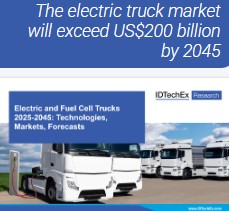
Tesla, Daimler, VW, and Volvo are all investing heavily in battery electric trucks.
A smaller minority have chosen to focus their efforts on fuel cell trucks as the powertrain of the future, says Edmondson.
In spite of issues with the efficiency and cost of hydrogen as a fuel, FCEV remains in the conversation as a technology for long-haul trucking applications, dependent on the production of low-cost green hydrogen, he says.
An increasing number of cities and nations worldwide are phasing out diesel and petrol-fuelled vehicles by 2030.
Truck fleet electrification is likely to happen rapidly – electric truck sales in 2022 were 2.2 times that of 2021, says Edmondson.
“In China, India, and several other Asian regions, the two- and three-wheeler is the dominant form of personal mobility.
“With the small battery size and low motor power required for these vehicles, they can present a relatively low-cost form of electrification.”
Electric microcars are an emerging form of transport that has proven especially popular in China, thanks to the lower range requirement needed and the ability to traverse crowded cities more easily than a full-sized car.
Edmondson says the electric boating market has tripled since COVID-19 emerged, as more time away from the office has led to increased interest and free time for leisure boating.
“While low-power outboard categories are typically two times more expensive than petrol equivalents, the business case is strong from a TCO standpoint alongside other advantages (quiet, clean, etc).”
High battery prices remain a barrier in higher power outboard or inboard categories.
“Unlike the automotive market, the industry lacks governmental policy drivers, which have remained largely unchanged for a decade,” says Edmondson.
“Ferries are the most common electric vessels as the low-hanging fruit that can opportunity charge and travel shorter and consistent routes.”
The IDTechEx report provides forecasts for electric leisure boats, short sea commercial vessels, and deep-sea commercial vessels.
Commenting on construction EVs, Edmondson says broader commitments to climate change are spurring some countries like Norway and Holland, or companies like Volvo, to set their own targets for construction equipment electrification.
“Health and safety concerns like the impact of diesel particulate exhaust emissions on construction worker health and noise could be equally important drivers.
“Much of the early vehicle development has been through retrofitting, a necessary development phase but not a sustainable strategy in the long term.
“OEMs need to design large EVs from scratch and manufacture at volume to realise economy of scale savings.”
The report forecasts that electric construction vehicles will be a market worth about US$154 billion by 2044, comprising a low volume of high individual value vehicles.
The timeline for eVTOLs to become commercial is highly dependent on the final certification process in each geographical market, says Edmondson.
“Significant technological and funding issues will need to be addressed for many companies before a production eVTOL can be launched.”


Join the conversation