
BEVs dominate NZCOTY top 10 finalists
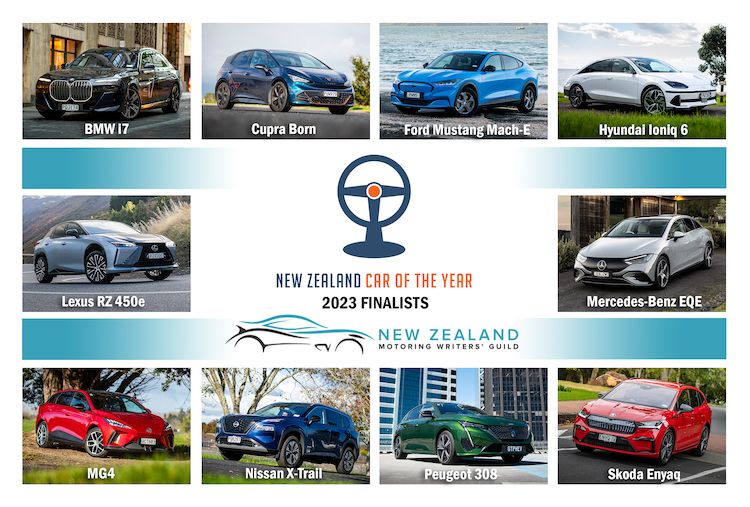
Eight battery electric vehicles priced from $46,990 to more than $276,000 are amongst the top 10 finalists chosen for the 2023 New Zealand Car of the Year award of which 18 members of the New Zealand Motoring Writers’s Guild will decide the winner.
The candidates are: BMW i7, Cupra Born, Ford Mustang Mach-E, Hyundai Ioniq 6, Lexus RZ, Mercedes-Benz EQE sedan, MG4, Nissan X-Trail, Peugeot 308, and Skoda Enyaq.
Amongst the finalists, the BMW i7, Cupra Born, Ford Mustang Mach-E, Hyundai Ioniq 6, Lexus RZ, Mercedes-Benz EQE, MG4 and Skoda Enyaq are fully electric. The Peugeot 308 range includes a plug-in hybrid version, while the e-Power version of Nissan’s X-Tail takes an innovative approach to conventional hybrid motoring.
Seeing electric vehicles come to the fore for New Zealand Car of the Year is not in itself new, but this is the first time in the award’s history that every one of the finalists is either a pure EV, or is available in hybrid form.
The first electric-powered model to achieve New Zealand Car of the Year was the BMW i3, in 2015. That was a range extender version with small supplementary petrol engine acting as a power generator. The prize has since gone to four fully electric cars. The Jaguar i-Pace achieved the 2019 award, Mercedes-Benz EQC took the 2020 prize, the Hyundai Ioniq 5 triumphed in 2021, and the BYD ATTO3 is the current holder.
Now entering its 36th year, New Zealand Car of the Year has firm industry recognition as country’s most prestigious motoring award. It is a truly national prize without commercial ties or influence.
To be considered as a finalist, a vehicle must have been launched in New Zealand as an all-new model in the past 12 months,
The award’s winner will be decided by the Guild’s voting members over the coming months and announced in February next year.
Finalists are assessed on a specified range of criteria spanning how the vehicle performs its intended role; its styling, interior design and accommodation; fit, finish and quality; ride and refinement; performance; road-holding and handling; value for money; active and passive safety and environmental responsibility.
New Zealand Motoring Writer’s Guild president Robert Barry says the top 10 contenders reflect the sophisticated engineering which underpins the automotive manufacturers’ drive to full electrification of their brands.
“Although the BMW i7 is purpose-designed as an EV, the 7-Series has a common body represented by the 740i mild hybrid and the PHEV-configured 750e,” Barry says.
“Locally the Peugeot 308 is sold either with a turbocharged petrol engine or as a plug-in hybrid, and in overseas markets there is also a battery electric version available, which further reflects the flexibility of modern vehicle platforms.
“Five of the battery electric vehicles under consideration also offer variants that currently meet the threshold for the $7015 Clean Car Rebate until December 31, with the 51kWh MG4 Excite priced from $46,990 (before rebate) which shows that manufacturers are also achieving price parity with non-electrified vehicles,” he says.

Join the conversation