
Nissan Skyline R32 GT-R reimagined as an EV
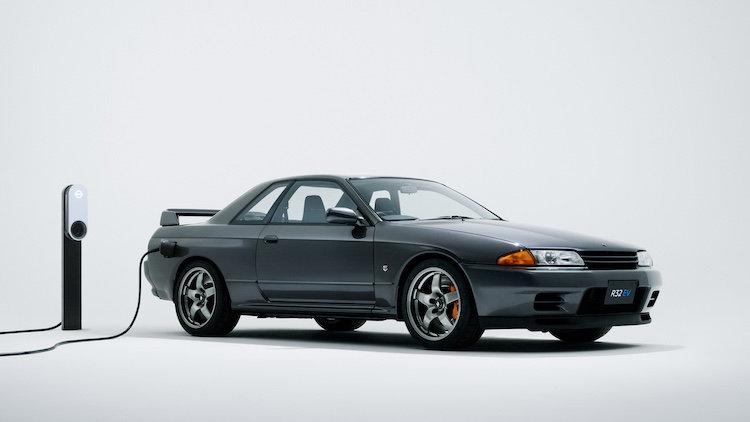
What do you get when you combine a small team of passionate engineers, one of Nissan’s iconic performance cars and the latest EV technology?
The answer to this question was revealed when Nissan displayed its one-off R32 EV conversion at the 2025 Tokyo Auto Salon.
Created as a passion project by a small group of Nissan teammates in Japan, the R32 EV probes the potential of electrification to deliver a driving experience as engaging and rewarding as the R32 GT-R.
The driving force
Ryozo Hiraku, a long-time Nissan EV powertrain engineer, headed the project. A fan of the R32 GT-R and a former R32 Skyline owner, Hiraku knew the project would be rewarding and contentious from the start.
Central to his decision to leverage an R32 GT-R as the donor vehicle for the team’s exploration was a desire to electrify a car he revered and ensure it could be driven for decades.
Hiraku says, “I wondered if 30 years from now — in 2055 or beyond — owners of this incredible machine could still buy gasoline and enjoy driving it. I saw merit in using electrical and digital technology to replicate the appeal of the R32 GT-R so future generations could experience it.”
The team was also confident that if it could successfully match the legendary model’s driving performance using electrons instead of gasoline, the resulting know-how could support the development of future EVs.
At first glance, the R32 EV could almost pass for a standard R32 GT-R. Finished in Gun Grey metallic, its factory-fresh appearance disguises its heart transplant.
Aiming to reproduce the prowess of the 2.6-litre twin-turbo engine, the team installed a pair of 160kW electric motors, each capable of delivering up to 340 Nm of torque. They also removed the rear seat and installed a 62kWh battery borrowed from the LEAF NISMO RC02.
While the tuning and development of the R32 EV is ongoing, the team aims not to exceed but instead match the performance of the original GT-R, which produced 280 PS (206 kW) and 353 Nm of torque.
Although the R32 EV is approximately 370 kg heavier than the donor vehicle due to the battery pack and electrical components, engineers have tuned its output and torque to match the original R32 GT-R’s torque-to-weight ratio.
Targeting dynamic performance
As with the R32 GT-R, the team working on the R32 EV aims to create a valid driver’s car rather than chase outright power and straight-line performance. Likewise, an impressive all-wheel-drive system is the key to achieving the desired dynamic prowess.
When it debuted 35 years ago, Nissan’s ATTESA E-TS all-wheel drive system ensured the original R32 GT-R delivered impressive all-weather traction and stability. A hydraulically actuated clutch system could apportion torque up to 50:50 between the front and rear wheels.
As the team progresses in developing the R32 EV, they are working to tune the twin electric motors to match the benchmark set by the original vehicle. With an array of modern sensors and no mechanical components like clutches, the dual electric motors can respond faster and distribute torque between the front and rear wheels more precisely than the mechanical system they replaced.
Sports suspension
The R32 EV features a NISMO Sports suspension kit with Öhlins dampers to ensure optimal handling and limited body roll despite the additional weight of the EV components.
While most mass-produced EVs today aim to provide a whisper-quiet cabin experience, the R32 EV team sought to replicate the sensory engagement of the R32 GT-R.
The R32 EV features paddle shift functionality, and a cabin speaker pipes in sound inspired by the original RB26DETT engine note.
To replicate the sensation of manual gear shifts, the team even programmed the shift shock into the paddle shift logic, simulating the brief jolt a driver experiences when engaging the clutch and shifting up or down through a mechanical gearbox.
The team sourced larger rotors and Monoblock callipers from the R35 GT-R, ensuring optimal stopping power despite the R32 EV’s added heft. The team developed a factory-inspired 18-inch wheel that resembles the 16-inch alloys fitted to the R32 GT-R to accommodate the larger discs and meatier callipers.
Inside the cabin, the aim was to keep things as original as possible while upgrading key items to enhance the driver’s experience. The factory seats were replaced with custom Recaros. The double DIN audio, gauges, and meter cluster received high-resolution digital screens that provide key driver information while retaining their original profile—a touch R32 GT-R aficionados will undoubtedly appreciate.
Once all the components were painstakingly installed, the team turned to Nissan master test driver Hiroyoshi Kato to assess the driving experience. Kato is not only one of Nissan’s most experienced drivers but also a member of the evaluation group that fine-tuned the R32 GT-R before its 1989 launch. He spent time in the R32 EV driver’s seat, providing the project team invaluable feedback.
What’s next for the R32 EV?
With the fabrication and assembly stages complete, Hiraku and the team can now focus on tuning and dynamic development.
While there are no plans to commercialise the R32 EV or offer a conversion kit, the project yields valuable insights for the team’s members, who have dedicated countless hours to making their vision a reality.
Join the conversation