
Global lithium market worth NZ$98.8 billion by 2035
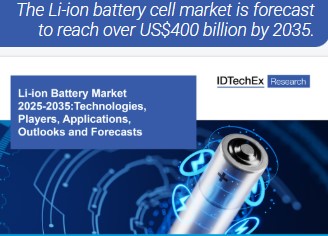
New IDTechEx reports on lithium suggest a NZ$98.8 billion (US$55.8 billion) market and a NZ$707.6 billion (US$400b) market for lithium-ion (li-ion) battery cells by 2035, partly due to increasing EV demand.
The reports include Direct Lithium Extraction 2025-2035: Technologies, Players, Markets and Forecasts and Li-ion Battery Market 2025-2035: Technologies, Players, Applications, Outlooks and Forecasts.
They explore methods for extracting the metal and the main applications driving its global demand.
Brine direct lithium extraction (DLE) has been named by IDTechEx as the fastest extraction method available, taking only a few hours to a few days.
Other options covered include brine evaporation, which takes between one and two years, and hard rock mining, which requires anywhere from a few weeks to months. Lithium extraction from sediment-hosted deposits is not yet a proven technology, though is also likely to take weeks to months – still no match for Brine DLE, says IDTechEx.
A new generation of DLE has been cultivated, where ponds are not a necessary part of the process, it says, adding some issues which can arise from heavy reliance on ponds include location and space limitations, weather uncertainty, and longer time periods associated with solar evaporation.
The new generation of DLE that allows water to be collected and recycled instead of evaporating into the atmosphere through solar evaporation has had commercial operations started by a few companies within the industry, such as International Battery Metals and Eramet, says IDTechEx.
“Forced evaporation and reverse osmosis are two common approaches to water recovery. With this generation of DLE, water can be recycled and reused to reduce the overall water consumption for lithium extraction.”
DLE technologies are less sensitive to impurities than pond-based extraction methods and more robust in their abilities to selectively extract lithium, says IDTechEx.
“This can be beneficial for brine deposits with higher impurity levels, such as where there is a high magnesium to lithium content, or in complex brine resources like geothermal brine, which stands at around 120 – 300 °C.”
IDTechEx covers the differences between new approaches and traditional evaporation in greater detail in its Direct Lithium Extraction report.
IDTechEx forecasts lithium-ion battery demand to grow at a compound annual growth rate (CAGR) of 15% from 2024-2035.
“Most of this demand will, in turn, come from demand for battery electric cars and vehicles.
“There have been some setbacks to the battery and EV industries, with demand growth slowing in Europe and the US.
Uncertainties remain regarding the role of policy and regulation, potential trade tariffs, and electrification timelines.
“However, the medium-long-term outlook for battery and EV demand remains positive, while demand for stationary battery systems continued its trajectory of strong growth through 2024.”
IDTechEx says new lithium extraction technologies offer a route to quickly increasing the supply of lithium at potentially competitive prices.

Join the conversation