
FCEVs boom or bust in the next 20 years?

While battery electric vehicles (BEVs) continue to grow in model availability, sales numbers, and available charging infrastructure, the same cannot be said about fuel cell electric vehicles (FCEVs).
So says IDTechEx technology analyst John Li, adding 2024 saw the second successive year of declining sales for FCEV passenger cars while fuel cell commercial vehicles also lagged behind BEVs despite their promising properties on paper, such as quicker refuelling, longer range, and heavier maximum payloads.
Rapid DC chargers continue to grow rapidly, meaning that BEVs can now charge hundreds of kilometres in range in reduced time, says Li.
IDTechEx also forecasts battery costs to continue to decrease while battery energy density increases, resulting in longer-range, lower cost vehicles.
In the report Fuel Cell Electric Vehicles 2025-2045: Markets, Technologies, Forecasts, IDTechEx assesses whether the window of opportunity for FCEVs for on-road vehicles has disappeared.
About 5000 fuel-cell passenger cars were sold globally in 2024, representing a minute portion of the global passenger vehicle market, says Li.
“In the same year, battery electric passenger car sales exceeded 11 million.”
From IDTechEx’s analysis, in California, the Toyota Mirai costs more than eight times as much per mile compared to a Tesla Model 3 and about three times as much as an internal combustion engine (ICE) car.
The year 2024 saw hydrogen prices at the pump soar as high as US$36/kg at some stations, a 120% increase from the average price in 2022.
Even with reduced prices and fuel credits, the uncertainty behind the availability and price of hydrogen fuel has been a deterrent for potential customers, says Li.
IDTechEx forecasts the FCEV market to increase more than 60 times between 2025 and 2045 – the largest demand in terms of volume coming from cars and heavy-duty trucks.
Honda returned after three years out of the FCEV market with the Honda CR-V Fuel Cell in July 2024, which also has plug-in electric-only driving capability.
Furthermore, Hyundai stated it will release its next generation Initium FCEV in H1 2025, and BMW stated that it would commercialise a fuel cell car based on the BMW iX5 Hydrogen by 2028, says IDTechEX, adding that new generations of fuel cells by Honda and Toyota have promised significant power density and durability increases at lower manufacturing costs.
IDTechEx forecasts growth of the fuel cell passenger car market, accounting for these factors, although this will be regionally limited to where hydrogen refuelling stations are available.
Growth will come with more widespread hydrogen refuelling at lower costs, preferably with more green hydrogen produced on-site, it says.
For commercial vehicles, greater size may reflect greater opportunity.
IDTechEx categorises them into buses, light commercial vehicles (vans), and medium and heavy trucks.
Similar to passenger cars, light commercial vehicles (LCVs) generally have their payload and range requirements well-served by BEVs, says Li.
“From a total cost of ownership (TCO) perspective, fuel cell LCVs generally do not offer any advantage in up-front or running costs.”
IDTechEx expects fuel cell LCVs will likely be restricted to regions with access to a reliable supply of low-cost hydrogen or areas where reliable grid connections are challenging.
The opportunity for fuel-cell buses lies in routes beyond the range of battery-electric buses.
IDTechEx sees the most opportunity for fuel cell buses in intercity coaches. Fuel cell demand from buses is also limited by the fact that many fuel cell buses have relatively small fuel cell stacks that are generally used as a range extender for a larger lithium-ion battery., it says.
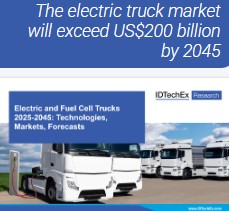
IDTechEx sees the most opportunity for heavy-duty fuel cell trucks.
Long-haul heavy-duty trucks have the greatest payload requirements and the harshest duty cycles, which BEVs generally do not meet, it says.
“The weight of the massive battery packs required can eat into the payload of a heavy-duty truck, although there are measures to combat this. For example, the EU allows zero-emission trucks to be four tonnes heavier than the standard weight limit for diesel trucks.”
Megawatt charging deployments are also increasing, allowing trucks to charge at powers great enough to yield hundreds of kilometres in range in about 30 minutes, it says.
“Furthermore, battery-electric trucks such as the Tesla Semi and the Windrose electric truck have ranges exceeding 600km.
“In this sense, FCEVs are chasing a moving target, just like other vehicle segments.”
However, IDTechEx expects fuel cell trucks to play a part in the longest, heaviest journeys, such that FCEVs will be about 20% of zero-emissions heavy-duty truck sales by 2045.


Join the conversation