
Farizon SV: Great EV, good van
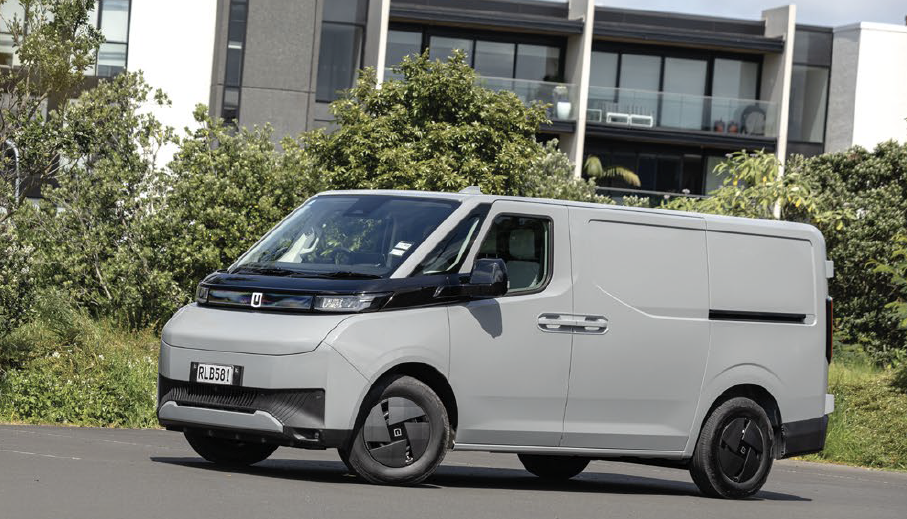
Let’s be honest — commercial vans don’t usually turn heads. Yet during a week with the Farizon SuperVan (or SV for short), people stared. Kids pointed. Someone even leaned out of a car window to film it. Not bad for a box on wheels.
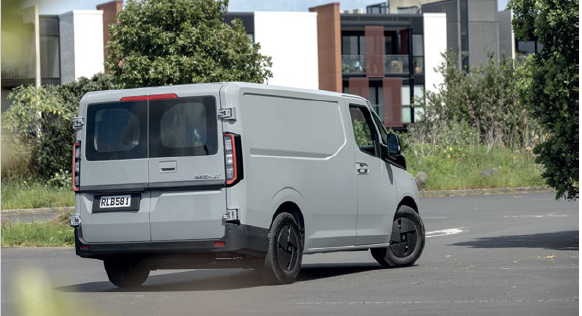
Farizon is part of the Geely Group, meaning this “newcomer” isn’t a start-up experiment. It shares DNA with the Radar ute and Geely’s EX5 SUV, and it feels like a product from a brand that knows how to build vehicles — not prototypes. The SuperVan arrives as a cargo-only model in three sizes: L1H1, L2H2, and L3H3. The one tested here, the L1H1, roughly matches a Ford Transit Custom or Toyota Hiace in footprint, but the lineup offers genuine flexibility.
Power comes from a 170 kW / 336 Nm motor driving the front wheels, paired with either a 67 kWh or 83 kWh LFP battery. DC charging tops out at 140 kW, excellent for a van, while AC is 11 kW. Farizon claims up to 370 km WLTP for the big-battery version; around 300 km loaded is more realistic – still class-leading.
BUILT TO WORK, WITH SOME CLEVER TRICKS
Under the short bonnet you’ll find only coolant and washer fluid. The charging port sits up front, handy for drive-in bays but less so for kerbside parking. Cameras encircle the van, creating one of the crispest 360° views we’ve seen on a commercial vehicle.
Round the side, things get trickier. There’s only one sliding door — on the passenger side. Many couriers prefer dual sliders for kerbside loading in both directions, and its absence will rule out some fleets. Farizon says the single-door setup improves structure because there’s no B-pillar, allowing a walk-through design for single-seat layouts. Clever packaging but not yet optimised for New Zealand use.
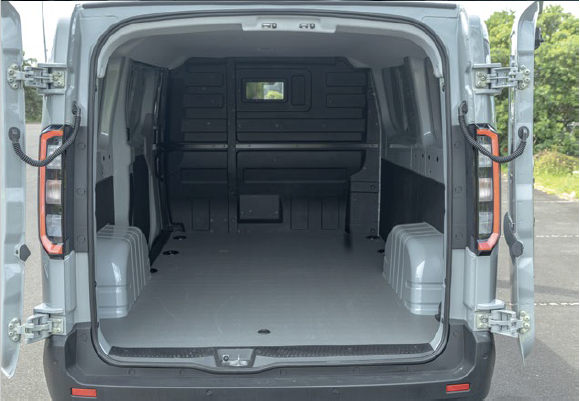
At the rear, wide-opening barn doors reveal a cavernous, low-floor cargo area only 550 mm off the ground, even with the battery beneath. The space is broad and well-shaped, with plenty of tie-downs and mounting points, though the doors don’t lock open — a basic oversight. Still, the SV redeems itself with a built-in load scale displaying current vehicle weight (ideal for avoiding overload fines) and a 3.3 kW vehicle-to-load outlet for powering tools or site gear. Payload sits around 1300 kg depending on spec, and it’ll tow two tonnes — competitive with diesels.
MISSING VAN ESSENTIALS
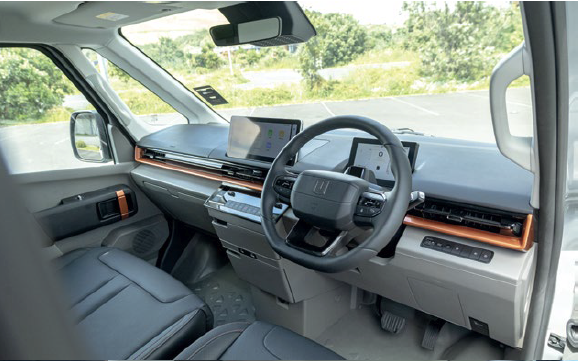
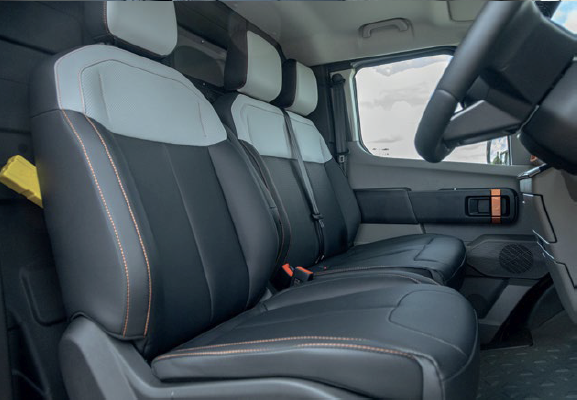
Climb aboard via the well-placed handles and you’ll find an interior that’s part utilitarian, part crossover. Hard plastics dominate — expected for durability — but a splash of colour brightens the dash, and the chunky wheel feels modern. The seats (heated and cooled in the Convenience Pack) are comfortable for long shifts, though the passenger bench is fixed and the driver’s seat lacks height adjustment.
A 12-inch touchscreen anchors the dash, running a simple OS with wired and wireless Android Auto and Apple CarPlay. Physical climate dials sit below — big and gloved-hand-friendly — with two cupholders and decent door storage. What’s missing is dash space for paperwork, scanners, or tools; compared with a Transit Custom or Hiace, it feels under-thought for daily working life.
Those touches matter to tradies who treat their vans as mobile offices — and it’s an area where Farizon still needs to learn Western van habits.
ON THE ROAD
If this is what the electric future of light commercials feels like, it’s a bright one. The SV drives with unexpected polish. Steering is quick and well-weighted (if a touch eager at
motorway speeds), and the ride stays composed even over rough city tarmac. The low-mounted battery brings impressive stability and cornering confidence, making it genuinely car-like.
It’s also the first true drive-by-wire vehicle to reach New Zealand — with no physical link between steering, brakes, and wheels. Instead, multiple redundant electrical systems handle control. You wouldn’t know it; the calibration is seamless. What the
van gains right now is unclear, but the potential packaging freedom is fascinating.
Performance is brisk. Unladen, it darts through traffic like a hot hatch in hi-vis, despite a 0–100 km/h time just north of ten seconds. Even loaded, it stays lively thanks to that 170 kW output and instant torque. There’s a faint whine on decel — something Geely’s engineers could easily tune out — but refinement otherwise is excellent.
Energy use averaged sub-20 kWh/100 km around town and about 26kWh/100 km on the highway, making the claimed range believable and the real-world usability strong.
SAFETY AND TECH
Despite lacking side or curtain airbags, the SV achieved a five-star Euro NCAP rating, a testament to solid structural engineering. The ADAS suite is extensive: adaptive cruise, blind-spot detection, rear cross-traffic alert, forward-collision warning, driver monitoring, lane-keeping assist, and more.
Quantity, however, doesn’t equal perfection. Lane-centring can be overly assertive, and adaptive cruise over-brakes into corners. These are software-tuning issues, likely fixable via over-the-air updates (supported), but they show that Chinese vans still need refinement to match Ford or Toyota calibration polish.
Other quirks: each time you indicate at speed, a message pops up — “vehicle speed too high, panoramic display unavailable.” You’ll tire of it quickly.
RANGE, REFINEMENT, AND THE NUMBERS
Empty, the SV easily delivers 300-plus km from the 83 kWh pack. Fully loaded, expect mid-200s — still solid for urban or regional delivery routes. 11 kW AC charging handles overnight duty, while 140 kW DC can take the battery from 20–80 per cent in about 35 minutes.
Pricing starts at $74,990 for the base 67 kWh, rising to $89,990 for the long-wheelbase high-roof L3H3. The tested L1H1 83 kWh sits at $79,990. Early buyers also score the Convenience Pack: heated/ventilated seats, heated wheel, power-fold mirrors, onboard scales, and those wide-opening rear doors. Warranty matches Geely Group norms — eight years/160,000 km for the battery, five years/150,000 km for the vehicle.
VERDICT: NEARLY THERE
Farizon’s first electric van for New Zealand impresses hugely. It’s efficient, powerful, and pleasant to drive. It charges faster than most rivals, and its design and onboard tech show clear promise. As an EV, the SV is arguably one of the most polished commercial vehicles yet from China.
But as a van, it’s not fully baked. The single sliding door, limited interior storage, and absence of small workday conveniences mark it as a first-generation effort. For couriers, tradies, and fleets used to Transit, Hiace, or eDeliver 9 practicality, those details matter.
If Farizon fixes them — perhaps in the inevitable facelift — it’ll have a genuine contender.
For now, the SuperVan is a superb first step and convincing proof that electric vans can be both capable and enjoyable. It just needs a touch more real-world refinement before it truly earns the “Super” title.
Join the conversation