
FORD DELIVERS MOST COMPLETE ELECTRIC VAN YET
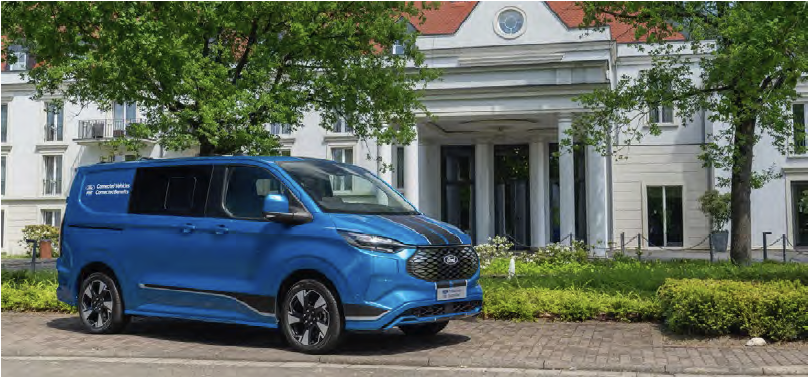
The Ford Transit Custom is more than just a vehicle; it’s a legendary nameplate that has defined the light commercial vehicle market for decades. Tradesmen, racers, musicians, bank robbers, and even the guy who fitted my EV charger— they have all driven Transits.
So, a new generation Transit, or in this case, the mid-size Transit Custom, is a big deal. As is the shift into electrification. The last generation eTransit was available as a plug-in hybrid that was, well, restricted in capability. The full-size eTransit, quite the opposite, is big, capable, drives well, and is not badly priced.
With the new generation Transit Custom, Ford is electrifying its most popular van in New Zealand and doing a proper job of it as well. Available in van and Tourneo forms, with a reasonable-sized battery and range, proper charging speeds, and more. There is also a PHEV option—better than the old one—but we are yet to know if that will make it here.
Transitioning such a storied nameplate into the electric age poses challenges—not only in maintaining the reliability and performance that the Transit brand is known for but also in winning over a loyal customer base that may be hesitant to embrace change.
We flew to Frankfurt, Germany, to check out the new model, and came away—overall—impressed. You can see more from that experience on our YouTube channel, but let’s discuss the van itself.

FIRST, A VAN
This is the first new Transit Custom (but let’s just say Transit from here on in) in a decade, and the first time the model has been developed in isolation. The last model was based off the larger model, but this time they’ve only had to worry about the one. And it seems they have spent as much time talking to people who operate vans as they did putting pen to paper, or the modern digital equivalent.
Thus, the key van details are all there. Lots of storage, a flat cab floor, wide-opening rear side doors (now available as electric), and more. Then there are other details missing in competitor vans that Ford developed from client feedback.
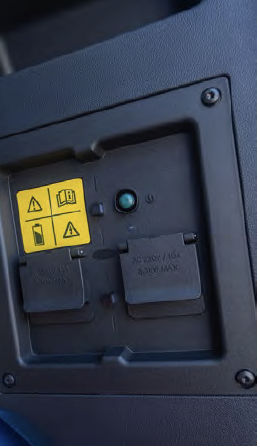
Users also want power. No, not that sort of power—electrical power for their tools and equipment, or that laptop they are using in the cab. So they installed ProPower, a system that makes 2.3kW available through plugs at the rear of the load box or in the cabin, with discharge controlled through the infotainment system. It is Vehicle-to-Load on steroids.
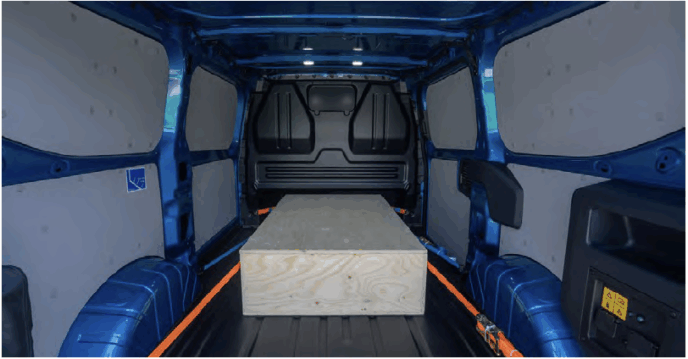
The cargo space itself is well-engineered to meet the needs of businesses that rely on the Transit’s versatility.
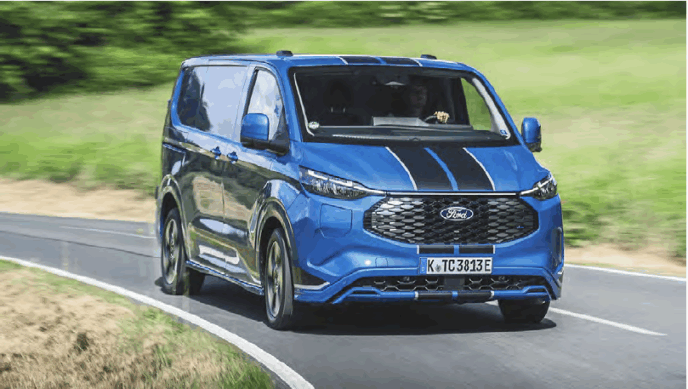
Despite the clean sheet, it reassuringly still looks like a Transit, with Ford doing an astounding job of rounding the corners off what is still essentially a box on wheels. The short nose looks sculpted and aerodynamic, with a closed-in mesh look to the grilles. The side windows, or metal panels in the case of the cargo versions, are angled up at the rear for a fast look. The higher-spec models feature skirts and wings, making this look like a tradesman in trainers.
The eTransit Custom offers a maximum cargo volume of up to 6 cubic meters in the standard roof version, while the high-roof variant provides even more space, stretching to approximately 7.6 cubic meters. This ample volume is complemented by a maximum load length of around 3,450 mm, making it capable of accommodating long items such as pipes, ladders, or sheets of plywood with ease.
The width between the wheel arches is another crucial dimension, and the eTransit Custom maintains a generous 1390 mm, allowing for the easy loading of wide items. Additionally, the overall height of the cargo area is just over 1400 mm in the standard roof version, which ensures that most bulky items can be loaded without issue.
Ford has also ensured that the electric powertrain does not compromise the cargo area’s functionality. The battery pack is integrated into the chassis, preserving the flat load floor that Transit users have come to expect.
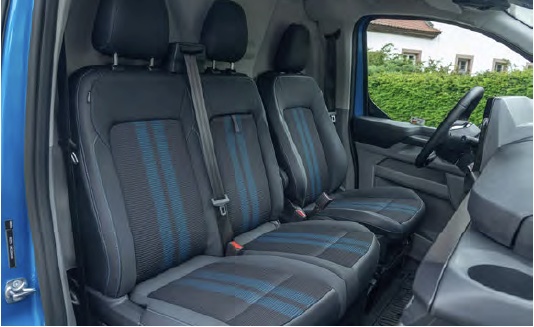
Then, of course, there is a Tourneo version, with two rows of three seats, a glass roof, and all the trimmings.
CAB COMFORT
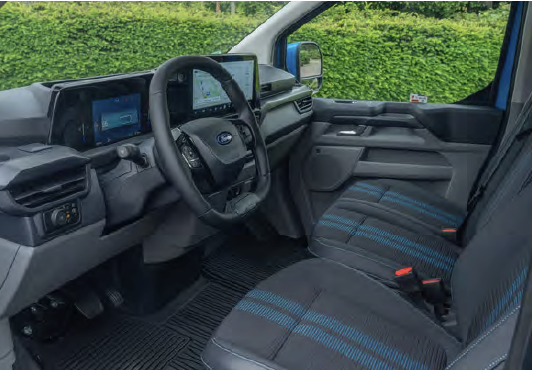
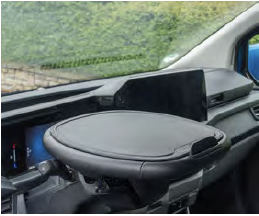
Upon entering the cab, one of the first things you notice is the completely flat floor that enhances flexibility and space. The dashboard is set far back with creative storage options, including the relocation of the passenger airbag to the ceiling, making way for a larger glove box.
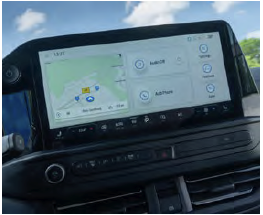
The eTransit features a large 13+ inch infotainment screen for navigation and multimedia, supported by Apple CarPlay and Android Auto, along with a similar screen for the driver. It is a relatively clean system, though not necessarily the most logical. It does host the software for the aforementioned ProPower system and has preparation for adding control for other accessories—think lightbars, spotlights, trailer equipment—into the system to reduce additional switchgear. The system features a standard 5G modem for over-the-air updates and connectivity to the free Ford app. Unconfirmed yet for New Zealand is its integration with Ford’s own telematics systems. The Ford Pro Telematics system provides remote insights into vehicle charging status, usage patterns, and enables better route planning.
You also get a comprehensive safety assist and feature list. Ford’s safety list looks more like that of a premium passenger car than a load hauler.
Similarly, Ford has made available a range of connection points—including a cacophony of screws—for interior accessories to be added.
The seats are designed for both comfort and practicality, with optimized storage for documents and other necessities. The eTransit Custom sports a chic Bang & Olufsen sound system, adding a touch of luxury.
PLUGGING IN
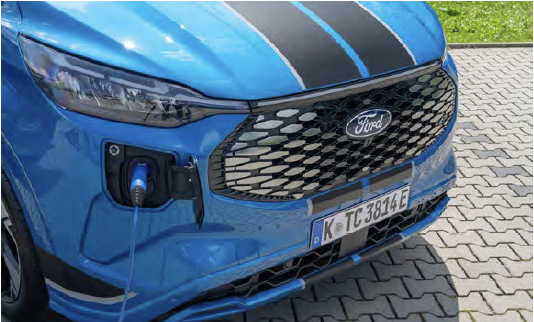
The Ford eTransit Custom comes equipped with a unique charging point located on the front corner of the vehicle. It supports both 125 kW DC fast charging and 11 kW AC charging capabilities. And yes, the handy release button there is something we have been huge fans of on our long-term Mach-E GT.
With a 64kWh usable battery out of a 70kWh total, the range hovers around 335km under WLTP, translating roughly to 250km in real-world driving. We will admit it is not ideal, but it is suitable for an average working day, with fast charging options making mid-day top-ups feasible during breaks.
We asked the Ford team why they didn’t go for a bigger battery, or for that matter a more durable LFP formulation—the current unit is NCM—and they indicated that they wanted a bigger battery, but the need to balance payload to range meant this was the best combination for now. We get it.
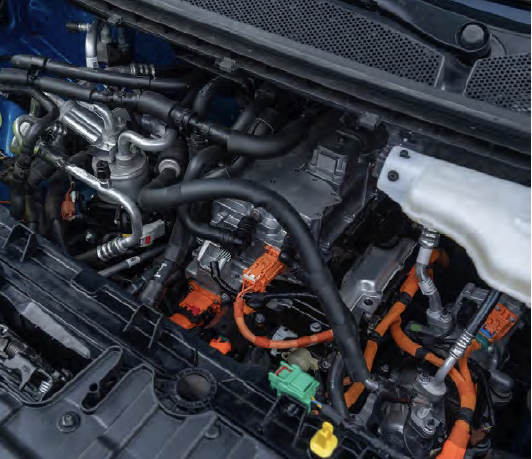
While the diesel versions of the Transit are front or all-wheel drive, the electric model is rear-wheel drive, using the same motor-axle package as the larger Transit. The powertrain is pegged at 160kW with 450Nm of torque for NZ models, though there are lower output options and even a 210kW MSRT sports version on offer overseas. Performance is solid, though the 130km/h limited top speed was amusingly annoying on the autobahn. Power delivery is typically EV smooth, with an optional one-pedal driving mode for a more efficient drive.
The transmission shifter is in the form of a steering column shifter.
While containing a half-tonne load, the car-like handling remains composed, with drive modes offering adaptability across different terrains and conditions, including Normal, Eco, Sport, Slippery, and Tow Haul. Yes, it will tow, 2300kg.
EV PREMIUM
When it comes to pricing, the Ford eTransit Custom commands a premium, starting at $92,490. In contrast, the non-electric Transit Custom Van offers a more budget-friendly alternative. The diesel model starts at $66,990, while going EV will set you back $92,490 for the short wheelbase and $93,990 for the long.
Similarly, the Tourneo, at $99,990, is $26,000 more than a diesel equivalent.
Of course, that is only half the picture, and Ford believes operating costs for the e models will be 40% lower than that of a diesel.
FINAL THOUGHTS
Overall, the Ford eTransit Custom excels in combining the functionality and work-ready nature of a Transit with the perks of electrification. Its range and charging capabilities are adequate for urban delivery routes, while its towing capacity and payload make it a versatile work vehicle.
Range may still be an issue for some, and our hope is that as technology improves, Ford will add a larger battery option, truly perfecting this still excellent vehicle.
Join the conversation