
Study results: Modern EV batteries built to last beyond vehicle service life
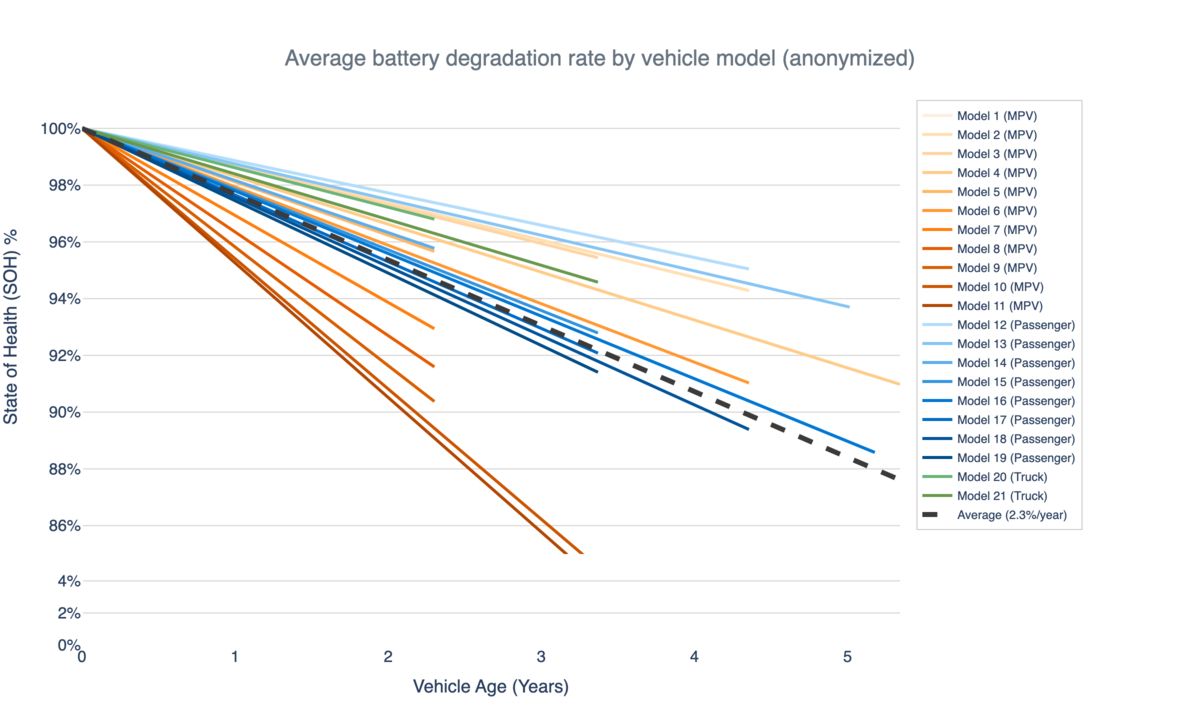
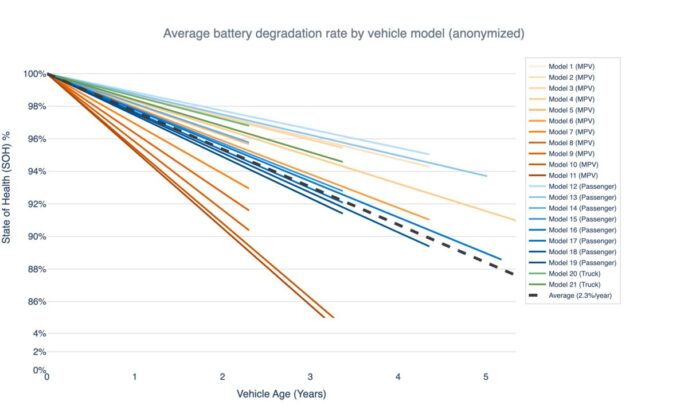
Modern electric vehicle batteries are built to last beyond a typical vehicle’s service life, with an average annual degradation rate of 2.3%, according to a comprehensive new study by global telematics company Geotab.
The analysis of over 22,700 electric vehicles covering 21 different models confirms that EV batteries remain robust, though certain operating conditions can significantly impact their longevity.
Charlotte Argue, Senior Manager of Sustainable Mobility at Geotab, says the study used real-world telematics data collected directly from vehicles to understand how quickly EV batteries degrade under various conditions.
“While some battery degradation is inevitable, fleet managers can make some adjustments to get the most life out of their batteries and their investment,” Argue says in the report.
The 2025 study shows the average battery is projected to retain 81.6% of its original capacity after eight years, returning to the same degradation rate found in Geotab’s initial 2020 analysis. A 2023 study had shown improvement to just 1.8% annual degradation, likely due to advancements in battery technology and thermal management systems.
Fast charging emerges as biggest threat
High-power DC fast charging above 100kW emerged as the single largest stressor on battery health, leading to degradation rates up to twice that of low-power charging.
Vehicles that used DC fast charging for more than 12% of their charging sessions experienced 2.5% annual degradation compared to 1.5% for those using it less frequently.
The impact becomes more pronounced when considering charging power levels. Vehicles frequently using high-power charging above 100kW showed 3.0% annual degradation, compared to 1.5% for those predominantly using lower-power charging.
“For the best long-term battery health, the best practice is to use the lowest power level that still meets your operational schedule,” the study notes.
This finding has particular relevance for New Zealand as the country’s charging network continues to expand, with the Government targeting 10,000 public chargers by 2030.
Climate and usage patterns matter
Hot climates impose a measurable penalty on battery life, with vehicles operating in conditions above 25°C for more than 35% of days degrading 0.4% faster annually than those in milder climates.
The study also examined state of charge management, finding that strict adherence to the commonly recommended 20–80% charging range is unnecessary for typical daily use. Degradation only accelerates when vehicles spend more than 80% of their total time at extreme charge levels.
Vehicle utilisation showed a clear trade-off between productivity and battery life. High-use vehicles completing the equivalent of a full battery cycle every one to two days experienced 2.3% annual degradation, compared to 1.5% for low-use vehicles cycling every seven days or more.
“The acceleration in degradation from high utilisation is a manageable cost when weighed against the significant revenue and productivity gains from maximising vehicle deployment,” the study concludes.
Recommendations for EV owners
The research provides several practical recommendations for preserving battery health. These include using AC charging or lower-power DC charging where possible, avoiding prolonged exposure to extreme temperatures, and not worrying about strict state of charge limits for daily use.
For fleet operators, the study suggests prioritising vehicle utilisation while being strategic about charging power selection.
The findings have implications for New Zealand’s growing EV market, where battery electric vehicle registrations totalled 1823 in the first three months of 2025, up from 1223 in the same period last year, according to Motor Industry Association data.
As New Zealand’s charging infrastructure develops and more powerful charging options become available, understanding these degradation factors becomes increasingly important for both individual EV owners and fleet operators considering the transition to electric vehicles.
The full Geotab study is available at geotab.com/blog/ev-battery-health.
Source: Geotab study “How long do electric car batteries last? The updated guide to real-world EV battery health” – https://www.geotab.com/blog/ev-battery-health/

Join the conversation