
Lexus RZ first drive – Well done yoke
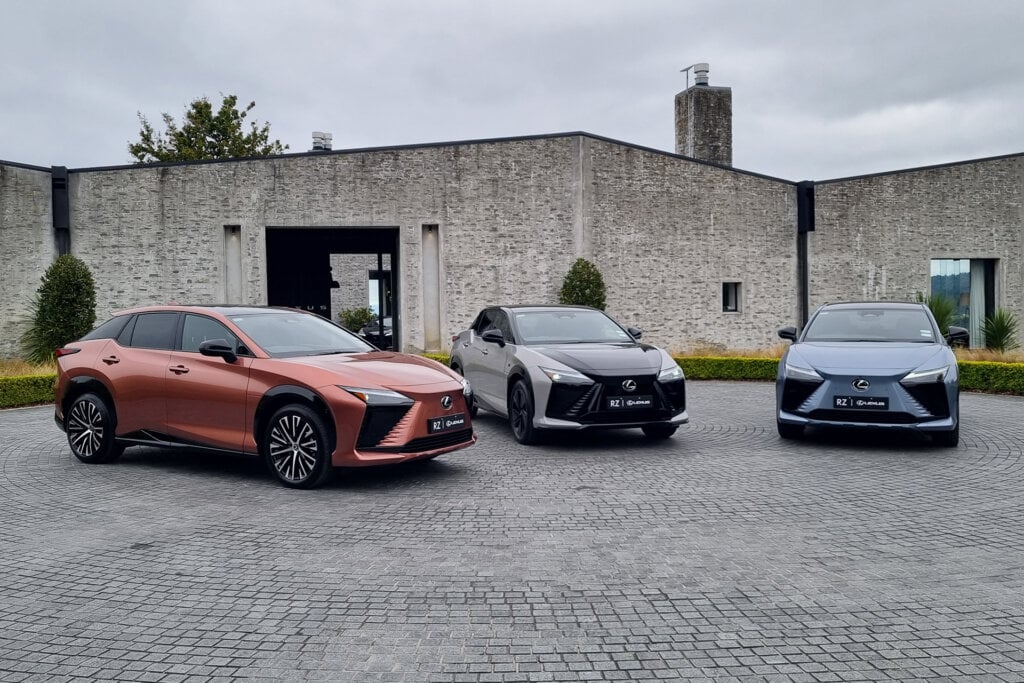
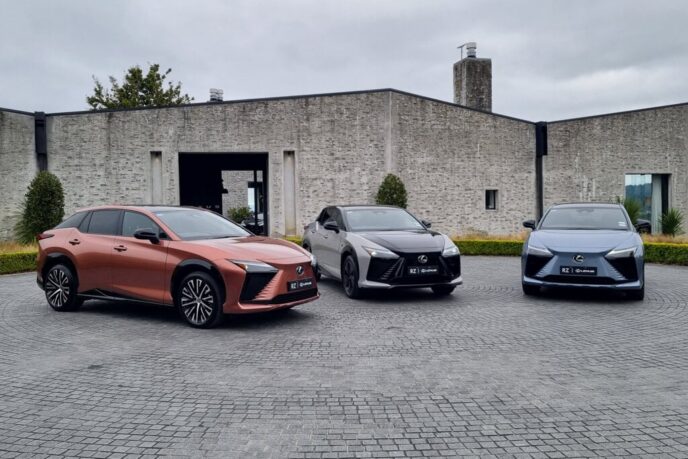
Lexus has finally given its RZ electric SUV the update it needed, arriving in New Zealand sharper, more efficient, and crucially, considerably cheaper than the car it replaces.
The Japanese luxury brand has built its case in the premium segment largely on hybrid tech, climbing to second place behind BMW and pushing past Mercedes and Audi along the way. More than 90 per cent of its sales are electrified, but the pure battery share remains modest. With the UX gone, the RZ has been carrying that load alone, and the previous version wasn’t really doing it any favours.
The reset is significant. The old RZ sat at around $150,000 and felt under-cooked for the money. The updated car starts at $109,900 for the 500e Dynamic and tops out at $134,900 for the 550e F Sport, slotting between the NX and RX in the range and undercutting the RX 350h.
Lexus NZ VP Andrew Davis says the brand has reviewed pricing across the entire line-up to figure out where the new RZ needed to land.
Was the original simply too expensive, we asked? “Well, when you look at this to that, you’d say yes…we priced it traditionally. It was new technology and we looked at it in isolation. Now, we look at it across the whole segment.”
“The challenge we’ve had is we want to offer multi-pathway (in terms of powertrain options), so it’s got to be accessible to customers. But we’ve had to review all of our pricing to make that work. The market just doesn’t seem to be in a position to accept high-priced BEVs.”
That’s a notable admission, and one that reflects where the local EV market sits right now. Buyers are out there, but they’re not paying premium-luxury money for the badge alone.
What’s changed under the skin
The 500e Dynamic gets a meaningful power lift, from 230kW to 280kW, paired with a slight bump in battery capacity to 74kWh. The bigger story is the revised thermal management system, which improves efficiency and, critically for New Zealand conditions, delivers more consistent range in cooler temperatures. Range is now 460km on the WLTP cycle, and 0-100 takes 4.6 seconds.
DC charging stays at 150kW peak, with a 10-80 per cent stop quoted at 28 minutes 10 seconds. The improved thermals should also mean more repeatable charge times in real-world use, particularly when paired with the new battery preconditioning function, something the previous RZ sorely lacked. AC charging has doubled to 22kW, which is genuinely useful for owners with three-phase supply at home or work.
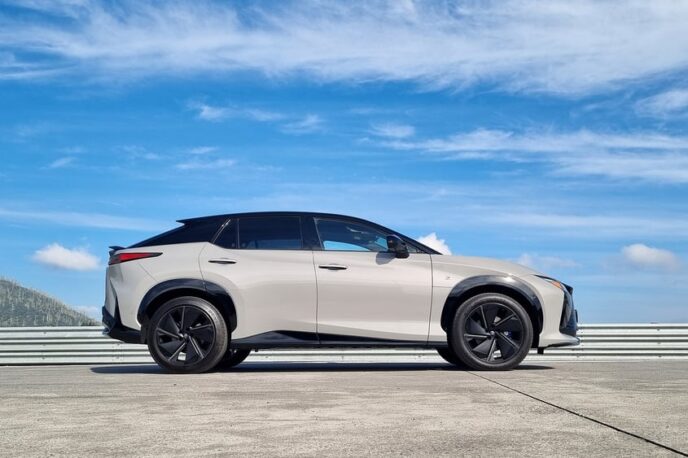
Above that sits the 550e F Sport with 300kW, a slightly larger battery and 437km of range. It carries a two-tone exterior, an interactive manual drive mode with eight simulated ratios, and gets the new steer-by-wire system as standard. That tech can be optioned onto the 500e for $10,000.
Steer by wire, properly this time
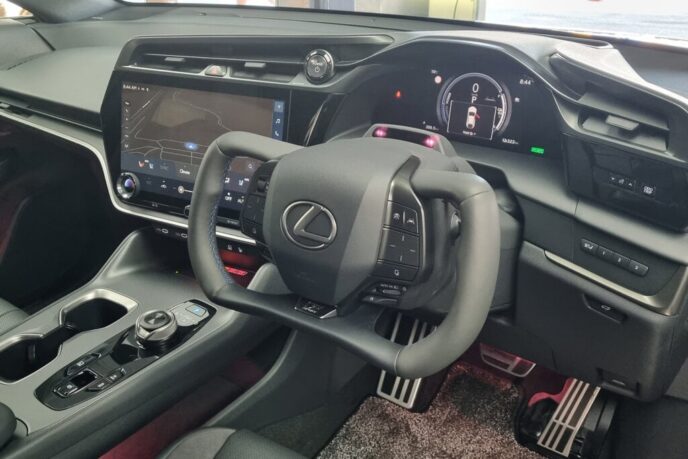
There’s no physical steering column in the 550e. Digital signals from the yoke are interpreted by the rack, which then turns the wheels. The pay-off is dramatically reduced effort, with a full-lock U-turn requiring only the equivalent of half a turn of a traditional wheel.
The system varies steering response with vehicle speed, so both car-park manoeuvres and motorway cruising feel appropriately weighted. It also filters out vibration and road shock, and Lexus says built-in redundancy keeps things working even if a fault develops.
We put the F Sport through a slalom on track, and the feedback is genuine. It takes very little time to recalibrate to the reduced input needed. Weight builds progressively in tighter corners, and there’s surprisingly decent feel given there’s no mechanical connection to the wheels.
Doing the same thing in the conventionally-steered RZ requires noticeably more arm work, the driver winding away at the rim. The yoke car is also more precise, the programming clearly well sorted. The yoke itself has miniaturised indicator and wiper stalks, with multifunction pads sitting where your thumbs naturally rest. The whole setup is built around keeping hands on the wheel.
Pretending to be petrol
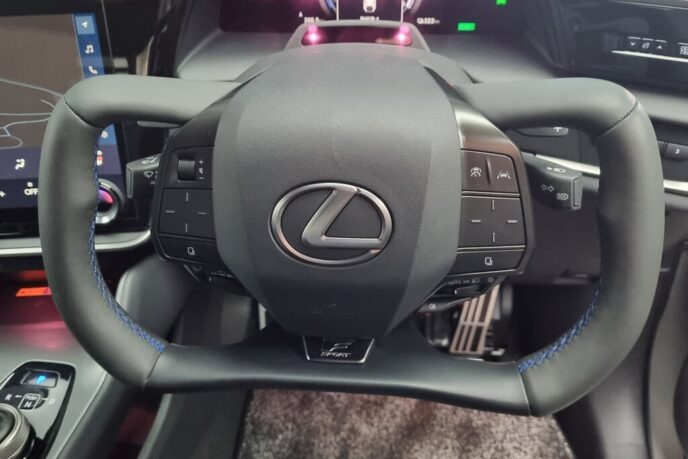
The F Sport’s interactive manual drive mode adds simulated gearchanges, and Lexus has gone to genuine effort here. When activated, the paddles switch from regen control to gear selection, and the system delivers shift shock on upshifts, throttle blips on downshifts, and a rev limiter if you ignore the redline. Floor it in sixth and the car labours convincingly. There’s a generated soundtrack to go with it.
It’s a proper effort, and it does add some texture to the drive. Whether owners will actually use it beyond the first few weeks is another question. EV buyers tend to come round to the smooth, instant nature of electric drive fairly quickly, and reaching for fake gears starts to feel like work.
The verdict for EV buyers
For people considering the move out of a luxury combustion car, the updated RZ is a much more compelling proposition than its predecessor. The added power is welcome, the efficiency gains are real, and the price reset puts it on the same shopping list as the RX 350h, which changes the conversation entirely.
Existing RZ owners may feel a touch sore about the repricing, but the broader signal here is positive. Lexus has accepted that a premium EV needs to be priced as a credible alternative to its hybrid siblings, not as an isolated technology showcase. That’s the kind of recalibration the segment needs more of.
Join the conversation