
Supersizing fuel-cell technology for heavy trucks
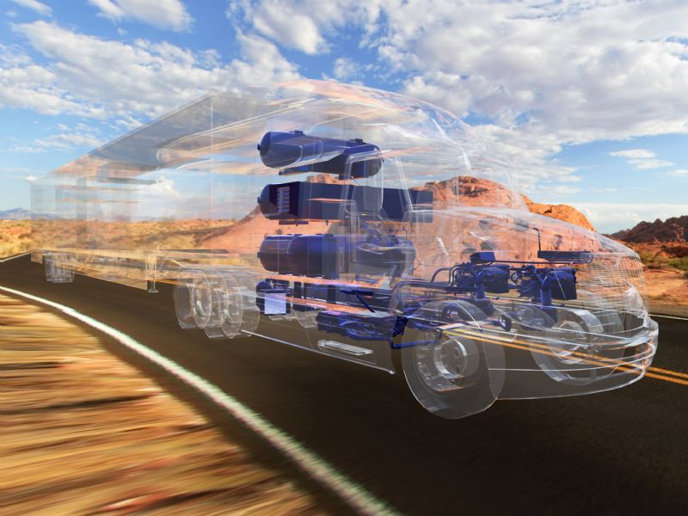
Toyota is adapting its advanced hydrogen fuel-cell technology for use in heavy-duty trucks.
The company has scaled-up its proprietary fuel-cell technology from the Mirai passenger car to develop a power source for a 36-tonne semi-trailer.
Known as Project Portal, Toyota will use the hydrogen-fuelled concept truck to conduct a feasibility study. It will haul cargo between the ports of Los Angeles and nearby Long Beach without producing any tailpipe emissions.
The Project Portal truck generates more than 500kW of power and almost 1800Nm of torque from two Mirai fuel-cell stacks and a 12kWh battery.
The concept’s gross combined weight capacity is more than 36.2 tonnes and its estimated driving range is 320km per fill, under normal operation.
Toyota’s fuel-cell technology offers zero tailpipe emissions with the convenience of today’s conventional vehicles, yet it runs on hydrogen instead of petrol or diesel.
The Mirai is on sale in Japan, the United States and Europe in areas supported by refuelling infrastructure. Testing will start in China from October this year to determine the feasibility of selling Mirai in that market.
Toyota Motor North America executive vice president Bob Carter says Toyota believes hydrogen fuel-cell technology has tremendous potential, which also includes fuel-cell buses in Japan.
“Toyota is a leader in expanding the use of versatile and scalable zero-emission technology,” says Carter. “With Project Portal, we’re proud to help explore the societal benefits of a real zero-emission heavy-duty truck platform.”
Port officials and representatives from the California air resources board (CARB) and the California energy commission (CEC) are applauding Toyota’s initiative.
CARB chairperson Mary D. Nichols says Toyota is taking a leap into the future of technology, just as it did with the Prius petrol-electric car and the Mirai fuel-cell sedan.
“By bringing this heavy-duty, zero-emission hydrogen fuel-cell proof-of-concept truck to the port, Toyota has planted a flag that we hope many others will follow,” says Nichols.


Join the conversation