
Solar powered micro-grid research at port
Solar power will play an important part in Ports of Auckland’s aim to become a leading sustainable port globally and emissions-free by 2040.
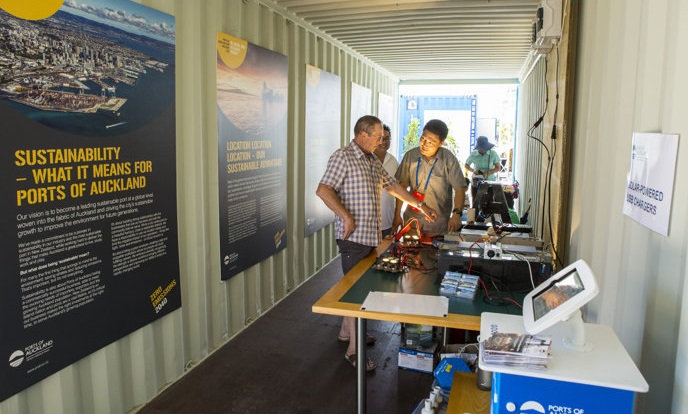
To this end the port (POAL) has a pilot programme to establish a DC micro-grid for buildings at the company’s sea port and inland freight hubs.
A container on Auckland’s waterfront houses the first test installation.
The DC micro-grid research project displayed at the SeePort festival attracted considerable public interest, the port says.
The container has been relocated next to the port’s tug berth for further research. It will go on public display again later this year.
The pilot is in conjunction with electronics engineer associate professor Nihal Kularatna from the University of Waikato, who is developing technology to make faster, more compact and economical energy products.
This research is focussing on buildings, homes and offices, but any application to boats and electric vehicles hasn’t been ruled out.
Homes and offices have traditionally been wired for AC (alternating current).
Solar panels produce DC (direct current) energy, needing conversion to AC before use.
Up to 10% of energy can be lost in the conversion process, which costs money and reduces the efficiency of solar, the port says.
More and more products are being built to work on DC electricity, avoiding costly energy loss.
It says the project could enable stand-alone office units not reliant on wiring up to other sites, saving costs.
Kularatna has been working on an international committee studying the advantages of DC in buildings, with workshops on energy storage.
POAL sees the value of a DC micro-grid, starting with solar panel installation and using DC for lighting, then introducing it into air-conditioning and white goods, and finally computer and information systems.
The port has also installed a solar panel array on its rail office roof to evaluate solar panel performance in the port environment. It’s expected to lead to the implementation of much larger projects.
The office roof system is on-grid, so excess electricity can used elsewhere in the port.
The 12 panels have a 3kW peak design, expected to generate more than 4300kWh annually.
The rail office uses about 3000kWh/year, mainly during the day.
Meters and a web logger will monitor generation and electricity use, the data helping future solar projects.
PowerTech NZ supplied and fitted the solar panels and Phillips provided interior LED strip lighting.

Join the conversation