
Electric tourists hit the road

This story first appeared in the February issue of EVtalk – CLICK HERE to download the magazine FREE
Two French students have finally set off on their seven-month “ecolectric” tour of New Zealand, thanks inpart to EVtalk.
We publicised the 23-year-olds’ plans to check out EVs and sustainability here in our October magazine.
That caught the attention of tourism rental company Jucy, which plans to introduce a new category of electric vehicle to its fleet to meet growing demand from environmentally minded tourists.
It’s resulted in Paris-based students Heloise de Bokay and Solene Trinquet, getting the keys to an all-electric Jucy campervan – a prototype Nissan eNV200 – during most of their stay.
The van has a range of about 100km and can use different types of charging plugs but the pair aim to remain within about a 70km range where possible.
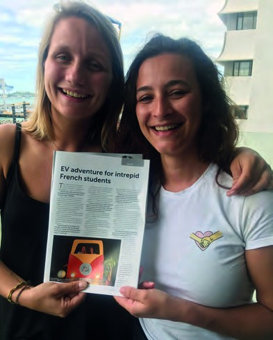
“Electric vehicles are the future of the Jucy campervan fleet and this trial is the ideal platform to test our product offering for customers,” Jucy chief executive Tim Alpe says.
The students arrived in Auckland on January 12 and went about organising their tour, honing up on New Zealand’s road rules and setting up destinations, communications, school visits and more before hitting the road in the first week of February.
They’ll be joining the Leading the Charge EV tour of New Zealand for about four days and have set up a partnership with ChargeNet for the duration of their stay.
The two good friends intend to start the South Island leg of their journey in March and hope to finish off parts of the North Island by the end of June before returning home.
Trinquet and de Bokay will not only visit picturesque places such as Zealandia eco-sanctuary in Wellington but will also check out sustainable living programmes, permaculture developments, car-sharing schemes, learn about Maori culture, investigate plastic bag recycling, and establish French and New Zealand school exchanges.
They’ve already created a partnership with Kapiti School with an exchange of letters between French and New Zealand children. They are keen to meet other schools as well.
Both are travelling during a gap year in their university studies.
Environmental law student de Bokay and communications student Trinquet say the trip is not part of their studies but a personal project they’ve created on their own over two years. They plan a documentary once their journey is completed.
They have four key questions for many people they meet, such as their opinion on the future of EVs in New Zealand. The idea is to have an overview of the different viewpoints at the end of the journey.
“The goal is not to make money (they worked for two years and have fundraised and gained sponsorship to cover their costs) but to make people more aware,” Trinquet says.
They believe electric tourism is the future for New Zealand.
“Petrol is very expensive here,” de Bokay says. “In an EV it’s quiet so you can travel to wildlife places and hear the sounds around you.”
Zero emissions travel is good for the environment too, they say.
Their roles are very complementary – de Bokay has the knowledge of environmental subjects and Trinquet knows how to present those subjects in an attractive way – and they are very good friends, essential when spending so much time travelling together, especially in a campervan.
Both admit it will be hard to return to Paris, probably to find work, and they have no plans as yet for any further travel.
People have been very supportive of their tour.
“Thanks to EVtalk, Jucy got in touch with us about their electric campervan,” de Bokay says. “However, we were thinking of a loan to buy an electric car to travel around in and then sell later.
“We’re very grateful to the EV community here and others because they’ve been so welcoming and helped out.”
Says Trinquet: “It feels like home here.”
Both admit they were quite nervous about making the trip to the other side of the world and driving an EV campervan, particularly because nobody has done that before.
While de Bokay has access to a family Citroen C-Zero EV at home, Trinquet isn’t so familiar with them, although a Paris car sharing scheme has EVs available.
“But we’re now relaxed,” de Bokay says.
They’ve seen new charging stations going in even since arriving here and are quickly learning where they can plug in.
“New Zealand is the perfect country for EVs,” Trinquet says.
“In France, electricity comes mainly from nuclear energy. Here it’s nearly all from renewable sources.”
Contact the students on news.land@hotmail.com if you can help, for school visits and more information.
Join the conversation