
Breakthrough means AVs no longer blinded by fog
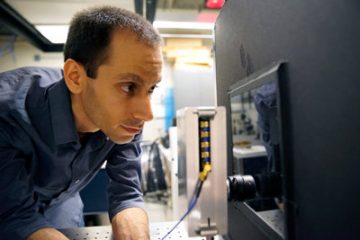
Guy Satat. Photo: Melanie Gonick/MIT
Driving in fog has always been tricky for autonomous vehicles (AVs).
Now Massachusetts Institute of Technology (MIT) researchers have developed a system that can produce images of objects shrouded by fog so thick that human vision can’t penetrate it. The system can also gauge the object’s distance.
Inability to handle misty driving conditions has been one of the chief obstacles to AV development in navigation systems that use visible light, preferable to radar-based systems for their high resolution and ability to read road signs and track lane markers.
So, MIT says its system could be a crucial step toward self-driving cars.
Researchers tested the system using a small tank of water with the vibrating motor from a humidifier immersed. In fog so dense that human vision could penetrate only 3cm, the system was able to resolve images of objects and gauge their depth at a range of 57cm.
The fog produced for the study is far denser than any that a human driver would have to contend with.
“We’re dealing with realistic fog, which is dense, dynamic, and heterogeneous,” MIT research leader Guy Satat says.
“It is constantly moving and changing, with patches of denser or less-dense fog. Other methods are not designed to cope with such realistic scenarios.”
Satat and his colleagues describe their system in a paper they’ll present at the International Conference on Computational Photography in May.
The new system uses a time-of-flight camera, which fires ultrashort bursts of laser light into a scene and measures the time it takes their reflections to return.
Light scatters in fog, often reflected by the air-borne water particles rather than objects an AV needs to “see” and avoid.
MIT researchers were able to show that, no matter how thick the fog, the arrival times of the reflected light adhere to a statistical pattern known as a gamma distribution.
Crucially, the system calculates a different gamma distribution for each of the 1024 pixels in the sensor. That’s why it’s able to handle the variations in fog density that foiled earlier systems – it can deal with circumstances in which each pixel sees a different type of fog.
Visit HERE
for more information.
Join the conversation