
French e-tourists say ‘au revoir’
This story first appeared in the July issue of EVtalk – CLICK HERE to download the magazine FREE
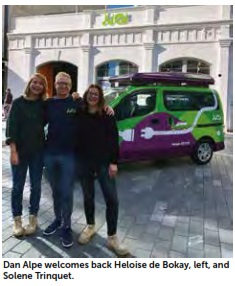 A five-month tour in a prototype Jucy electric campervan has ended for two French students – but their journey still has a way to go.
Paris-based Heloise de Bokay and Solene Trinquet provided valuable information for Jucy chief operating officer Dan Alpe during a debrief in Auckland on returning the modified Nissan eNV200 van.
The pair plan to spend until early August covering North Island sections they missed, like the East Coast, before returning to France.
Trinquet expects she’ll be working on a documentary of their e-tour during the next year, which they hope to have featured on television, in cinemas, on the internet and at events and university gatherings.
De Bokay will return to university studying environmental law, but both want to come back.
Their presence remains in the meantime.
The pair’s Jucy e-campervan will feature at EVtalk’s EVworld NZ stand at the ASB Showgrounds on August 10 and 11.
Videos of the students’ tour are expected to be included.
The French pair completed 13,000km, travelling most of the country.
With the 24kWh van’s range of about 100km, they planned their trip carefully to ensure they didn’t run out of charge, plugging in 218 times.
“The key thing was to be organised.
We managed with the range we had.
”
They stopped often, and usually found residents waiting to welcome them at charging sites.
ChargeNet NZ provided charging free while Jucy donated use of the e-campervan.
Alpe says the trial has proved valuable.
He’s considering introducing up to 10 electric campervans this summer, but says they will have the 40kWh battery for longer range.
By using the students’ itinerary, Alpe is planning a more packaged style tour for overseas visitors, also catering for those concerned about their environmental footprint.
A packaged tour would probably mean visiting key sections of the country and staying at camping grounds where charging and other facilities would be available.
The students say it’s impossible to see the whole country in a fortnight, as some tourists try to do.
“Many people tell us they’re always driving,” de Bokay says.
“Do less but do it better,” she suggests.
Alpe is also considering alternative power sources, such as solar, as the students say they struggled to keep laptops charged to inform followers of their travels.
Lack of wi-fi was a bigger problem in many areas to send their reports, photos and videos.
Alpe says many people were still able to track the students and greet them because “the New Zealand EV community is small and tight”.
He says the pair’s adventures were well advertised because of publicity given through EVtalk, Jucy’s own communications, some television coverage and social media such as Facebook.
Alpe says Jucy plans to get its New Zealand operations to a point where it can then look to doing more in Australia.
Trinquet says their trip has been an education for many people.
“We’ve learned lots too.
”
She says some “real work” has to be done educating campers, perhaps through information centres like i-Sites.
Both students say New Zealand is a beautiful country with people to match.
They say everyone they met was friendly and helpful, whereas in Paris people don’t speak to strangers.
The two also used the trip to check out sustainable practises here and to establish liaisons between some New Zealand and French schools.
Alpe recently spoke to a University of Auckland class about sustainable tourism and expects that will be part of Jucy’s philosophy.
“The bigger picture is around tourism’s impact on our environment.
”
The students say many tourists visit the same spot and take the same photos, whereas they often visited a similar area nearby free from crowds.
“It’s about immersion too,” de Bokay says.
“Go to the local shops, not just the supermarket.
”
Trinquet and de Bokay say some of their favourite places include Milford Sound, the Heaphy Track, Lake Benmore, Farewell Spit, and beaches like Piha.
Other highlights were meeting Californian EVangelist Chelsea Sexton on the Better NZ Trust’s Leading the Charge tour, attending events like the opening of EV City in Christchurch, paragliding and other adventures.
They had a tight budget of 50,000 euros (NZ$84,326), raising 10,000 euros of that in France through crowdfunding and friends.
“We spent about 4000 euros, before even leaving, on photographic and video equipment and essentials,” Trinquet says.
“We couldn’t have done it without the generous donations and help we’ve received,” de Bokay adds.
They intend raising more to complete their documentary.
“We don’t know the cost yet.
”
Alpe says the whole project has been “an amazing experience to do”.

Join the conversation