
Could eNV200 be next as new Leaf heads for New Zealand?
This story first appeared in the March issue of Evtalk – CLICK HERE to download the magazine FREE
The head of Nissan in Australia and New Zealand has suggested the e-NV200 van could follow the Leaf as the second electric vehicle to arrive in local dealerships.
Evtalk is in Hong Kong to try out the new Leaf and attend the Nissan Futures event – a discussion of how mobility will look in the future. Of course, electrified vehicles will play a part in that.
Nissan plans to release eight electric models by 2022, though it is unclear which of those we will see in this corner of the world.
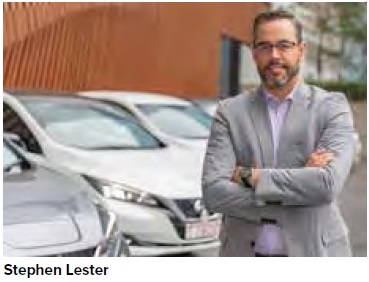
Nissan Australia and New Zealand managing director and chief executive Stephen Lester sat down for a chat with EVtalk and told us the electric van is very much on the radar for both markets.
“For both Australia and New Zealand, we’d love to see a broader LCV range, and the e-NV200 I think would make perfect sense in the metropolitan mar- kets, and even to a degree in some of the more rural markets as well.”
Lester says he is requesting access to the model, which last year received a bump in battery size from 24kWh to 40kWh.
“Unfortunately, I don’t always get what I ask for. We have got to build a business case for it.”
Lester notes the move globally is to restrict access to city centres for fossil fuelled vehicles, which creates a strong need for such vehicles.
“The e-NV200 offers a perfect solution for a variety of local delivery for small business.”
With the Leaf, Lester expects a pric- ing announcement for New Zealand to come soon. He would not be drawn on why there was a delay other than inter- nal discussions on the pricing continue.
He notes New Zealand’s open market creates challenges for the brand – there are nearly 10,000 Leaf on our roads already.
“There’s no question that the New Zealand market presents complexities that other markets don’t. As the OEM of the Nissan Leaf we certainly retain advantages in terms of what we want to do in terms of distributing the vehicle and selling the vehicle in New Zealand.”
Lester confirmed a broader range of dealers would sell and service the Leaf, a move likely to expand service options for the existing fleet.
Nissan is unlikely to get into the charging market in New Zealand, though across the Tasman they are working with Jet Charge on some developments. For a start, he feels it is not necessary with cars like the new Leaf having enough range to meet the needs of most buyers without regular charging away from home base.
“The reality is that for most Australians and New Zealanders, the ownership of a house and therefore a driveway, or a carport, or a garage allows for the basic infrastructure to be met simply via the external outlets on all of our houses that exist today,” Lester says.
“And that charging capability, without having to add any extra infrastructure, without a wall box, is actually where we see in our research – based on the hun- dreds, if not billions of kilometres, I think they’ve said now of EV-driven kilometres – will actually be where people charge and utilise that infrastructure.
“Even in my own situation, having lived with a Leaf in my family for weeks at a time, not only do I enjoy the fact that I’ve never visited a petrol station, but it’s two seconds for me before I walk into the house or walk out of the house to plug in and unplug the vehicle.
“I don’t have that personal feeling that ownership of an EV would be compelled only if I knew where all the DC charging stations were in Australia.
Lester believes while the industry should promote infrastructure, ultimately it will be other parties who take control.
“I think we will see the industry continue to promote infrastructure. And I think we’ll see energy companies get behind the game very strongly, and that will support the adoption rate.
An area where Nissan could be in- volved is in vehicle-to-grid (V2G) tech- nology. In a solar-friendly country like Australia it could be vehicles are pack-Stephen Lester aged with a V2G unit and be seen as an alternative to buying a car and a battery storage system – a Leaf can act as both.
Lester believes Nissan can success- fully sell electric cars without government subsidy, but direction from governments is required.
“I think the most important role the government plays in both countries is providing direction. A plan, a policy that means something, a policy that sets the direction so that everybody involved can understand where we’re really headed,” he explains.
“Some of that comes certainly in the form of monetary, non-monetary subsi- dies or incentives – but that is used as a way to accelerate towards a direction. In the absence of that direction, subsidies or incentives don’t do anything to drive an understanding – from a consumer or in- dustry standpoint – where they’re going.”
The last time Nissan brought the Leaf to Australian and New Zealand markets it arguably didn’t go well.
The car sold in very low numbers and was ultimately dropped, the remaining stock shifted to New Zealand for sale at a discounted price. Lester believes the situation will be very different this time.
“The fact is, we’re five years removed from that, and we’re in a different time,” he notes. “A different mindset for con- sumers, a different understanding of the impact an EV could have on your life. And I think, the technology – when you look at the output of the engine, when you look at the efficiency of the engine, the battery capacity, etc, and so forth – everything is moving in the right direction.

Join the conversation