
5G enables AVs

This story first appeared in the April issue of AutoTalk – CLICK HERE to download the magazine FREE
A futuristic looking autonomous vehicle (AV) with 5G connection successfully tested in Auckland will pave the way for the combination of the two technologies.
The four-seater AV from Kiwi company Ohmio has been hailed as the first New Zealand 5G driverless car tested, and took guests on a 745-metre ride in a controlled area at Auckland’s waterfront Wynyard Quarter.
Spark supplied its pre-commercial 5G network as part of its 5G Innovation Lab opened in November to test its capabilities – the lab also available for inspection by guests.
Speeds of up to 18Gbp/s have been recorded – about 100 times faster than many New Zealand wireless device users experience, and Spark expects to have 5G ready by July 1, 2020, for use by Emirates Team New Zealand as part of its America’s Cup preparation.
The AV test run showed 5G works well with such vehicles, Ohmio research and development head Dr Mahmood Hikmet says.
He says the 5G modem used, controlled via a tablet, is heavy and contributes to the Ohmio Hop AV needing more regular charge top ups, but that the devices will improve with less impact on charge.
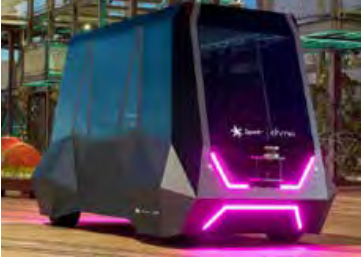
“The focus is on operation at the moment and functionality using 5G,” Hikmet says.
He says the battery usually lasts about four hours during regular operations, and that testing and development will continue.
“We believe this test with Spark is only the second of its type in the world,” Hikmet says.
“A 5G network can be up to 100 times faster than 4G, which unlocks the true potential for autonomous driving, as messages need to be transmitted and decisions made in real time.”
He says improved reaction times give cars human-like reflexes and opens multiple possibilities for connected infrastructure and a smart city ecosystem.
The AV can reach 25km/h but was limited to 7km/h for the test route which it covered in seven minutes.
The Ohmio Hop shuttle used can carry up to four people at a time.
Users are able to hail the car using a tablet, the AV then stopping to pick them up.
A dashboard tells passengers what the car is monitoring in real time using Lidar technology to help it make sense of the surrounding environment.
It can stop quickly, for instance, if a pedestrian steps in front of it.
Hikmet says Ohmio will continue development of its larger Lift AVs, capable of carrying about 20 people, which he expects to have ready for use at Christchurch airport later this year.

The company also expects to launch more driverless cars on closed facilities across New Zealand, including university campuses, retirement villages and hospitals.
Spark network evolution lead Colin Brown says its partnership with Ohmio demonstrates the potential of 5G.
“We want to encourage businesses to begin thinking about their own ‘driverless car’ technology and how they can prepare for the future of 5G.”
The speed at which 5G is being rolled out globally was demonstrated at the recent Mobile World Congress in Barcelona, Brown says after attending.
He says 5G was a major feature at the congress and is already in a number of markets with businesses across multiple industries launching new products and services around it.
Brown says the AV test is “another step on the road to 5G” with more real-world tests planned during coming months.
Visit www.sparklab.co.nz for more information.
How safe is the 5G test? – SUBHEAD
The Spark 5G Innovation Lab has already been independently tested by New Zealand’s foremost expert on electromotive force (EMF).
The EMF level outside the lab is only a few per cent of the New Zealand limit, says Spark, which adds that it will continue to test and comply with all national and international safety limits and always ensure substantial safety margins are incorporated.
Spark designs all its mobile cell towers to comply with National Environmental Standards (NES), including radiofrequency standard NZS2772.
“Based on our continuous and robust testing obligations Spark’s cell towers transmit at around 1-2% of the New Zealand standard.”
Should the New Zealand Safety Standard need revising at any point then the director of health would advise Standards New Zealand, and Spark will continue maintain its strict safety obligations, the company says.
EMF is the electrical intensity or “pressure” developed by a source of electrical energy such as a battery or generator.
A device that converts other forms of energy into electrical energy provides an EMF as its output.


Join the conversation