
Researching bidirectional charging to store excess electricity
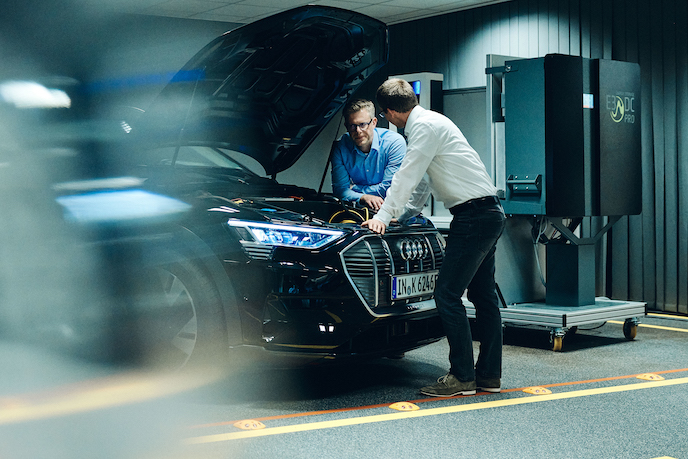
Audi has teamed up with the Hager Group to research how electric cars can be incorporated into the domestic grid to store surplus electricity generated by a photovoltaic system (solar panels).
The two partners believe that bidirectional charging capability in electric cars will create financial incentives as well as offer greater security of supply.
Renewable energies contributed to more than 50% of the German electricity mix in the first half of 2020, but the dilemma is that solar and wind generated power is not always consistent.
On sunny days or phases of strong wind, there is often a lack of storage capacity for the additional power generated by the renewable resources which is not used by the grid.
However, as the number of registered electric cars increases, the number of mobile energy storage units also rises. This offers great potential, provided that the storage capacity can be used intelligently says Audi and the Hager Group.
“The battery of an Audi e-tron could supply a single-family home with energy for around one week independently. We want to make this potential accessible and make the electric car part of the energy transition as an energy storage device,” says Martin Dehm, technical project manager for bidirectional charging at Audi.
The electric car as a flexible energy storage unit
The high-voltage battery of the electric car can supply energy back to the house as a decentralised storage medium. If the customer has a photovoltaic system, the electric car serves as a temporary storage medium for the domestically generated electricity. When the sun is no longer shining, the vehicle can supply the stored electricity back to the house.
Bidirectional charging at home – also known as Vehicle to Home (V2H) – has potential to reduce the home owner’s electricity costs and increase network stability. As a further expansion stage in combination with a home storage unit, it is possible to achieve near complete energy independence and increased security of supply in the event of a blackout.
Near-series technology in use
What sounds simple in theory requires a high level of technical intelligence and coordinated interaction between infrastructure and in the vehicle in practice. An Audi e-tron with near-series charging technology was used in the research project.
In the test grid, the electric Audi model operated with a DC wall box, which enables a charging capacity of up to 12 kW, and a flexibly extendable home storage unit with a capacity of 9 kWh.
While it could provide additional flexibility in possible series production, it is not a necessary requirement for bidirectional charging. Thanks to the DC voltage level in the overall grid, the connection between the PV system and the vehicle does not require an inverter and is a particularly efficient solution.
Charging with PV electricity saves money
Bidirectional charging focuses mainly on use cases where home owners use their own photovoltaic system to benefit from cost-optimized charging with their domestically generated electricity. The electric car stores the excess electricity from the PV system that is not used by appliances in the house.
If the customer has variable rates, the electric car can supply the entire house in phases where electricity prices are high. At night or during non-productive times of the rate, the car then uses inexpensive electricity to charge up to the desired target SOC (state of charge).
The joint research project with the Hager Group has proven two things: customers who have their own PV system can design their mobility to be optimised in terms of cost and CO2 consumption while taking some of the burden off the grid at the same time.
The intelligent use of the HV battery in the vehicle also opens up possibilities to use an existing resource that was previously used for mobility purposes alone in a sustainable way.


Join the conversation