
Evnex passes 20,000 chargers, with the second 10,000 taking nine months
Christchurch's Evnex has passed 20,000 home EV chargers across Australia and New Zealand, with the second 10,000 taking nine months against eight years for the first.

Christchurch’s Evnex has passed 20,000 home chargers installed and online across Australia and New Zealand, and the second 10,000 took nine months against eight years for the first.
The company also says the number of its chargers running in each country drew level this month, a crossover it had expected to take another year. Evnex now sells about twice as many chargers in Australia as it does here.

The reason sits in the Australian sales figures. Battery electric vehicles took 24.9% of that market in August, more than petrol and diesel, and Australians have registered 127,244 EVs so far this year. New Zealand’s market is running well behind: battery electrics were 9.2% of August registrations here, with plug-in hybrids taking another 10.4%.
“I started the company from my parents’ farm in Marlborough as a slightly naive 22-year-old simply because I wanted a charger for the 1997 Honda Accord I’d converted into an EV,” says founder and chief executive Ed Harvey. “What’s followed has been a wild but enormously gratifying journey.”
Evnex says its chargers have delivered 75GWh since the first shipped in 2017, enough for roughly 450 million kilometres of driving, and worth about $22 million at typical retail rates. The company estimates its customers actually paid closer to half that, because most of the energy went in overnight or in the middle of the day on off-peak tariffs or household solar.
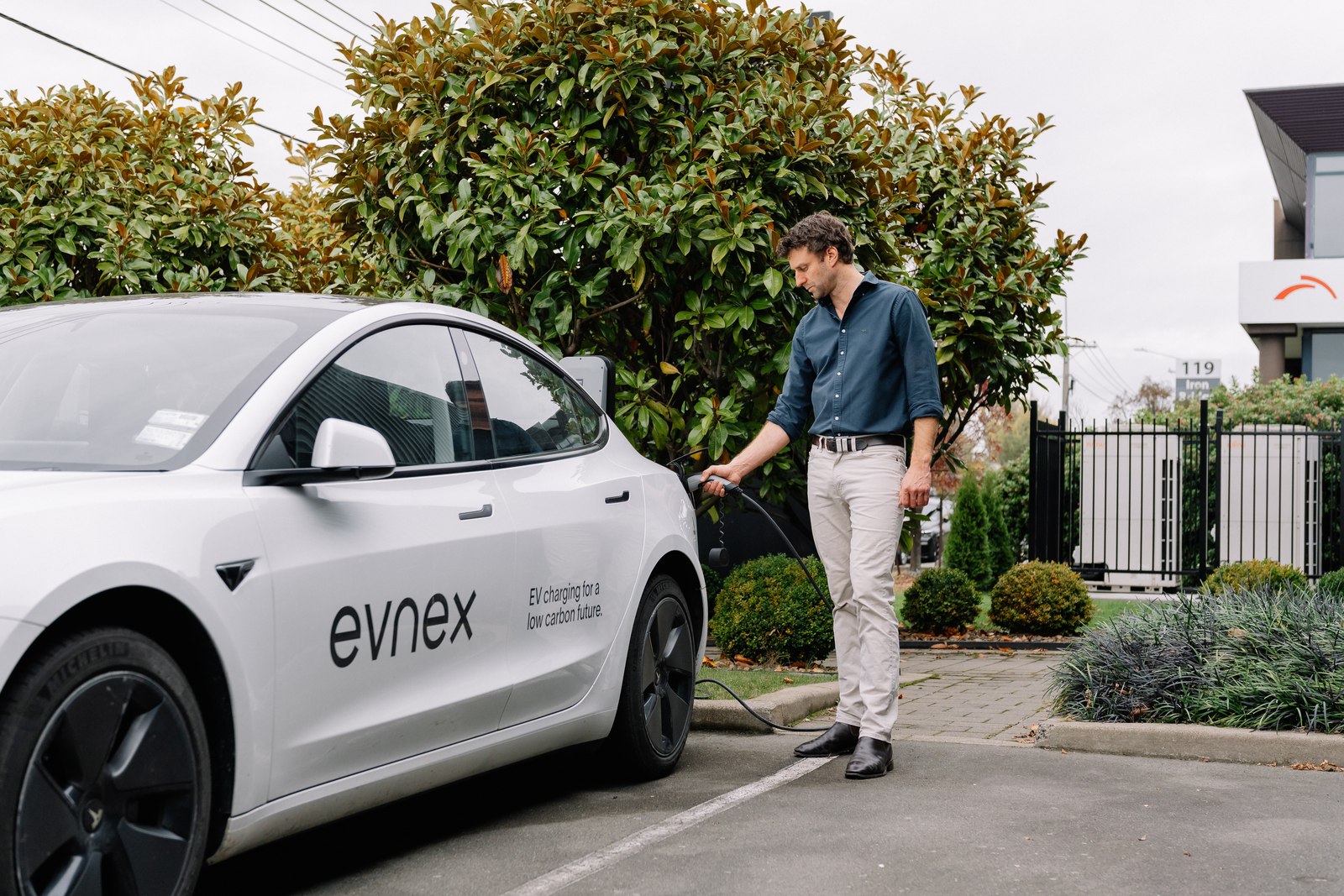
That timing argument is the company’s pitch. Australia now has more than 4.3 million homes and small businesses with rooftop solar at a combined 28.3GW, more than the country’s remaining coal fleet, and more than 500,000 home batteries installed under a federal subsidy programme. From July, a federal Solar Sharer offer has given eligible households in New South Wales, South East Queensland and South Australia three hours of free electricity in the middle of each day, including for charging a car.
“A typical Australian EV driver uses about 2,000 kWh a year,” Harvey says. “On a decent off peak rate that is a few hundred dollars. Off your own roof it is close to nothing. Charge at the wrong time on the wrong tariff and you hand most of that back.”
Evnex has partnered with EnergyAustralia and launched the E2 Flex, a charger aimed at homes without rooftop solar that can add solar integration later through a software update rather than a second electrician visit. The chargers are still designed and built in Christchurch, with 48 staff.
“The next 20,000 will come a lot faster than the first,” Harvey says. “We have had spikes before, but this one feels structurally different. Our modelling suggests Australia is moving into the early stages of mass EV adoption, not just a fad with good timing.”
His longer view is that the home charger becomes part of the household energy system rather than a piece of car equipment, soaking up cheap power when it is abundant and eventually supporting vehicle-to-grid. That thinking is showing up on this side of the Tasman too, in Meridian’s community decarbonisation grants for solar, batteries and EVs and in charging data reshaping how public sites are built.
Join the conversation