
Anatomy of the new supercapacitor industry
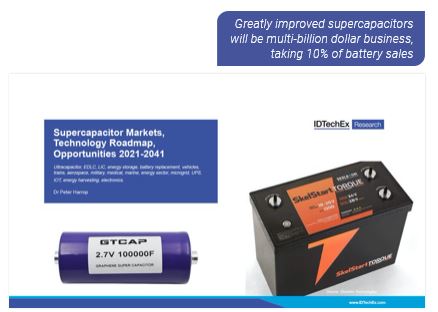
Surprises abound in the new IDTechEx Research report Supercapacitor Markets, Technology Roadmap, Opportunities 2021-2041.
In 2010, there were no Chinese manufacturers in the top 10 supercapacitor manufacturers, but in 2020, 40% of them are Chinese.
This has been achieved by world-class research and development, being in one of the largest markets globally, strong investment and government support including protective trading.
However, China is not leading in capacitor-supercapacitor hybrids where the USA saw a US$7 million follow on order recently.
“Supercapacitor manufacturers used to be divided into those making small ones for electronics and those that also made similar flat or cylindrical formats for electrical engineering such as the archetypal 2.7V 3000F cylinder,” IDTechEx chief executive Raghu Das says.
“No longer. A considerable market for even large supercapacitors is rapidly emerging.
“The first big success with large ones is boxed car stop-starters at around 20Wh, with over five million sold,” he says.
“The number of auto makers going for that fit-and-forget, grab more electricity, waste less electricity proposition still increases.
“The natural extension of this logic is the newly committed adoption of larger supercapacitors for peak-shaving and acceleration boosting at 30-100Wh across the batteries in mild hybrid cars then full hybrid then totally replacing the lithium-ion battery if pure electric cars have not destroyed the hybrid car business by then.”
The new large versions appear in trains at 1kWh and 1MWh appear as hospital and data centre uninterruptable power supplies that double for peak shaving.
It is a long way from small supercapacitors usually made to standard.
IDTechEx counts 89% of supercapacitor manufacturers making them, though Panasonic recently exited.
About 37% of these are in China because it exports them strongly – its share of the supercapacitor value demand being only 27% because of its giveaway pricing and lateness into car stop-start.
An exception to the commoditisation is small supercapacitors in the form of battery-supercapacitor hybrids (BSH), aerospace and military ones working at 150C, capacitor-supercapacitor hybrids beating tantalum electrolytics on ripple and one fifth to one tenth of the size and weight and ones in odd formats such as to go in a watch or smart card.
Those working at 85C, minus 40C and 3V as single cells are less common and in demand.
BSH are almost always lithium-ion capacitors, Das says. They offer higher energy density often with effectively infinite cycle life and better charge retention than pure supercapacitors.
IDTechEx measures that 24% of supercapacitor manufacturers now have a BSH range and, of those, 32% are made in China where they are most successful commercially.
Several companies declare their supercapacitors to be “graphene” as a badge of honour, Das says. It can mean non-flammable, relatively non-toxic, no use of the volatile, toxic carcinogen acetonitrile, valuably improved series resistance, better voltage and energy density in a pure EDLC – all good things justifying higher price, he adds.
“IDTechEx measures that 8.75% of supercapacitor manufacturers now offer graphene versions, up from zero 10 years ago,” Das says.
“About 43% of the manufacturers using graphene are in China so they are ahead in numbers, though certainly not in graphene supercapacitor research, much of which is aimed at the massive emerging market for replacing lithium-ion and lead-acid batteries with highest energy density of 100Wh/kg or more.
“In research, this is usually achieved by boosted pseudocapacitance, though some perfect the technology of the newly commercial 100Wh/kg lithium-ion supercapacitors.
“About 33% of supercapacitor material research is graphene-centric followed by carbon nanotubes then metal organic frameworks.”
Large supercapacitors are more difficult to make, more profitable and represent most of the addressable market 2021-2041, Das explains.
They typically come with integral power electronics for optimal safe operation, microprocessors for intelligent response, and often with cooling systems.
About 47.5% of supercapacitor manufacturers now claim to make them.
“Billion-dollar supercapacitor businesses may be created by 2045,” Das predicts.
“Given past disappointments, our upside forecast currently stands at US$7 billion in 2041.”

Join the conversation