
Nissan reveals ‘Re-Leaf’ emergency EV
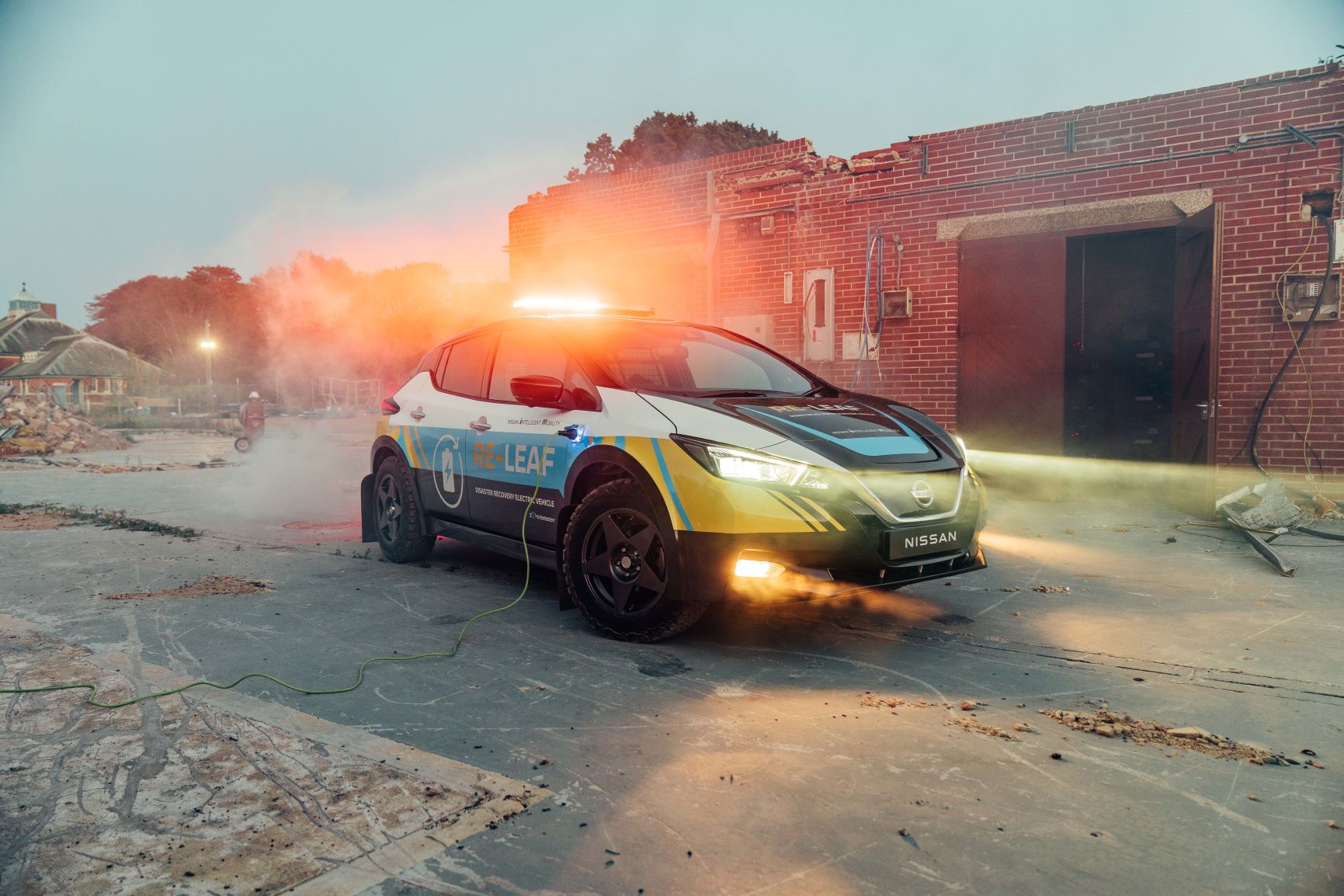
Nissan has unveiled a 100% electric emergency response vehicle concept, designed to provide a mobile power supply following natural disasters or extreme weather events.
Called Re-Leaf1, the working prototype is based on the Nissan Leaf EV.
Alongside modifications to navigate roads covered in debris, the Re-Leaf features weatherproof plug sockets mounted directly to the vehicle’s exterior enabling 110-230v devices to be powered from the car’s high capacity lithium-ion battery.
The Re-Leaf can be driven into the centre of a disaster zone and provide a fully mobile power supply to aid the recovery process, Nissan says.
Its integrated energy management system can run medical, communications, lighting and other life-supporting equipment.
Natural disasters are the biggest cause of power cuts – a 2019 World Bank report finding natural shocks and climate change caused 37% of outages in Europe between 2000 and 2017, and 44% of cuts in the US over the same period.
When a disaster hits, the time for electricity supply to be restored is typically 24 to 48 hours, depending on damage severity. During that period, EVs can be used to provide a zero-emission, mobile emergency power supply, Nissan adds.
The Re-Leaf working concept was created to demonstrate the potential of EVs in disaster recovery.
In Japan, Nissan has been using the Leaf to provide emergency power and transportation following natural disasters since 2011, the company forming partnerships with more than 60 local governments to support disaster relief efforts.
Through Nissan Energy Share, EVs act as mobile storage batteries to supply homes and society with electricity, creating a distributable energy model that can be used to help stabilise the supply and electricity demand.
“Concepts like the Re-Leaf show the possible application of EVs in disaster management and demonstrate that smarter, cleaner technology can help save lives and provide greater resilience for the future,” Nissan Europe electric passenger cars and infrastructure head Helen Perry says.
“By having thousands of EVs available on standby, either as disaster-support vehicles or plugged into the network through Vehicle-to-Grid (V2G), they’re uniquely capable of creating a virtual power plant to maintain a supply of energy during a major outage.”
The Re-Leaf uses the Leaf’s bi-directional charging ability, a standard feature of the model since its introduction in 2010.
This means the Leaf can not only ‘pull’ power to recharge the high-capacity battery, but also ‘push’ it back to the grid through V2G or directly to electronic devices through vehicle-to-everything (V2X) technology.
The latest Nissan Leaf e+ with a fully charged 62kWh battery can power the average European household for six days.
As a disaster recovery vehicle, the Re-Leaf can run multiple devices simultaneously, including a LED flood light, electric jack hammer, a 10-litre soup kettle, a medical ventilator and a pressure ventilation fan.
When it arrives at a disaster zone, a pull-out desk extends from the boot with a 32-inch LED screen and dedicated power supply creating an operational hub to run communications and manage the recovery process.
Once electricity is restored, the EV can be recharged to provide transport.
Click here
to learn more about how Nissan has used its EVs to support disaster recovery in Japan.

Join the conversation