
Revelations aplenty as Harley’s Livewire sparks up

Harley-Davidson call their first all-electric powertrain the ‘Revelation’ and it’s an apt moniker given the ability of the new Livewire electric motorcycle to surprise, thrill, delight, and sometimes numb those who ride it.
Numb? That reaction mostly occurs when you clock the $53,995 price-tag for the first time, and the figure represents perhaps the greatest hurdle that the Livewire must overcome to be a success. The affordability challenge is therefore no different to that faced by all new electric vehicles, and Harley-Davidson haven’t cut any corners on the Livewire’s specifications in order to achieve a more accessible price point. This is definitely a premium motorcycle from an aspirational brand. The suspension, brakes, design, wheels, tyres, switchgear, electronics, build, and finish all ooze high quality.
Those who can get their heads around the purchase cost, and can delve a bit deeper into the possibility of owning a Livewire, will find that this young American new-age motorcycle is also one of the most exciting to ride on the market. When you first encounter the tyre-shredding, out-of-the-hole acceleration that the Livewire offers, a price positioned alongside that of Ducati’s race-ready Panigale V4R limited-edition superbike suddenly doesn’t seem all that expensive
 Your inner accountant begins to realize that the five-year development of the Livewire probably cost double that of the V4R given all the new technical territory that it had to explore, then successfully traverse. There’s also a fairly expensive component located right at the heart of the first ‘humming Harley’ – the Samsung 15.5kWh lithium-ion battery. Warranty-protected for five years, said battery has a $15,000 replacement cost.
This electricity reservoir stores enough juice in its air-cooled chemistry for the Livewire to travel 170km on a full charge on any trip that is a 50/50 combo of city/highway riding. Harley-Davidson says that the range of the bike can be extended to 235km if it is kept confined to city limits, and, presumably, the rider has left his/her significant other at home and has consumed a light breakfast. That maximum range will definitely be enhanced by the bike’s ‘economy’ mode, which dulls the throttle response to its calmest-yet-still-frisky setting and lets the powertrain recover the most energy whenever the bike is coasting.
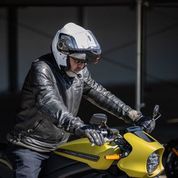 Other modes include ‘sport’ – full wide open throttle, 100% power regeneration on deceleration, ‘highway’ – smoother throttle response, 35% power regeneration, and ‘rain’ – softest throttle setting, 35% regen. If none of the four modes suit, the Livewire has three further mode folders where owners can store their own custom settings. Which is handy if your pillion values the thrill of the most aggressive throttle setting of the ‘sport’ mode, but not the helmet-butting potential of the aggressive off-throttle deceleration that accompanies it when the powertrain is fully recovering energy. Another obvious custom setting would be to enjoy the delightfully smooth throttle response of the ‘highway’ mode while having 100% battery regeneration during periods of deceleration. On a personal note, the latter custom setting is probably how I’d configure the bike most.
For ‘highway’ does little to diminish the outstanding acceleration of the 80kW/116Nm permanent-magnet electric motor of the Livewire. It simply provides a smoother interaction between rider and machine instead. With 251kg of bike to propel, the instant access to peak riding force makes light work of the task – to the point where this is the fastest accelerating street-stock motorcycle that Harley-Davidson have ever created. No owner of any of the brand’s current range of combustion-engine bikes has a show of winning an impromptu traffic-light sprint against the Livewire, no matter how judiciously they’ve been shopping for hot-up parts from Harley’s Screaming Eagle catalogue.
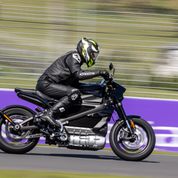
Harley says the Livewire can accelerate from 0-100kmh in 3.0 seconds, and from 100-130kmh in 1.9; but it feels even quicker judging from the seat-of-the-pants feedback. Extend the testing territory to the long straights of Pukekohe race circuit (surely not the preferred battleground terrain of an electric motorcycle) and the powertrain performance is equally revelation-ary (sic). According to the speed readouts of the luxuriously-appointed TFT instrument array, the bike was regularly hitting velocities in the 185kmh region. Harley officially states the bike’s V-max at 177kmh.
Naturally, all this wide-full-open throttling did tax the energy reserves of the battery quite a bit, to the point where 10 hot-pace laps of the race circuit had consumed roughly 60% of the residual charge of the Samsung. This left more than enough for a relaxing cruise around the countryside surrounding the circuit, an exercise that instantly proved that while the Livewire might be limited in fast track use by its rapidly-reducing range figures, it remains a bloody-brilliant short-haul motorcycle.

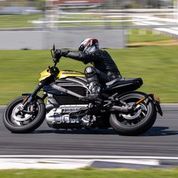
Top-shelf suspension and brakes add bike-handling highlights to the dynamics of the Livewire, while a full suite of riding aids (traction control, ABS, wheelie control, rear wheel lift control) help keep it shiny side up. Not only is this the Milwaukee motor company’s fastest-accelerating bike, it’s also the quickest to shed speed thanks to the might of the Brembo four-piston calipers and 300mm disc rotors fitted up front. A wheelbase length between that of a Sportster and a Softail adds plenty of stability, while steeper steering geometry than both those trad Harley model ranges increases cornering precision. Equipped with 120/70 front and 180/55 rear Michelin Scorcher radials mounted on 17-inch wheels, the Livewire has all the sporty chassis prowess it needs to impress those used to Ducati Monsters, Triumph Speed Triples, or KTM Dukes.
The single dynamic caveat is that this comparison with other sporty streetbikes is only applicable to short hauls. For it only takes an hour or two of riding before it’s time to stop and plug the Livewire in again.
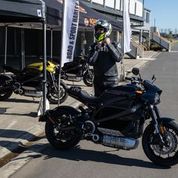 When that time inevitably comes, there are two recharging options. Commuters will use the Level 1 cable stashed under the seat and plug into the their AC house supply overnight to activate the bike’s onboard 12-amp charger. This will deliver 20km of travel for every hour of charging. Those riding further afield than their regular commutes will stop at a DC fast charger and attach the charging station’s Level 3 cable to charge the depleted battery of the Livewire to 80% in 40 minutes or 100% in an hour.
The battery range and affordability challenges of the Livewire need to be balanced against the high quality of the performance of the bike and its undeniably-cool design. For there is no better antidote to the tedium of cross-town commuting than this adventurous and brave new solution from America’s oldest motorcycle-maker. If you’ve got the coin to buy one, you’ll find that the bike delivers an experience that is absolutely priceless.
 Meanwhile, this is Harley’s first toe into EV waters, and the company is working on new electric motorcycles based on the Revelation powertrain that’ll have a lower entry price. Back in 2008, Tesla kicked off with a fairly ordinary sportscar, the first Roadster – basically a Lotus Elise with an electric powertrain. The Livewire is arguably a better-conceived first step forward than Tesla’s first EV, and blesses Harley-Davidson with an unaccustomed new status. For what was once the most conservative of motorcycle brands is now an absolute technology leader.

Join the conversation