
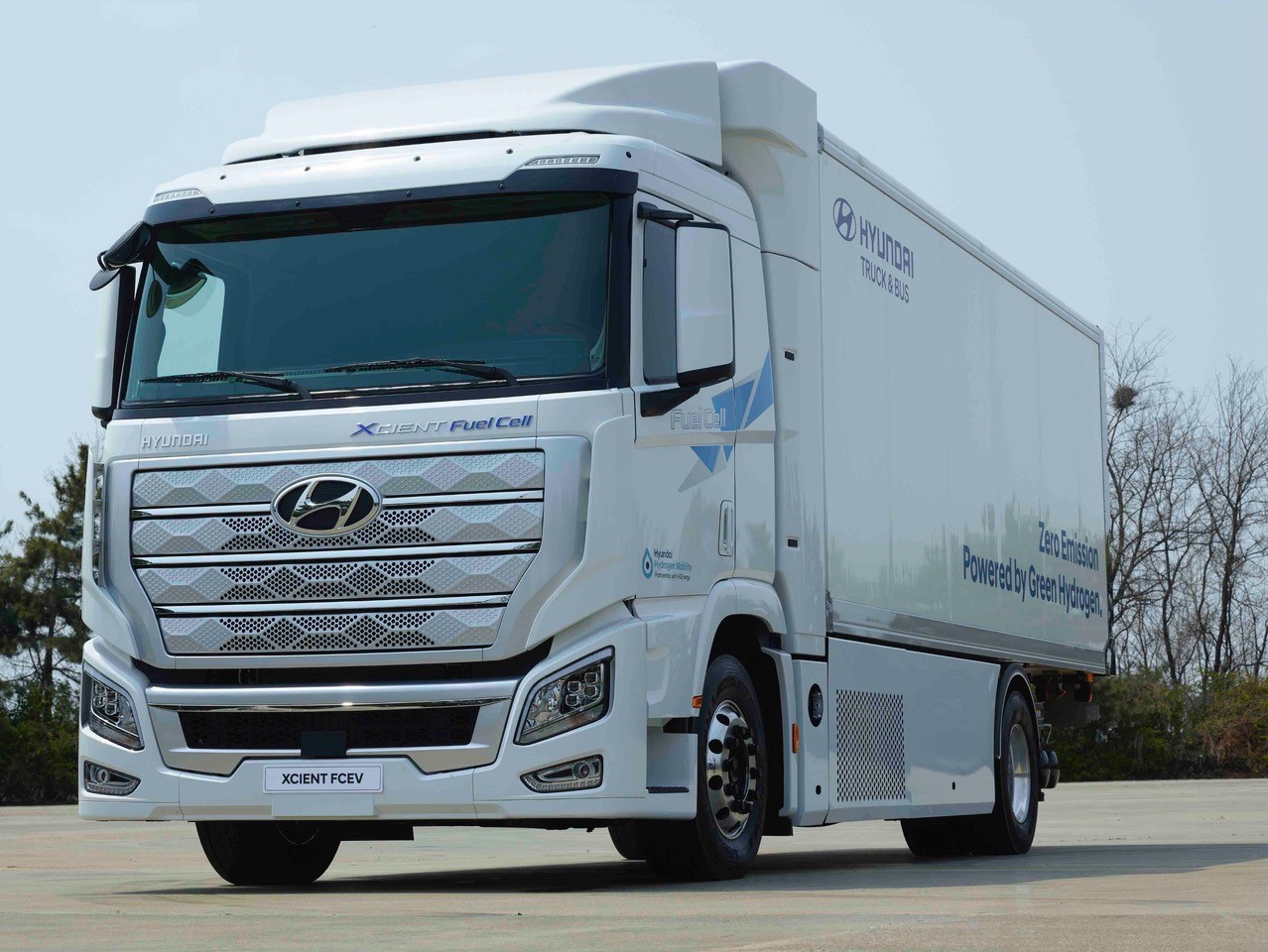
Hyundai has livestreamed the launch of its Xcient fuel cell heavy duty truck as plans to step up production get underway with future New Zealand deliveries on the cards.
The truck will be the world’s first mass produced fuel cell heavy duty vehicle, the company says.
The Xcient is equipped with seven large tanks with a combined storage capacity of around 32kg of hydrogen to provide around 400km of driving range with a full trailer in tow. Fueling time to full charging takes around eight to 20 minutes.

It is powered by a 190kW hydrogen fuel cell system with dual 95kW fuel cell stacks. The electric motor delivers 350kW and 3400Nm of torque through a six-speed Allison gearbox.
The truck also provides various features such as front collision-avoidance assist (FCA), lane departure warning (LDW), smartphone mirroring and wireless charging.
Hyundai already delivered its first 10 units of the Xcient truck to commercial fleet customers in Switzerland earlier this year with plans to deliver 50 units by the end of this year and 1600 units there by 2025.
It plans to expand production capacity throughout Europe, the U.S. and China to reach 2000 units annually by 2021.
The company is backing increased production with a US$1.3 billion investment in addition to a previously announced US$6.4 billion stake in establishing a hydrogen ecosystem.
Hyundai commercial vehicle division executive vice president In Cheol Lee says the Xcient fuel cell truck is not just a “future drawing board” project but “a present-day reality”.
“By putting this groundbreaking vehicle on the road now, Hyundai marks a significant milestone in the history of commercial vehicles and the development of hydrogen society,” Lee says.
“Building a comprehensive hydrogen ecosystem, where critical transportation needs are met by vehicles like Xcient Fuel Cell, will lead to a paradigm shift that removes automobile emissions from the environmental equation.
“Having introduced the world’s first mass-produced fuel-cell electric passenger vehicle, the ix35, and the second-generation fuel cell electric vehicle, the Nexo, Hyundai is now leveraging decades of experience, world-leading fuel-cell technology, and mass-production capability to advance hydrogen in the commercial vehicle sector,” Lee says.
Hyundai New Zealand is also celebrating the global launch of the Xcient fuel cell truck.
The company is a champion of fuel cell technology and has been committed to alternative fuel technologies since 2018 when it joined the New Zealand Hydrogen Association.
It introduced the Nexo fuel cell electric vehicle in 2019 and has made investments in its own hydrogen refuelling station.
“This is an exciting milestone for Hyundai globally with the launch of the world’s first mass-produced fuel cell heavy-duty truck, but equally for us and New Zealand as it presents a practical and sustainable option for many industries that utilise trucks,” Hyundai New Zealand general manager Andy Sinclair says.
“We look forward to bringing the Xcient Fuel Cell into New Zealand in the future.”

Join the conversation