
EU emission standards see EV sales boom – but warnings come
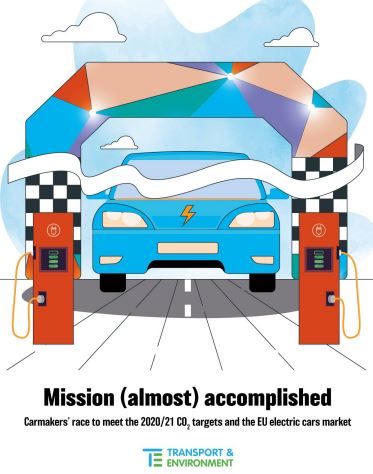
EVs should triple their market share in Europe this year because of European vehicle emissions targets.
That’s according to a new report from Transport & Environment (T&E), an umbrella group which promotes sustainable transport in Europe and which expects one in every seven cars to be sold in Europe next year to be a plug-in.
It says growing EV sales in Europe have already resulted in a significant drop in CO2 emissions and expects EV sales in Europe to reach 10% by the end of 2020 (EU27, the UK, Norway, Iceland and Liechtenstein).
However, the T&E report warns electric car supply could stagnate after 2021 just as the technology matures and market demand surges.
The report suggests stagnation may follow if emissions standards and policies are not upgraded.
“The European EV market share would only grow by one third over four years (between 2021 and 2025) under the current regulation, compared to a five-fold increase between 2019 and 2021.
“Instead of a stagnating market, electric car sales should in the 2020s be entering the technology (s-shaped) uptake curve, with a mass market developing across Europe,” the report states.
It says 2020 also saw Chinese electric models enter markets in notably Norway, the Netherlands and the UK – “a clear sign that the European automakers are still failing to supply the adequate numbers of EVs for the booming market”.
“Norway shows how fast the market can grow – from 6% sales in 2013 to almost 50% five years later, in 2018.
“With electric cars expected to reach price parity with diesels and petrols after 2022, the growth must accelerate much faster than the current pace of regulations in order to sell the last (internal) combustion engine (ICE) car no later than 2035 to reach zero emissions by 2050.”
The T&E report says electrification is now a core part of several carmakers’ industrial strategies, including the Volkswagen Group, the Renault-Nissan-Mitsubishi Alliance, BMW and Hyundai-Kia.
“Although conceived as a climate regulation, the 2020/21 EU vehicle CO₂ emission standards are the modern day example of an excellent industrial policy that pushes the car industry to invest in and supply future-proof zero emission technologies in Europe.”
But the report adds that in spite of the impressive electric car sales observed this year, the figures mask successive failures to cut vehicle CO₂ emissions over the past few years.
“New car CO₂ emissions were actually increasing between 2016 and 2019 as a lucrative but polluting SUV addiction was growing,” the report says.
“Worryingly, sales of ICE SUVs grew 39% in the first half of 2020 due to a loophole in the EU regulation that gives carmakers selling heavy vehicles laxer CO2 targets.”
It goes to say that “half of all the plug-in sales today are ‘fake electric’ plug-in hybrids that are rarely charged and emit two to four times more CO₂ in the real-world than the lab tests show”.
The expected plug-in sales in 2020/21 of 10-15% also serve to underline the inadequacy of the current 2025 and 2030 car CO₂ targets, the report says.
“EU manufacturers are back in the EV race, but without more ambitious CO2 targets in 2025 and 2030 to spur them on they’ll run out of steam as soon as 2022.”

Join the conversation