
What sells EVs?
Tesla became the most valuable car manufacturer for many reasons, from glamour to having the longest-range vehicles.
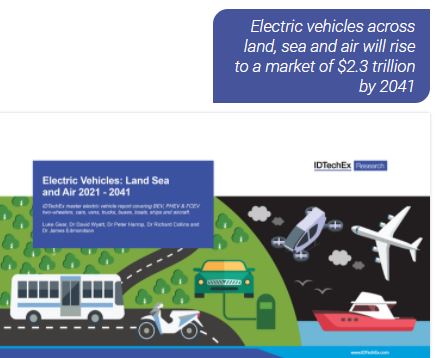
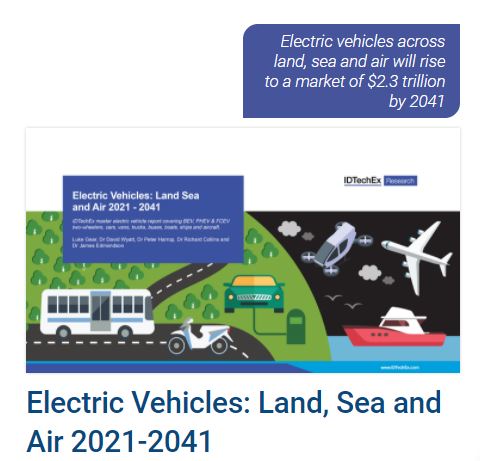
That’s explained in the IDTechEx report Electric Vehicles: Land, Sea and Air 2021-2041.
A long-range battery-electric vehicle BEV sells for 60% of its original price after three years but a short range one retrieves only 20% regardless of purchase price.
“Just as the automotive industry is accelerating the introduction of the latest electrified vehicles, it faces the double whammy of a coronavirus second wave and the possibility of leaving the EU without a deal,” United Kingdom Society of Motor Manufacturers and Traders (SMMT) chief executive Mike Hawes warns.
He says EVs could become more expensive under a no-deal Brexit, cancelling out government incentives designed to tempt buyers into zero-emission vehicles.
World Trade Organisation (WTO) tariffs would add 2800 pounds to the cost of EVs in the UK.
This would largely negate the government’s plug-in car grant, which sees EV buyers save 3000 pounds off the original price, Hawes says.
That’s the wrong emphasis, the IDTechEx report suggests.
“Tesla succeeds regardless of tariffs. The European car industry can do the same.”
The UK will benefit from trade deals being signed from Ukraine to Japan and maybe something will happen with the European Union but that is not key to the success of the UK motor industry, IDTechEx says.
“It is making what is wanted in the light of tightening zero-emission legislation across the world, including in the UK.
“Having brought forward its ICE ban from 2040 to 2035 earlier this year, the UK government is now likely to make that 2030.
“A large number of Conservative MPs support the call. So does a coalition of fleet operators and the political opposition. The European Union, a global leader in emissions legislation, is also reviewing its position in this respect.”
The report says the carrot instead of stick effect in London is now seen.
“The congestion zone is being expanded, parking restricted except for battery electric vehicles (BEVs). Londoners are moving to the outer regions for an affordable house and buying an affordable BEV even though many only have 320km range.”
In the UK, Nissan, Jaguar-Land-Rover (and now Bentley) and some others are committed to primarily making BEVs – but many UK car companies are not, IDTechEx says.
“Consequently, Londoners are often buying those affordable BEVs from Korea or China and luxury ones from Tesla.”
Meanwhile, IDTechEx adds in its report Materials for Electric Vehicles 2020-2030 that in spite ofthe potential reduction per vehicle of materials like neodymium and dysprosium (often used in magnet-based motors which EV manufacturers are now moving away from), the increase in the global EV market will lead to a rise in demand for rare-earth materials – which are mainly found in China.
The report expects the market value for EV powertrain materials to reach US$47 billion by 2030.

Join the conversation