
Better understanding needed of hydrogen in heavy transport

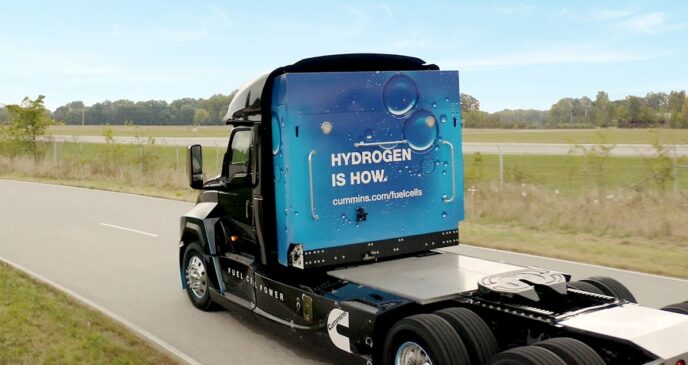
A new study says much work is needed to understand the full extent of the role hydrogen and other low emission technologies will play in decarbonising New Zealand’s long-distance heavy freight transport sector.
The study done for Ara Ake (formerly the National New Energy Centre) by NERA Economic Consulting found that existing quantitative research undertaken in New Zealand into hydrogen fuel cell electric vehicles (FCEVs) as an option to decarbonise long-distance heavy freight focuses almost entirely on the costs to truck operators of running FCEVs compared to vehicles powered by electric batteries or diesel.
In making the transition there are several rapidly evolving options each with social costs and benefits to be considered, Ara Ake chief executive Dr Cristiano Marantes notes.
“Consequently, issues such as the ability of owners to purchase new technology vehicles, the economic and environmental impacts of decommissioning the existing diesel fleet, the ability of manufacturers to scale up production to meet the demand for vehicles using new fuels, the potential to make greater use of rail and coastal shipping, and the potential use of other low emissions fuels were not taken into consideration in the quantification of costs,” he says.
“Therefore the existing quantitative analyses do not paint a complete picture.
“Furthermore, the likely advances in both battery and fuel cell technology are considered inconsistently across the studies and the assumptions made may already be out of date.”
Marantes says New Zealand’s heavy truck fleet contributes 27% of total transport emissions but accounts for only 7% of total annual travel.
“Decarbonising the heavy freight industry would be a major step towards a low-emission economy,” he adds.
“However, it is important we consider not just that final destination, but also the best way for us to get there.
“What works for a single operator at a single point in time is not necessarily the best solution for the whole industry, let alone for society overall.”
Marantes says focusing on the search for a single long-term solution to what was a multi-faceted problem could mean missing opportunities to make significant reductions in emissions in the meantime.
“Policy settings and incentives must be flexible enough to encourage all viable options to be brought forward.”
While government has a key role to play in supporting the development of new energy innovations, if that support is not implemented carefully it could advantage technologies that may not provide the best long run solution, Marantes says.
He believes funding and other decisions taken now will have long term implications for New Zealand’s progress towards establishing a sustainable, low-emission economy.
It is essential those decisions are based on comprehensive information, Marantes says. For example, decarbonisation of long-distance heavy freight is likely to require a number of technologies.
“To determine which technology is best suited for each application, we need a publicly available total cost of ownership model that incorporates economy-wide costs and benefits, not just the capital and operating costs incurred by individual truck operators.”
Marantes says Ara Ake is working on how to develop such a model, which would incorporate data on freight movements within Aotearoa and aims to collaborate with the Ministry of Transport and industry groups to compile this data.
Other issues needing further attention include the potential role of biofuel, blue hydrogen, and cleaner burning fossil fuels, as well as opportunities to increase the use of other means of transport such as rail and coastal shipping, he adds.
The ongoing review of long-distance freight transport decarbonisation options demonstrates one aspect of how Ara Ake will contribute to a just transition to a low emissions economy.
“Through research, collaboration and practical assistance we intend to give government and other decision-makers the information they need to make accurate and well-informed decisions.”
Marantes and his role at Ara Ake feature in the December EVs and Beyond magazine.

Join the conversation (1)
Hopefully Hydrogen will find a place some where in the energy mix ,but for road transport it shows no sign of stacking up.