
‘Ford Ion Park’ to test EV batteries
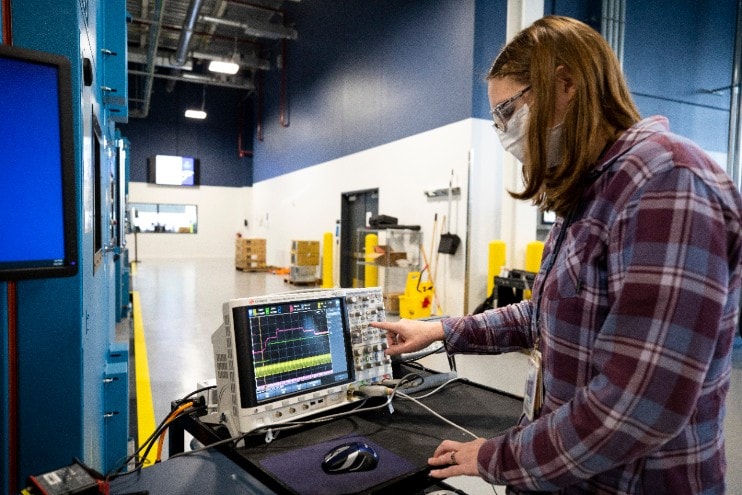
Ford is creating a new global battery centre of excellence called Ford Ion Park in southeast Michigan to research EV batteries, possibly building another factory to make them at commercial scale.
It’s aiming to drive high-volume battery cell delivery, better range and lower costs for customers.
Ford Ion Park will use state-of-the-art equipment to pilot new manufacturing techniques that will allow Ford to quickly scale breakthrough battery cell designs with novel materials once the company vertically integrates battery cells and batteries.
The US$185 million collaborative learning lab coming late next year will develop and manufacture lithium ion and solid-state vehicle battery cells and arrays, test manufacturing approaches, while optimising all aspects of the value chain from mines to recycling
“We’re already scaling production of all-electric vehicles around the world as more customers experience and crave the fun-to-drive benefits of electric vehicles with zero emissions,” Ford’s chief product platform and operations officer Hau Thai-Tang says.
“Investing in more battery R&D ultimately will help us speed the process to deliver more, even better, lower cost EVs for customers over time.”
A team of 150 experts in battery technology development, research, manufacturing, planning, purchasing, quality and finance will help Ford more quickly develop and manufacture battery cells and batteries.
The Ford Ion Park team is exploring better integration and innovation opportunities from mines to recycling – working with all teams within Ford, including experts at Ford’s new Battery Benchmarking and Test Laboratory, Ford Customer Service Division, plus key suppliers and partners.
“We are creating new tools and solutions we need for a carbon-free, affordable and better future,” Thai-Tang says.
“We are modernising Ford’s battery development and manufacturing capabilities so we can better control costs and production variables in-house and scale production around the world with speed and quality.”
This 18,580 square metre learning lab will include pilot-scale equipment for electrode, cell and array design and manufacturing and will pilot new manufacturing techniques.
Anand Sankaran is the Ford Ion Park team’s new director who applied his research and technical innovations on key production vehicles, including the original Escape Hybrid, 2021 Mustang Mach-E and 2022 F-150 Hybrid.
Sankaran also holds 32 US patents in automotive power electronics and hybrid vehicle technologies and is a fellow of the Institute of Electrical and Electronics Engineers.
“Ford’s modern EV journey started with Escape Hybrid in 2004, the world’s first hybrid SUV, and it continues today – all driven by the inspiration to deliver no-compromise vehicles for a better world,” he says.
The Ford Ion Park team will ensure batteries are optimised for its diverse customers – from daily commuters to performance enthusiasts to commercial vehicle fleet operators.
That means creating distinct batteries and technologies to deliver meaningful towing and off-road capability for truck customers as well as stop-and-go driving efficiency for fleet operators in cities worldwide.
Ford this year announced its commitment to invest at least US$22 billion through 2025 to deliver connected, electrified vehicles, starting with EV versions of its most popular nameplates.
In North America, the Ford Mustang Mach-E has found early sales success while the all-electric Ford Transit is set to go on sale late this year and the all-electric F-150 arrives by mid-2022.
In Europe, Ford is moving to an all-electric line up by 2030, with its commercial vehicle range 100% zero-emissions capable – all-electric or plug-in hybrid – by 2024.
Ford also is investing US$1 billion in a new EV manufacturing centre in Cologne to build a high-volume all-electric passenger vehicle for European customers starting in 2023.
In China, Ford is preparing to produce the Mustang Mach-E for local customers later this year, and announced it is establishing a BEV division with a direct sales model and network that will reach 20 major cities there in 2021. In addition, Ford has partnered with China’s State Grid and Nio to offer EV customers access to more than 300,000 public charging stations (160,000 of them fast-charging) in about 340 cities.
Join the conversation