
Mercedes-Benz putting $67b into electrics
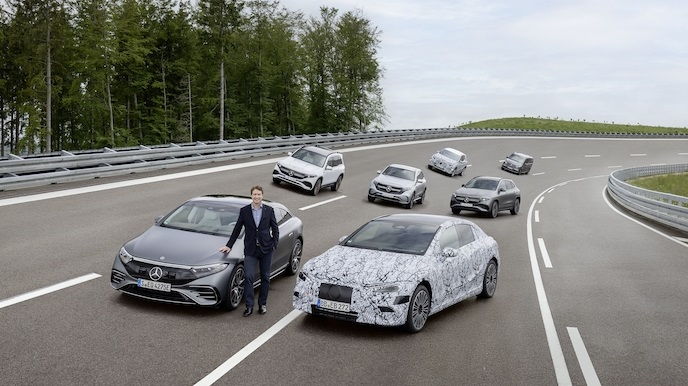
Mercedes-Benz says it is getting ready to go all-electric by the end of the decade, where market conditions allow.
The company says it is accelerating toward an emissions-free and software-driven future.
By 2022, Mercedes-Benz will have battery electric vehicles (BEV) in all segments the company serves.
From 2025 onwards, all newly launched vehicle architectures will be electric-only and customers will be able to choose an all-electric alternative for every model the company makes.
“The EV shift is picking up speed – especially in the luxury segment. The tipping point is getting closer and we will be ready as markets switch to electric-only by the end of this decade,” Daimler AG and Mercedes-Benz AG chief executive Ola Kallenius says.
“This step marks a profound reallocation of capital. By managing this faster transformation while safeguarding our profitability targets, we will ensure the enduring success of Mercedes-Benz.”
To facilitate this shift, Mercedes-Benz is unveiling a plan which includes significantly accelerating R&D. In total, investments into battery electric vehicles between 2022 and 2030 will amount to over €40 billion. .
“Our main duty in this transformation is to convince customers to make the switch with compelling products. For Mercedes-Benz, the trailblazing EQS flagship is only the beginning of this new era,” Källenius says.
Technology Plan
In 2025 Mercedes-Benz will launch three electric-only architectures:
· MB.EA will cover all medium to large size passenger cars, establishing a scalable modular system as the electric backbone for the future EV portfolio.
· AMG.EA will be a dedicated performance electric vehicle platform addressing technology and performance oriented Mercedes-AMG customers.
· VAN.EA ushers in a new era for purpose made electric vans and Light Commercial Vehicles, which will contribute to emission free transportation and cities in the future.
Mercedes-Benz says it will deepen the level of vertical integration in manufacturing and development, and insource electric drive technology. This step includes the acquisition of UK based electric motor company YASA. With this deal, Mercedes-Benz gains access to unique axial flux motor technology and expertise to develop next generation ultra-high performance motors. In-house electric motors, such as the eATS 2.0, are a key part of the strategy with a clear focus on efficiency and the overall cost of the entire system, including inverters and software.
China, the world’s largest new energy vehicle (NEV) market, which is home to hundreds of companies and suppliers specialized in EV components and software technologies, is expected to play a key role in accelerating the Mercedes-Benz electrification strategy.
Mercedes-Benz says it will need a battery capacity of more than 200 Gigawatt hours and plans to set up eight Gigafactories for producing cells, together with its partners around the world. This is in addition to the already planned network of nine plants dedicated to building battery systems.
The next generation batteries will be highly standardized and suitable for use in more than 90% of all Mercedes-Benz cars and vans while being flexible enough to offer individual solutions to all customers. With regard to cell manufacturing, Mercedes-Benz says it intends to team up with new European partners to develop and efficiently produce future cells and modules, a step which ensures that Europe remains at the heart of the auto industry even in an electric era. Cell production will give Mercedes-Benz the opportunity to transform its established powertrain production network. By continuously integrating the most advanced battery cell technology in cars and vans, Mercedes-Benz aims to increase range during the production lifecycle of a model.
Mercedes-Benz says it will work with partners like SilaNano to further increase energy density by using silicon-carbon composite in the anode. This will allow for unprecedented range and even shorter charging times. When it comes to solid-state technology, Mercedes-Benz is in talks with partners to develop batteries with even higher energy density and safety.
Mercedes-Benz says it is currently developing the Vision EQXX, an electric car with a real world range of more than 1,000 kilometres, targeting a single-digit figure for Kwh per 100 kilometres (over 6 miles per Kwh) at normal highway driving speeds.
A multi-disciplinary team including experts from Mercedes-Benz’s F1 High Performance Powertrain division (HPP) is making rapid progress towards the project’s ambitious goals. The world premiere will be in 2022. Technological advances made with Vision EQXX will be adapted and applied for potential use in new electric architectures.
Financial Plan
Mercedes-Benz says it is also working on further reducing variable and fixed costs and cutting the capex share of investments. Common battery platforms and scalable electric architectures combined with advances in battery technology, will bring higher degrees of standardisation and lower costs. The proportion of battery costs within the vehicle is expected to fall significantly. Capital allocation is moving from EV-first to EV-only. Investments into combustion engines and plug-in hybrid technologies will drop by 80% between 2019 and 2026. On this basis, Mercedes-Benz says it projects company margins in a BEV world which are similar to those in the ICE era.
Join the conversation