
Huge $100m solar farm for Christchurch Airport

New Zealand’s largest solar farm has been launched at Christchurch Airport which is providing 400 hectares at its Harewood campus for renewable energy generation to enable businesses to transition away from fossil fuels.
Kowhai Park is expected to have solar panels in place within two years and will produce 150MW within about seven years – enough to power 30,000 homes – and scale up over 30 years to power land and air transport, green data centres and green vertical farming.
The renewable energy park was launched this week by energy minister Megan Woods, climate change minister James Shaw and Christchurch mayor Lianne Dalziel.
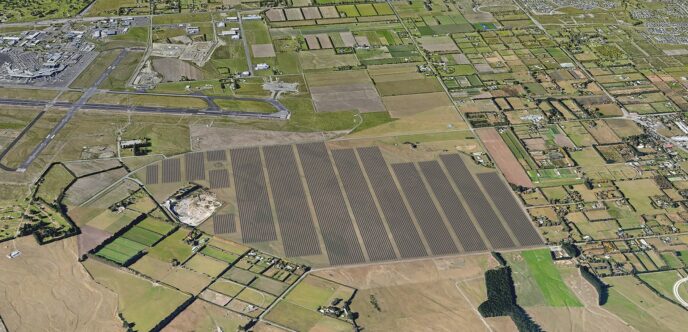
Australian renewable energy fund Solar Bay is committing $100 million to the development of Phase One which will deliver a 220-hectare solar array.
“There is nothing else like this in New Zealand – it’s innovative, far ahead of its time and absolutely world-leading in every sense,” investment director Jack Sherratt says.
“The Phase One solar array is 50 times larger than any existing array in the country – and it’s just the beginning. This will accelerate Canterbury’s low carbon future.”
Sheratt says Kowhai Park is close to New Zealand’s second largest city, flat and sunny, and the park has Orion’s lines network (supplying Christchurch) on one side and Transpower’s national grid pylons on the other.

Christchurch Airport chief executive Malcolm Johns says Kowhai Park is part of the airport’s plan to become climate positive over the coming decade and to maintain its world leading position on sustainability.
“Over the past decade, our team has systematically decarbonised our business,” he explains.
“We’ve reduced 85% of our direct emissions and we’re on track to be carbon zero well before the city’s goal of 2030 and New Zealand’s goal of 2050.
“We want to enable the rest of the economy to decarbonise at the fastest possible rate. That is what Kowhai Park is about.”
Johns says demand on renewable energy supply is expected to increase by 68%.
“Kowhai Park will, over time, help meet that additional demand and provide a resilient supply of renewable energy Canterbury and New Zealand can rely on.
“It will also assist aviation to decarbonise and decouple from fossil fuels. In New Zealand we’re likely to see both electric and hydrogen-fuelled planes on our domestic routes over the next few decades.”


Join the conversation